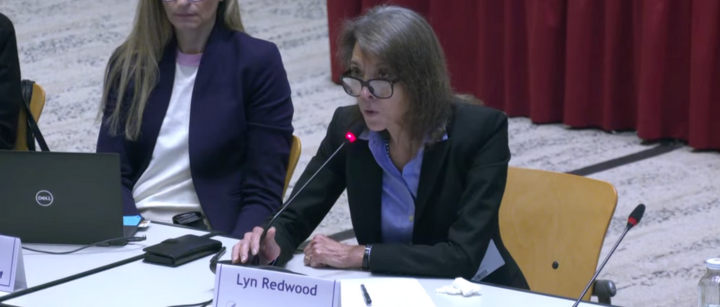
Este artículo estará disponible en español en El Tiempo Latino. A Centers for Disease Control and Prevention advisory panel vote to recommend against use of seasonal influenza vaccines containing small amounts of thimerosal followed a presentation that misled on the risks of the rarely used preservative. There isn’t evidence that thimerosal in vaccines is harmful, and studies assessing a variety of health problems, including neurological conditions, have supported its safety. Despite this, a June 26 presentation by longtime anti-vaccine advocate Lyn Redwood, given before the Advisory Committee on Immunization Practices, made unfounded or misleading claims, including that thimerosal is ineffective and a neurotoxin. (ACIP, which has been guiding the CDC’s vaccine recommendations since 1964, was recently completely reconstituted by Health and Human Services Secretary Robert F. Kennedy Jr., in an unprecedented move.) Thimerosal, which is mercury-based, has long been a focus of anti-vaccine groups, including Children’s Health Defense, the nonprofit founded and formerly chaired by Kennedy. He has credited Redwood, a retired nurse practitioner who was also involved in the founding and past leadership of the nonprofit, as one of the people who introduced him 20 years ago to the thoroughly debunked claim that thimerosal in vaccines causes autism. Thimerosal has been used in vaccines since the 1930s but in the U.S. today is only present in flu shots taken from multidose vials, as the preservative is needed to prevent the growth of germs that could be introduced each time a needle enters the vial. In 1999, the Food and Drug Administration asked that vaccine manufacturers stop offering thimerosal-containing versions of vaccines routinely given in infancy as a precautionary measure, even though there wasn’t evidence of harm. Since 2001, no vaccines for children have included thimerosal, except for some flu vaccines. Subsequent evidence continued to support the safety of thimerosal-containing vaccines, and when flu vaccines were recommended annually for all children in 2004, ACIP endorsed them regardless of whether they contained the preservative. However, over the years Americans increasingly have gotten their flu vaccines in single-dose versions, which do not need preservatives. Flu vaccines with thimerosal made up less than 5% of vaccines given during the last flu season in the U.S., the FDA representative on the committee reported during the meeting. Ordinarily, work groups prepare for months preceding an ACIP vote, and someone — often a CDC expert — publicly presents evidence on the topic at hand to the panel. These presentations contain not only information on benefits and harms but also on practical implications of the decision for public health. None of this happened prior to the thimerosal vote. “There were many studies on the other side of the question that documented the safety of thimerosal that were not included, so it was a highly opinionated, data-sparse, incomplete presentation,” Dr. William Schaffner, a professor of infectious diseases at the Vanderbilt University Medical Center, told us, speaking of Redwood’s presentation. “And certainly in recent years, it would not have been permitted in that form.” Before ACIP convened, a CDC evidence review on thimerosal-containing vaccines and neurodevelopmental outcomes that did include many of the studies demonstrating thimerosal’s safety was posted to the agency’s website for the meeting, but then removed. Dr. Robert Malone, a new member of the committee who has a history of misleading on vaccines, said during the meeting that the document “was not authorized by the Office of the Secretary.” The “document by the CDC vaccine safety office did not go through the appropriate process to be posted,” an HHS spokesperson told us via email. “Nevertheless, our commitment remains the same: to evaluate the data and that’s what the new members did.” The spokesperson added that the “document was included in the ACIP member briefing packets.” The newly reconstituted ACIP “used absolutely none of the usual aspects of deliberation or evidence” before making a recommendation, Dr. Paul Hunter, a family physician in Madison, Wisconsin, and an ACIP member between 2016 and 2020, told us. “It’s settled science that the benefits of the thimerosal-containing flu vaccines far outweigh the risks,” he added. Misleading and One-Sided Presentation Redwood, who has stated that she believes her son’s autism was caused by thimerosal in vaccines and helped originate the idea that thimerosal in vaccines causes autism, misleadingly cast thimerosal as a dangerous neurotoxin. “Removing a known neurotoxin from being injected into our most vulnerable populations is a good place to start with Making America Healthy Again,” Redwood said, reading from her slides at the end of her presentation. While at higher doses thimerosal can be harmful, there isn’t evidence that in the small amounts in vaccines thimerosal poses any safety risk, other than rare allergic reactions or temporary redness, swelling or itchiness around the injection site in some individuals. The type of mercury in thimerosal is ethylmercury, which is substantially different and less toxic than methylmercury, which is what accumulates in fish from the environment. The 1999 decision to phase out thimerosal in children’s vaccines in the U.S. was based on calculations using guidelines on methylmercury exposure from the Environmental Protection Agency, but it’s clear the substances have different effects. As a 2006 review noted, a patient who consumed a massive dose of thimerosal became very ill, but completely recovered, in contrast to a methylmercury poisoning, which occurred at a much lower dose and left the individual with permanent brain damage. Similar findings have been reported in experiments on animals. Numerous studies have evaluated the effects of thimerosal in vaccines and have not identified any neurological harms. (There are a few studies that link thimerosal-containing vaccines to tics, but only weakly. Other studies have not identified these associations, or have observed them inconsistently.) Moreover, the amount of mercury in a flu shot is about the same as what is in a 3 ounce portion of tuna, according to the FDA. In 2004, the Institute of Medicine — an independent nonprofit now known as the National Academy of Medicine — concluded that “the evidence favors rejection of a causal relationship between thimerosal-containing vaccines and autism.” Credible studies conducted since then have also not identified any link, and indeed, as thimerosal has been removed from vaccines, autism diagnoses have gone up — not down. Redwood avoided making direct claims about autism, but selectively presented evidence to paint thimerosal