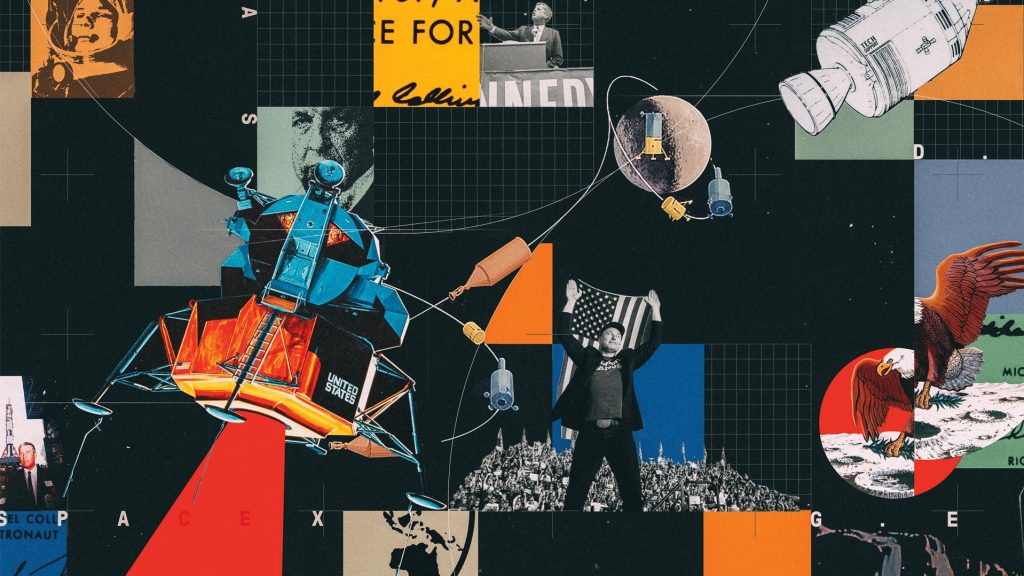
In the beginning, there was the name. A prophet guided Errol Musk to bestow it on his eldest son, or so he claimed. The seer was Wernher von Braun, a German engineer and an inspiration for Stanley Kubrick’s Dr. Strangelove. Though von Braun had built missiles for Hitler and used concentration-camp prisoners for manual labor, the U.S. government recruited him, and eventually brought him to a base in Alabama and tasked him with sending men into orbit, then to the moon. Von Braun had always dreamed of venturing deeper into the galaxy. Back in 1949, before he emerged as the godfather of the American space program, he spilled his fantasies onto the page, in a novel titled Project Mars. He described how a new form of government would take hold on the red planet: a technocracy capable of the biggest and boldest things. At the helm of this Martian state would sit a supreme leader, known as the Elon. Whatever the truth of this origin story, Elon Musk has seized on von Braun’s prophecy as his destiny. Since the founding of SpaceX in 2002, his business decisions and political calculations have been made with a transcendent goal in mind: the moment when he carries the human species to a new homeland, a planet millions of miles away, where colonists will be insulated from the ravages of nuclear war, climate change, malevolent AI, and all the unforeseen disasters that will inevitably crush life on Earth. Far away from the old, broken planet, a libertarian utopia will flourish, under the beneficent sway of the Elon. This sense of destiny led Musk on October 5, 2024, to a Trump rally in western Pennsylvania. Wearing a gray T-shirt bearing the slogan OCCUPY MARS, Musk told the crowd that Trump “must win to preserve democracy in America.” Thanks to their alliance, Musk briefly achieved powers that few unelected Americans have ever possessed. As the head of the Department of Government Efficiency, he demolished large swaths of the federal government and began to remake the infrastructure of the state. For a few erratic months, he assumed the role of the terrestrial Elon. Five months into Trump’s second term, Musk’s inflated sense of his place in history clashed with the ego of his benefactor, the relationship ruptured, and each man threatened to ruin the other. Musk vowed that his spaceships would no longer carry Americans, or the supplies that sustain them, to the International Space Station. Trump threatened SpaceX’s federal contracts, reportedly worth $22 billion. Weeks later, they were still bludgeoning each other. In July, Trump mused that he might deport the South African–born Musk, who in turn impishly announced that he would bankroll a new third party. Both men are likely bluffing. Musk still needs the U.S. government to fund his grand designs. And the U.S. government very much needs Elon Musk. Last year, 95 percent of the rockets launched in the United States were launched by SpaceX. NASA was a mere passenger. Musk has crowded low Earth orbit with satellites (nearly 8,000) that are becoming indispensable to the military’s capacity to communicate and the government’s surveillance of hostile powers. Even if Trump had pushed to dislodge Musk, he couldn’t. No rival could readily replace the services his companies provide. [Read: American spaceflight is now in Elon Musk’s hands] That Musk has superseded NASA is a very American parable. A generation ago, NASA was the crown jewel of the U.S. government. It was created in 1958 to demonstrate the superiority of the American way of life, and it succeeded brilliantly. In the course of landing humans on the lunar surface, NASA became the symbol of America’s competence and swagger, of how it—alone among the nations of the Earth—inhabited the future. NASA’s astronauts were 20th-century cowboys, admired in corners of the world that usually abhorred Americans. The Apollo crews traveled to the heavens on behalf of “all mankind,” a phrase that appeared both in the act that created NASA and on the plaque left on the moon by Apollo 11. Even NASA’s engineers, with their skinny ties and rolled-up sleeves, became the stuff of Hollywood legend. The rocket pioneer Wernher von Braun. In his novel, Project Mars, he imagined humans traveling to the red planet. (Evening Standard / Getty) NASA was born at the height of liberalism’s faith in government, and its demise tracks the decline of that faith. As the United States lost confidence in its ability to accomplish great things, it turned to Musk as a potential savior, and ultimately surrendered to him. This isn’t an instance of crony capitalism, but a tale about well-meaning administrations, of both parties, pursuing grandiose ambitions without the vision, competence, or funding to realize them. If the highest goal of policy is efficiency, then all the money that the government has spent on SpaceX makes sense. Even the company’s most vituperative detractors acknowledge its engineering genius and applaud its success in driving down launch expenses (unlike many defense contractors, SpaceX largely eats the cost of its failures). But in the course of bolstering Musk, in privatizing a public good, the government has allowed one billionaire to hold excessive sway. With the flick of a switch, he now has the power to shut down constellations of satellites, to isolate a nation, to hobble the operations of an entire army. Because of Musk’s indispensability, his values have come to dominate America’s aspirations in space, draining the lyricism from the old NASA mission. Space was once a realm of cooperation, beyond commercial interests and military pursuits. Now it is the site of military brinkmanship and a source of raw materials that nations hope to plunder. The humanistic pursuit of the mysteries of the universe has been replaced by an obsession with rocket power. Musk wants to use his influence to impose the improbable endeavor of Mars colonization on the nation, enriching him as it depletes its own coffers. In the vacuum left by a nation’s faded ambitions, Musk’s delusions of destiny