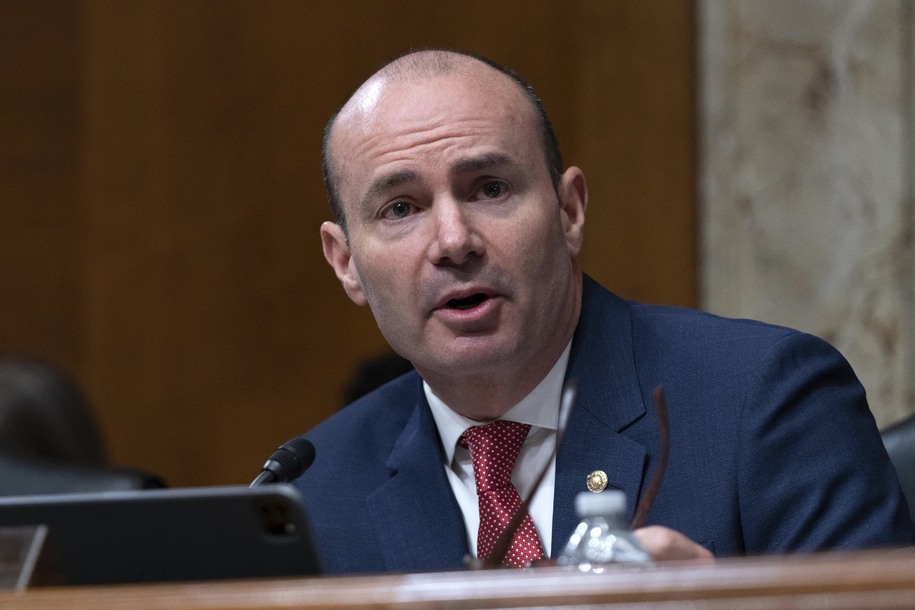
By Abe Streep for ProPublica On Monday, June 23, a crowd of about 2,000 people surrounded the Eldorado Hotel & Spa in Santa Fe, New Mexico, where members of President Donald Trump’s Cabinet had come for a meeting of the Western Governors’ Association. “Not for sale!” the crowd boomed. “Not one acre!” There were ranchers and writers in attendance, as well as employees of Los Alamos National Laboratory, all of whom use public land to hike, hunt and fish. Inside the hotel ballroom where the governors had gathered, Michelle Lujan Grisham, the New Mexico governor, apologized for the noise but not the message. “New Mexicans are really loud,” she said. On the street, one sign read “Defend Public Lands,” with an image of an assault rifle. Others bore creative and bilingual profanities directed at Trump, Secretary of the Interior Doug Burgum, who oversees most of the country’s public acreage, and Sen. Mike Lee, the Republican from Utah, who on June 11 had proposed a large-scale selloff of public lands. Lee, who chairs the Senate Committee on Energy and Natural Resources, was not in Santa Fe, so the crowd focused on Burgum, who earlier that afternoon had addressed the governors about energy dominance and artificial intelligence. “Show your face!” the crowd chanted. But he had already departed the hotel through a back door. That night, a hunting group projected an image of him on the exterior wall of the hotel. “Burgled by Burgum,” it read. Related | Rural populations near federal lands worry job cuts will hurt their communities In the weeks before the meeting, the possibility of selling off large swaths of public lands had seemed as likely as at any time since the Reagan administration. On June 11, Lee had introduced an amendment to the megabill Congress was debating to reconcile the national budget. The amendment mandated the sale of up to 3 million acres of land controlled by the U.S. Forest Service and the Bureau of Land Management, with the vast majority of proceeds going to pay for tax cuts. Although Lee had framed his measure as a solution to the West’s acute lack of affordable housing, it would have allowed developers to select the land they most desired. Under the amendment’s original language, the ultimate power to nominate parcels for sale fell to Burgum and Brooke Rollins, head of the Department of Agriculture, which oversees the U.S. Forest Service. Interior Secretary Doug Burgum In the days after the Santa Fe protest, the outcry from hunting and outdoor recreation groups escalated across the West and the Senate parliamentarian ruled that Lee’s amendment violated the chamber’s rules. Republican lawmakers from Montana opposed the amendment; Burgum also distanced himself from it. (“It doesn’t matter to me at all if it’s part of this bill,” he told a reporter on June 26.) By the time Burgum made his comments, Lee’s effort seemed doomed, and days later he announced that he was removing the amendment; public land advocates celebrated. “This win belongs to the hunters, anglers, and public landowners,” wrote Patrick Berry, the president of Backcountry Hunters and Anglers. But the celebration may have been premature. In a social media post announcing his decision, Lee indicated that he would revisit the issue: “I continue to believe the federal government owns far too much land,” he wrote. And powerful forces still support privatization. At the Santa Fe gathering, Rollins had been asked during a press conference about the effort to sell federal land. She told reporters she wasn’t familiar with the specifics of Lee’s amendment but supported his broader vision and suggested such efforts will continue regardless of the fate of the amendment. “Half of the land in the West is owned by the federal government,” said Rollins. “Is that really the right solution for the American people?” The circumstances that led to Lee’s proposal continue to simmer. The American West has an acute lack of affordable and attainable housing. According to the National Low Income Housing Coalition, Colorado, with a population of 6 million, is lacking 175,000 rental units for people who earn up to 50% of area median income. New Mexico, which has one-third of Colorado’s population, is lacking 52,000 such rentals; Utah, 61,000. But nowhere is the issue as acute as in Nevada, where Las Vegas and Reno are encircled by public land. The state of 3.27 million is estimated to lack 118,000 such rentals. Agriculture Secretary Brooke Rollins The lack of housing emerged as a lever for Lee, who has sought to challenge federal control of public lands since he was first elected to the Senate in 2010. A year after winning his seat, he introduced a bill to sell a limited amount of public land, saying, “There is no critical need for the federal government to hold onto it.” In 2013, he and others in his state’s delegation wrote a letter demanding the transfer of federal lands to Utah and angrily accusing the Bureau of Land Management, which manages 245 million acres nationwide, of “obvious abuse.” And in a 2018 address at a think tank, he compared federal land managers — and people who recreate on public acreage — to feudal lords, ruling from far-off kingdoms on the coasts. He also denounced “elite publications” that advocated for the protection of public lands, and he used the language of political war to describe the conflict over federal land: “It will take years, and the fight will be brutal.” (Lee’s office did not respond to detailed questions from ProPublica.) But this spring, Lee found support from unlikely places: the coastal elites he previously railed against seemed open to some of his ideas. The arguments in favor of privatization and development use a word of the season: abundance. Ezra Klein and Derek Thompson’s bestselling book of the same name argues that burdensome regulatory processes have crushed the American housing market. While the authors focus on increasing supply in urban areas, in April, The New York Times ran an op-ed calling for building housing on public lands. That same