Author name: moderat ereport

The Hill

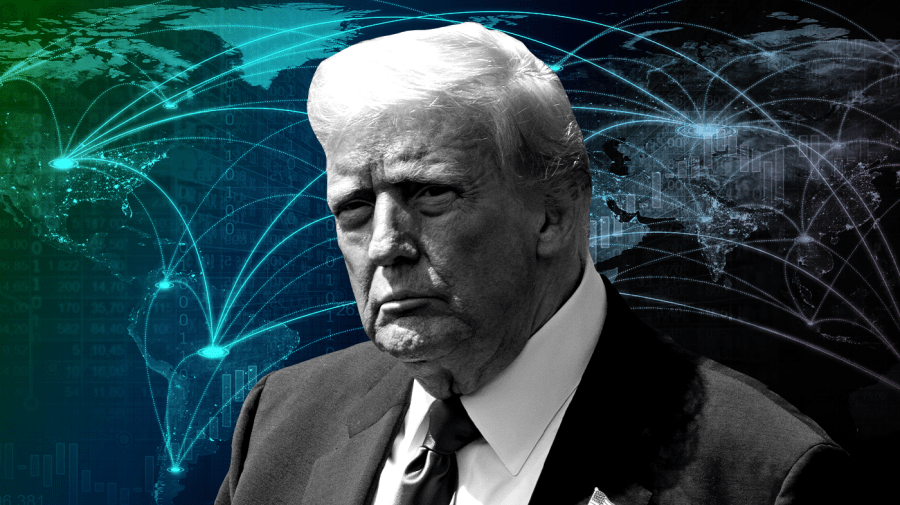
Republicans fear Trump tariffs are cutting into economy

Republicans on Capitol Hill are feeling jittery about the economy after the latest jobs report showed the economy added far fewer jobs than previously estimated over the past three months. President Trump and his economic team insist that the economy is going strong and poised for significant growth, but their bullish projections are meeting skepticism…

The Hill

Trump’s labor statistics shakeup sparks anxiety over future economic data

President Trump’s firing of the Bureau of Labor Statistics (BLS) commissioner is raising concerns about whether her replacement could manipulate job numbers to work in his favor. The traditionally nonpartisan commissioner role, usually held by career professionals who span multiple administrations, has given all presidents bad news in recent years. But Trump’s firing of Erika McEntarfer, a…

The Hill

Facing facts about Trump and the jobs numbers

In announcing the firing of the government’s chief labor statistician last week, President Trump condemned the works of Erika McEntarfer as “phony.” McEntarfer was just the 16th commissioner of the U.S. Bureau of Labor Statistics since the position was created by Congress in 1884 to keep track of unemployment during an ongoing depression of a…

The Hill

Trump hones in on energy in trade talks, but specifics are scarce

President Trump is seeking to promote U.S. energy in his trade negotiations, but announcements about agreements so far have been light on details, and actual outcomes are largely mysterious. Recently, the Trump administration and the European Union announced a trade deal under which the EU will buy “$750 billion in U.S. energy” by 2028.  An EU webpage said that the deal…

ProPublica

A Maine Woman Paid Her Back Rent. Her Record Still Says She Was Evicted.

by Sawyer Loftus, Bangor Daily News This article was produced for ProPublica’s Local Reporting Network in partnership with the Bangor Daily News. Sign up for Dispatches to get stories like this one as soon as they are published. When Jasmin Belanger agreed to a plan to pay $750 in back rent, she had no idea how the decision would haunt her. It wasn’t until 10 months later, while apartment hunting to distance herself from an ex-boyfriend she said had abused her, that she discovered an eviction on her record. She hadn’t ever been ordered to move out, having paid her back rent on schedule. But it turned out that the 2023 deal she made in court with her landlord to help her avoid eviction created a paper record that made it look like she had been evicted. That black mark kept her from finding a new place to live. Belanger’s landlord was the Bangor public housing authority, which operates apartments for low-income residents. The U.S. Department of Housing and Urban Development strongly encourages public housing authorities to offer so-called repayment agreements to tenants who have fallen behind on rent in order to help them stay in their homes. It recommends that authorities reach these deals before cases reach eviction court. But housing authorities have flexibility as to how to design and enforce such agreements. And the way these second-chance opportunities are executed in some parts of Maine — verbally in eviction courts with little judicial oversight — has come back to harm even tenants who meet every term of their deals. That’s because judges here don’t pause eviction cases even when tenants and housing authorities reach agreements. In fact, those judges often grant landlords possession of properties at the time that repayment deals are made — expediting the process of kicking out tenants who violate the agreements. Some states have taken steps to prevent this, requiring landlords to return to court to evict tenants who don’t fulfill the terms of their repayment plans. Housing authorities also could choose to pause or close eviction cases if repayment agreements are made in court, but they rarely do so in Maine, said Erica Veazey, an attorney with Pine Tree Legal Assistance, a legal aid group based in Portland that represents low-income tenants throughout the state. Most housing authorities in Maine, including Bangor’s, told the Bangor Daily News and ProPublica that they follow HUD’s guidance and try to reach agreements with tenants outside of courts. But court records show that’s not always true in Bangor, the state’s second-largest housing authority. There, 54 tenants had repayment agreements made in court, according to the newsrooms’ examination of eviction filings between 2019 and 2024. All 54 tenants ended up with eviction judgments in court records, including those who may have repaid their debts. (If a repayment agreement was made outside of court, it would not appear in any official record.) Maine’s court system is one of the last in the country to rely on paper records, making a holistic accounting of such ghost evictions difficult. But the Bangor cases show for the first time how these repayment agreements can backfire for tenants against the intent of the HUD guidance. Presented with these findings, Mike Myatt, executive director of Bangor’s housing authority, said he did not know public housing residents would automatically end up with evictions on their records if they entered into repayment agreements in court. “I don’t quite understand or know how those processes may be changed,” Myatt said, “but we would certainly lead an effort or be part of an effort that would change those rules.” Mike Myatt, executive director of Bangor’s housing authority. He said he did not know that public housing residents would automatically end up with evictions on their records if they entered into repayment agreements in court. (Linda Coan O’Kresik/BDN) HUD, during President Donald Trump’s first term, began urging housing authorities to reach repayment agreements before taking tenants to eviction court in July 2020 amid the coronavirus pandemic. In January, just before President Joe Biden left office, the agency reemphasized that guidance as part of new safeguards for public housing tenants; that doesn’t include a recommendation about whether evictions should be included on tenants’ records as part of such deals. “HUD’s intent seems pretty clear: Eviction filing should be a last resort for housing authorities and not essentially a way to strong-arm tenants into agreeing to whatever terms you want to put them under,” said Hannah Adams, a senior attorney at the National Housing Law Project, a nonprofit legal advocacy center for low-income tenants and homeowners. She practices in Louisiana, where judges regularly sign off on repayment agreements without entering an eviction judgment. Of the more than three dozen tenants contacted by the Bangor Daily News and ProPublica, only Belanger agreed to publicly share her experience about the consequences of having an eviction on her record. An eviction, even one that never actually happened, can haunt a person’s financial record for years, visible to lenders and prospective landlords and hurting opportunities to obtain credit or rent a home, Adams said. Asked to comment on a range of questions, including the effect of housing authorities deviating from federal guidance, HUD spokesperson Kasey Lovett issued a statement saying the Trump administration is reviewing all rules finalized during the last administration. “Many artificially raised the cost of housing and administration of HUD programs,” Lovett said. “HUD is looking into this specific rule and considering necessary options to revise or remove this burden.” The agency did not respond to follow-up questions about whether or how it would revise the guidance about repayment agreements. Perils of Court-Based Deals Belanger said she fell behind on her rent in 2023 because she was paying to stay at a hotel to live away from her ex. She had also lost income because she was no longer showing up regularly to her cosmetology job due to the stress. An eviction notice delivered to her door in May 2023 prompted

ProPublica

The Trump Administration Is Promoting Its Anti-Trans Agenda Globally at the United Nations

by Lisa Song ProPublica is a nonprofit newsroom that investigates abuses of power. Sign up to receive our biggest stories as soon as they’re published. It was meant to be a routine discussion on pollution. One by one, delegates at the United Nations expressed support for a new panel of scientists who would advise countries on how to address chemicals and toxic waste. But the U.S. delegate took the meeting in a new direction. She spent her allotted three minutes reminding the world that the United States now had a “national position” on a single word in the documents establishing the panel: gender. “Use of the term ‘gender’ replaces the biological category of sex with an ever-shifting concept of self-assessed gender identity and is demeaning and unfair, especially to women and girls,” the delegate told the U.N. in June. The Trump administration is pushing its anti-trans agenda on a global stage, repeatedly objecting to the word “gender” in international resolutions and documents. During at least six speeches before the U.N., U.S. delegates have denounced so-called “gender ideology” or reinforced the administration’s support for language that “recognizes women are biologically female and men are biologically male.” The delegates included federal civil service employees and the associate director of Project 2025, the conservative blueprint for Trump’s policies, who now works for the State Department. They delivered these statements during U.N. forums on topics as varied as women’s rights, science and technology, global health, toxic pollution and chemical waste. Even a resolution meant to reaffirm cooperation between the U.N. and the Association of Southeast Asian Nations became an opportunity to bring up the issue. Insisting that everyone’s gender is determined biologically at birth leaves no room for the existence of transgender, nonbinary and intersex people, who face discrimination and violence around the world. Intersex people have variations in chromosomes, hormone levels or anatomy that differ from what’s considered typical for male and female bodies. A federal report published in January just before President Donald Trump took office, estimated there are more than 5 million intersex Americans. On at least two occasions, U.S. delegates urged the U.N. to adopt its language on men and women, though it’s unclear if the U.S.’ position has led to any policy changes at the U.N. But the effects of the country’s objections are more than symbolic, said Kristopher Velasco, a sociology professor at Princeton University who studies how international institutions and nongovernmental organizations have worked to expand or curtail LGBTQ+ rights. U.N. documents can influence countries’ policies over time and set an international standard for human rights, which advocates can cite as they campaign for less discriminatory policies, Velasco said. The phrase “gender ideology” has emerged as a “catchall term” for far-right anxieties about declining fertility rates and a decrease in “traditional” heterosexual families, he said. At the U.N., the administration has promoted other aspects of its domestic agenda. For example, U.S. delegates have demanded the removal of references to tackling climate change and voted against an International Day of Hope because the text contained references to diversity, equity and inclusion. (The two-page document encouraged a “more inclusive, equitable and balanced approach to economic growth” and welcomed “respect for diversity.”) But the reflexive resistance to the word “gender” is particularly noteworthy. Advocates for LGBTQ+ rights said the U.S.’ repeated condemnation of “gender ideology” signals support for more repressive regimes. The U.S. is sending the world “a clear message: that the identities and rights of trans, nonbinary, and intersex people are negotiable,” Ash Lazarus Orr, press relations manager at the nonprofit Advocates for Trans Equality, said in a statement. Laurel Sprague, research director at the Williams Institute, a policy center focused on sexual orientations and gender identities at the University of California, Los Angeles, said she’s concerned that other countries will take similar positions on transgender rights to gain favor with the U.S. Last month Mike Waltz, Trump’s nominee for ambassador to the U.N., told a Senate committee that he wants to use a country’s record of voting with or against the U.S. at the U.N. as a metric for deciding foreign aid. In response to detailed questions from ProPublica, White House Deputy Press Secretary Anna Kelly said in a statement: “President Trump was overwhelmingly elected to restore common sense to government, which means focusing foreign policy on securing peace deals and putting America First — not enforcing woke gender ideology.” A clash between Trump’s administration and certain U.N. institutions over transgender rights was almost inevitable. Trump’s hostility to transgender rights was a key part of his election campaign. On his first day in office, he issued an executive order called “Defending women from gender ideology extremism and restoring biological truth to the federal government.” The order claimed there were only two “immutable” sexes. Eight days later, Trump signed an executive order restricting gender-affirming surgery for anyone under 19. Federal agencies have since forced trans service members out of the military and sued California for its refusal to ban trans athletes from girls’ sports teams. In June, the U.N. High Commissioner for Human Rights criticized American government officials for their statements “vilifying transgender and non-binary people.” The human rights office urges U.N. member states to provide gender-affirming care and says the organization has “affirmed the right of trans persons to legal recognition of their gender identity and a change of gender in official documents, including birth certificates.” The office also supports the rights of intersex people. “Intersex people in the U.S. are extremely worried” that they will become bigger targets, said Sylvan Fraser Anthony, legal and policy director at the intersex advocacy group InterACT. “In all regions of the world, we are witnessing a pushback against women’s human rights and gender equality,” Laura Gelbert Godinho Delgado, a spokesperson for the U.N.’s human rights office, said in an email. “This has fueled misogyny, anti-LGBTI rhetoric, and hate speech.” The Trump administration’s insistence on litigating “gender” complicates the already ponderous procedures of the U.N. Many decisions are made by consensus,

Scroll to Top