Author name: moderat ereport

The Hill

Abrego Garcia lawyers ask judge to block Trump administration from comments that could taint case

Attorneys for Kilmar Abrego Garcia asked a judge to block Trump administration officials from making damaging statements about their client, saying they could hinder his right to a fair trial. The request from the attorneys seeks to block extrajudicial statements they say violate court rules, pointing to specific comments from Homeland Security Secretary Kristi Noem. “These…

ProPublica

Four Years After Cop Was Filmed Slamming Black Woman to the Ground, Louisiana Passes Accountability Law

by Richard A. Webster, Verite News This article was produced for ProPublica’s Local Reporting Network in partnership with Verite News. Sign up for Dispatches to get stories like this one as soon as they are published. Louisiana passed a new police accountability law following allegations of civil rights violations against a sheriff’s deputy caught on video dragging a Black woman by her hair and slamming her head into the ground. The woman, Shantel Arnold, sued the deputy and the sheriff, accusing the Jefferson Parish Sheriff’s Office of conspiring to cover up the 2021 assault. The Sheriff’s Office agreed in March to pay Arnold $300,000 after three days of trial but before jury deliberations began, Arnold’s attorney said. After the incident, ProPublica, in partnership with WRKF, WWNO and The Times-Picayune, published an investigation detailing the long history of excessive-force complaints against Jefferson Parish sheriff’s Deputy Julio Alvarado. Alvarado, a 20-year veteran of the Sheriff’s Office, was employed by the department as of March. Arnold’s attorney, state Sen. Gary Carter, D-New Orleans, said he introduced the legislation after it emerged that Alvarado had failed to write a report about his encounter with Arnold despite his department’s policy that officers document each time they use force. Jefferson Parish Sheriff Joseph Lopinto said during his testimony in the March trial over Arnold’s lawsuit that Alvarado’s commanders instructed him against writing such a report after video of his actions spread across social media. Arnold’s run-in with Alvarado, which was captured in a 14-second video, left the woman with bruises and scratches across her body, a busted lip and recurring headaches, according to her subsequent account to police investigators. “Had it not been for a bystander capturing how this officer beat up Shantel Arnold, there would be no report, there would be no evidence of it, there would be no indication that it ever happened,” Carter said in a recent interview. The new law, passed unanimously by state legislators and signed by Gov. Jeff Landry in June, will require all law enforcement agencies to report every time an officer’s use of force results in serious injury. It directs the Council on Peace Officer Standards and Training, which certifies police officers, to adopt a policy on mandatory use-of-force reporting by Jan. 1. Details of how the process will work have not been spelled out, nor has the penalty for failing to comply. The bill was introduced as “Shantel Arnold’s Law,” but Carter said that name was removed because “Sheriff Lopinto got very upset about that, and that almost killed the bill.” Neither the Jefferson Parish Sheriff’s Office nor Alvarado’s attorney responded to requests for comment or an interview. Alvarado came across Arnold in September 2021, when the officer responded to a 911 call about a fight among 25 people in Jefferson Parish. When the deputy pulled up in his patrol car, Alvarado saw Arnold, covered in dirt, walking down the street. Arnold told the deputy she was attacked by a group of boys who frequently bullied her. When Alvarado ordered her to stop, Arnold said she just wanted to go home and kept walking. That’s when the deputy jumped out of his vehicle, grabbed Arnold and slammed her into the sidewalk, according to several witnesses. In a video taken by a bystander, Alvarado drags Arnold along the pavement, holds her by her braids and slams her repeatedly onto the pavement. Arnold was not charged with a crime and was later taken to a hospital. The Sheriff’s Office did not use body cameras at the time but has since begun using them. The Jefferson Parish Sheriff’s Office denied wrongdoing. A 2022 internal investigation by the Sheriff’s Office determined Alvarado’s actions against Arnold were “both reasonable and acceptable.” Alvarado received an “approximately” 40-hour suspension for failing to file a written report, Lopinto said in his March testimony. Arnold alleged in her 2022 lawsuit that the Sheriff’s Office knew Alvarado had a propensity for violence against Black people and other minority groups yet continued to have him patrol such communities, putting the public in danger. Lopinto attributed Alvarado’s history of complaints to his working a high-crime beat, according to a 2022 Times-Picayune interview. “It’s not like he’s getting a complaint every month,” Lopinto said. During that same interview, Lopinto dismissed Arnold’s account and accused her of “looking for a paycheck.” Alvarado’s alleged misdeeds fit a broader pattern in the Jefferson Parish Sheriff’s Office, as the yearlong investigation into the Sheriff’s Office by ProPublica, WRKF and WWNO found. Between 2013 and 2021, deputies disproportionately discharged guns against Black people. Of the 40 people shot at by Jefferson Parish deputies during that time, 73% were Black, more than double their share of the population. Twelve of the 16 people who died after being shot or restrained by deputies during that time were Black. Alvarado has been named in at least 10 federal civil rights lawsuits since 2007, all involving the use of excessive force; eight of the plaintiffs were members of minority groups. The Sheriff’s Office settled three of those lawsuits. Arnold’s $300,000 payout is the third — and largest — settlement involving Alvarado. Five other lawsuits were closed in favor of the Sheriff’s Office, one was dismissed on a legal technicality and one was indefinitely delayed. The Sheriff’s Office said in filings responding to the eight lawsuits that were not dismissed or delayed that officers’ actions were “reasonable under the circumstances” and characterized the claims as “frivolous.” Prior to the 2021 incident involving Arnold, the Jefferson Parish Sheriff’s Office had settled a 2016 lawsuit accusing Alvarado of grabbing a 14-year-old Hispanic boy by the neck and slamming his head against the concrete as the child screamed, “Why are you doing this to me?” A woman had called the police complaining that the boy and a friend were wrestling in a parking lot. Alvarado then threatened to have the boy and his family deported, according to the suit. The Sheriff’s Office, which paid the boy’s family $15,000, said in court filings

ProPublica

Do You Have Information About the CECOT Deportations? Help ProPublica Report.

by Perla Trevizo, Melissa Sanchez, Mica Rosenberg and Maryam Jameel Leer en español. The Trump administration sent more than 230 Venezuelan immigrants to CECOT, a maximum-security prison in El Salvador, and accused them of being members of the violent Tren de Aragua gang. For the past four months, ProPublica and The Texas Tribune have been reporting on these men, their backgrounds and how they ended up in custody. We’ve written about how the administration knew before removing them that the vast majority had not been convicted of any crimes in the U.S., contradicting its claims that the men were “the worst of the worst,” and how, by and large, they were abiding by the immigration system and not absconding from authorities. Now that they’ve been returned to Venezuela, we’re continuing to report on who the men are and what they went through. Do you have information about the men or about the operation in which they were deported that you can share? Fill out this form or contact us via Signal at 917-512-0201 or WhatsApp at 917-327-4868. We appreciate you sharing your story and we take your privacy seriously. We are gathering this information for the purposes of our reporting, and we will contact you if we wish to publish any part of your story.

The Hill

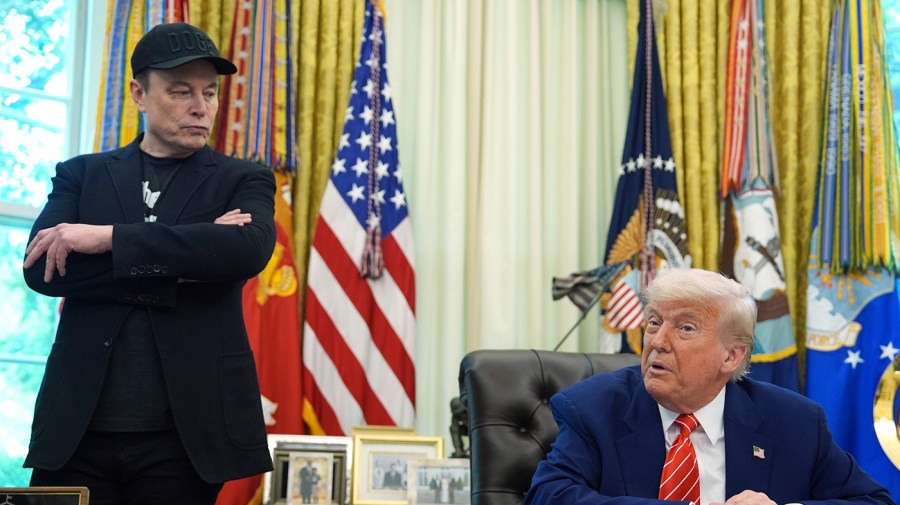
White House indicates Trump doesn’t support federal contracts for Musk’s AI company

White House press secretary Karoline Leavitt said Wednesday she does not think President Trump supports federal agencies contracting with Elon Musk’s artificial intelligence (AI) company. “I don’t think so, no,” Leavitt said. Asked if Trump would then want the government to cancel a recently announced contract with Musk’s AI venture, Leavitt said she would talk…

Factcheck.org

Gabbard’s Misleading ‘Coup’ Claim

Este artículo estará disponible en español en El Tiempo Latino. Director of National Intelligence Tulsi Gabbard claims to have uncovered “overwhelming evidence” that former President Barack Obama and others in his administration manipulated intelligence to “lay the groundwork for what was essentially a years-long coup against President Trump.” But the foundation for her case is misleading. Gabbard’s claim relies heavily on an alleged contradiction between a Jan. 6, 2017, intelligence assessment that Russian President Vladimir Putin had ordered an “influence campaign” in an attempt to help elect Donald Trump and earlier intelligence assessments that concluded Russia did not successfully use cyberattacks on election infrastructure in the 2016 election. But those two assessments are not in contradiction. “No one ever claimed Russia altered votes, but everyone claims that Russia tried to interfere on Trump’s behalf,” Democratic Sen. Mark Warner, the ranking Democrat on the Senate Intelligence Committee, said in a video message posted on X on July 21. That interference was “well documented” and “well vetted” not only by the Intelligence Community but also by a bipartisan Senate Intelligence Committee and as part of then special counsel Robert S. Mueller’s report, he said. Nonetheless, on Fox News on July 20, Gabbard said she was “referring all of the documents that we have uncovered to the Department of Justice and the FBI for a criminal referral,” adding, “In my view, we have the evidence to be able to move forward and bring about justice, yes, to prosecute and indict those responsible.” Trump has picked up on Gabbard’s statements, posting to Truth Social a fake video showing Obama being handcuffed by FBI agents as well as a message that said there is now “Irrefutable EVIDENCE” that Obama, Hillary Clinton and Joe Biden perpetrated “THE CRIME OF THE CENTURY!” In a press conference on July 22, Trump claimed Gabbard had “caught President Obama absolutely cold. … And there should be very severe consequences for that.” “After what they did to me and whether it’s right or wrong, it’s time to go after people,” Trump said. “Obama’s been caught directly. … Look, he’s guilty. … This was treason, this was every word you can think of. They tried to steal the election. They tried to obfuscate the election.” Obama’s office responded on July 22 with a statement on Gabbard’s memo and release of unsealed documents, saying, “Nothing in the document issued undercuts the widely accepted conclusion that Russia worked to influence the 2016 presidential election but did not successfully manipulate any votes.” “These bizarre allegations are ridiculous and a weak attempt at distraction,” Obama’s office said. Gabbard’s Case Gabbard, who was a Democratic congresswoman from Hawaii who ran for the party’s nomination in 2020 and left the party in 2022, announced on July 18 what she said was “new evidence” of an Obama administration “conspiracy to subvert President Trump’s 2016 victory and presidency.” In her press release, Gabbard wrote, “In the months leading up to the November 2016 election, the Intelligence Community (IC) consistently assessed that Russia is ‘probably not trying … to influence the election by using cyber means.’” As her unsealed documents show, Gabbard was citing a Sept. 9, 2016, email from an intelligence official who wrote, “Russia probably is not … trying to influence the election by using cyber means to manipulate computer-enabled election infrastructure.” (Emphasis is ours.) Gabbard misleadingly claimed the assessments changed after a White House meeting of Obama’s top National Security Council principals on Dec. 9, 2016. She said the IC was tasked with creating a new assessment at Obama’s request that led to the Jan. 6, 2017, release of a declassified Intelligence Community report that concluded “President Vladimir Putin ordered an influence campaign in 2016 aimed at the US presidential election.” In addition to a sophisticated social media campaign in support of Trump’s candidacy, the report said Russian intelligence services gained access to the Democratic National Committee computer network and released hacked material to WikiLeaks and other outlets “to help President-elect Trump’s election chances.” Gabbard claimed that assessment “directly contradicted the IC assessments that were made throughout the previous six months.” Gabbard created a timeline that purports to detail how the Intelligence Community’s assessment changed over time, and she linked to 114 pages of newly unsealed intelligence documents and communications to lay out her case. But Gabbard conflated assessments that Russia was not successful in hacking voting infrastructure to alter the election results with intelligence documenting Russia’s efforts to influence the election by swaying the American electorate’s opinions. For example, Gabbard cited: An Aug. 31, 2016, email from a Department of Homeland Security official to then DNI James Clapper about an analysis of local voting infrastructure that found “there is no indication of a Russian threat to directly manipulate the actual vote count through cyber means.” A Sept. 9, 2016, memo from an official in Clapper’s office arguing that a presidential briefing should note that Russia “probably is not trying … to influence the election by using cyber means” to “manipulate … election infrastructure.” A Sept. 12, 2016, Intelligence Community assessment on cyberthreats to the election that concluded, “We judge that foreign adversaries do not have and will probably not obtain the capabilities to successfully execute widespread and undetected cyber attacks on the diverse set of information technologies and infrastructures used to support the November 2016 US presidential election.” A post-election series of talking points prepared for Clapper to deliver in a Dec. 7 presidential briefing report, including that “[f]oreign adversaries did not use cyberattacks on election infrastructure to alter the US Presidential election outcome” and that “[w]e have no evidence of cyber manipulation of election infrastructure intended to alter results.” Gabbard claimed the assessment changed after a Dec. 9, 2016, meeting of National Security Council principals, including Clapper, John Brennan, and Susan Rice, the then CIA director, and national security adviser, respectively. The Gabbard memo accompanying her press release cited a subsequent email from Clapper’s assistant to his top aides directing them to “produce an assessment per

ProPublica

The Men Trump Deported to a Salvadoran Prison

by ProPublica, The Texas Tribune, Alianza Rebelde Investiga and Cazadores de Fake News ProPublica is a nonprofit newsroom that investigates abuses of power. Sign up to receive our biggest stories as soon as they’re published. On March 15, President Donald Trump’s administration sent more than 230 Venezuelan immigrants to a maximum-security prison in El Salvador. Without providing evidence, Trump has called the men “some of the most violent savages on the face of the Earth.” Last week, the men were released as suddenly as they’d been taken away. Now, the truth of all their stories — one by one — will begin to be told. Starting here. We’ve compiled a first-of-its-kind, case-by-case accounting of 238 Venezuelan men who were held in El Salvador. ProPublica, The Texas Tribune and a team of Venezuelan journalists from Alianza Rebelde Investiga (Rebel Alliance Investigates) and Cazadores de Fake News (Fake News Hunters) spent the past four months reporting on the men’s lives and their backgrounds. We obtained government data that included whether they had been convicted of crimes in the U.S. or had pending charges. We found most were listed solely as having immigration violations. We also conducted interviews with relatives of more than 100 of the men; reviewed thousands of pages of court records from the U.S. and South America; and analyzed federal immigration court data. Some of our findings: We obtained internal data showing that the Trump administration knew that at least 197 of the men had not been convicted of crimes in the U.S. — and that only six had been convicted of violent offenses. We identified fewer than a dozen additional convictions, both for crimes committed in the U.S. and abroad, that were not reflected in the government data. Nearly half of the men, or 118, were whisked out of the country while in the middle of their immigration cases, which should have protected them from deportation. Some were only days away from a final hearing. At least 166 of the men have tattoos. Interviews with families, immigration documents and court records show the government relied heavily on tattoos to tie the men to the Venezuelan gang Tren de Aragua — even though law enforcement experts told us that tattoos are not an indicator of gang membership. The men who were imprisoned range in age from 18 to 46. The impact of their monthslong incarceration extended beyond them. Their wives struggled to pay the rent. Relatives went without medical treatment. Their children wondered if they would see them again. White House spokesperson Abigail Jackson did not respond to questions about the men in the database but said Trump “is committed to keeping his promises to the American people and removing dangerous criminal and terrorist illegals who pose a threat to the American public.” She referred questions to the Department of Homeland Security, which did not respond. Read the men’s stories in our database. Reporting by: Perla Trevizo, ProPublica and The Texas Tribune; Melisa Sánchez, ProPublica; Mica Rosenberg, ProPublica; Gabriel Sandoval, ProPublica; Jeff Ernsthausen, ProPublica; Ronna Risquez, Alianza Rebelde; Adrián González, Cazadores de Fake News; Adriana Núñez Moros, independent journalist; Carlos Centeno, independent journalist; Maryam Jameel, ProPublica; Gerardo del Valle, ProPublica; Cengiz Yar, ProPublica; Gabriel Pasquini, independent journalist; Kate Morrisey, independent journalist; Coral Murphy Marcos, independent journalist; Lomi Kriel, ProPublica and The Texas Tribune; Nicole Foy, ProPublica; Rafael Carranza, Arizona Luminaria; Lisa Seville, ProPublica Design and development by: Ruth Talbot, ProPublica Additional design and development by: Zisiga Mukulu, ProPublica Additional data reporting by: Agnel Philip, ProPublica

Scroll to Top