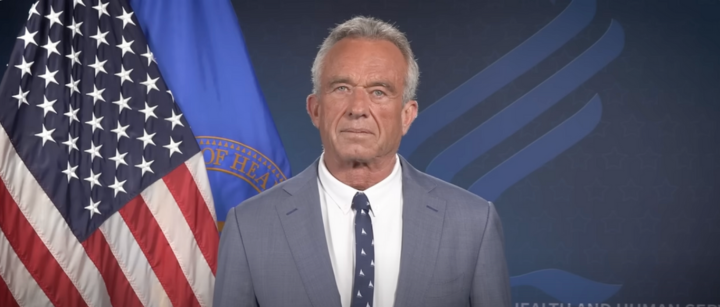
Este artículo estará disponible en español en El Tiempo Latino. In justifying the United States’ rejection of updates to global health regulations, the Department of Health and Human Services and Secretary Robert F. Kennedy Jr. falsely claimed that the policy would give the World Health Organization the ability to “order global lockdowns” or “travel restrictions” in response to a pandemic. Experts told us that is “entirely untrue” and “clearly” incorrect. On July 18, HHS issued a press release stating that the government was formally rejecting amendments to the WHO’s International Health Regulations, which had been adopted by member states last June. The regulations describe the rights and obligations of both the WHO and member countries in preparing for and responding to public health events, including pandemics. (Although President Donald Trump notified the WHO that the U.S. intends to exit the group, the U.S. still needed to say by July 19 if it opposed the amendments, as the process is separate.) Echoing false claims on social media that have for years exaggerated the power of the WHO, particularly about policy changes negotiated following the COVID-19 pandemic, HHS incorrectly said that the newly revised IHR “would give the WHO the ability to order global lockdowns, travel restrictions, or any other measures it sees fit to respond to nebulous ‘potential public health risks.’” In a video addressing the American public, Kennedy made the same claim, citing “national sovereignty” as the first reason why the U.S. was rejecting the amendments. “Nations who accept the new regulations are signing over their power in health emergencies to an unelected international organization that could order lockdowns, travel restrictions, or any other measures,” he said. He also claimed that the policy “lays the groundwork for global medical surveillance of every human being,” since it “contains provisions about global systems of health IDs, vaccine passports and a centralized medical database.” “Are we going to be subjects to a technocratic control system that uses ‘health risks’ and ‘pandemic preparedness’ as a Trojan horse to curtail basic democratic freedoms?” Kennedy asked. “Do we want a future where every person, every movement, every transaction and every human body is under surveillance at all times?” Later in the video, Kennedy acknowledged that “many of these amendments are phrased to be non-binding,” but said that “as a practical matter, it’s hard for many countries to resist them,” calling the agreement “bad for the entire world.” But Lawrence Gostin, a professor of global health law at Georgetown University who helped draft the amendments, told us that it’s not just that the IHR lacks teeth, but that the regulations also don’t do what Kennedy claims. “National sovereignty is expressly built into the IHR amendments,” he said in an email. “There is indeed a lack of any enforcement mechanism but even if it could be enforced, there is nothing in the IHR that undermines national sovereignty. It is entirely untrue.” “The IHR encourages international cooperation in rapidly detecting and responding to novel outbreaks,” he added. “That is decidedly in America’s core national interests.” “States have, in accordance with the Charter of the United Nations and the principles of international law, the sovereign right to legislate and to implement legislation in pursuance of their health policies,” the text of the IHR reads. Throughout, the document refers to “recommendations” the WHO may make as a result of a particular health risk, which are defined in the IHR as “non-binding advice.” “WHO has no authority to tell countries what to do. We cannot impose travel bans, lockdowns, vaccine mandates or any other type of measure. Nor do we seek to,” Dr. Tedros Adhanom Ghebreyesus, the WHO’s director-general, said in remarks during a July 23 press briefing. “That is clearly laid out in our founding document, the WHO Constitution. Our job is to provide evidence-based recommendations and guidelines, and to support countries to protect and improve the health of their populations. But how or whether countries implement that advice has always been and always will be up to them, based on their national guidelines and rules.” A WHO webpage about the IHR amendments also iterates this point. Ayelet Berman, a global health law expert at the National University of Singapore, explained that under article 12 of the IHR, the director-general can declare a public health emergency of international concern, or PHEIC — and now, under the updated IHR, a “pandemic emergency,” which serves as the highest level alert. With those declarations, the director-general can issue temporary or standing recommendations under articles 15 and 16. “These are legally non-binding: member states are not legally obligated to follow them. Therefore, it is incorrect to say that the WHO has legal powers to ‘ORDER’ lockdowns or any other public health measures for that matter,” she told us in an email. “The organization can issue recommendations, but it cannot compel states to implement specific measures.” She said, however, that the recommendations carry significant weight, which may be what the Trump administration is concerned about. “Even though they are not enforceable by law, failure to follow them could lead to international scrutiny/political backlash,” she said. “Hence, these recommendations may shape how governments respond and how they are perceived globally and at home.” Gian Luca Burci, a senior visiting professor of international law at the Geneva Graduate Institute, called HHS’ statement “clearly” incorrect. “WHO of course expects governments and other stakeholders to take its recommendation seriously, and at the very least not to fall below that standard in their national measures, but the recommendations are what their name says; they are obviously not binding orders and do not deprive states from taking their own final decisions on the national measures they consider necessary,” he told us in an email. “That is clearly stated in article 43 of the IHR and that is exactly what happened during the COVID pandemic, when WHO was not recommending total border closure or mass lockdowns but several states did precisely that.” Kennedy’s claims about global medical surveillance are also unwarranted. “The IHR certainly does not require vaccine passports but actually discourages them,” Gostin said. “There is