
The Light That Failed
Winston Smith Democracy dies in the dark. The post The Light That Failed appeared first on The Nation.


Winston Smith Democracy dies in the dark. The post The Light That Failed appeared first on The Nation.
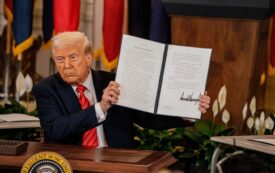
Elie Mystal In ruling the president can decimate the Department of Education, the court took a key Congressional power—and gave it to Trump. The post The Supreme Court Just Crowned Trump King—Again appeared first on The Nation.

The increasingly opaque path for protection adopted by Trump leaves those who fled their homeland with little hope. By Kate Morrissey for Capital & Main When Mohamad presented his evidence about how the Taliban had tortured him because of his previous work in the Afghan government, a U.S. official found his story credible. But the United States is still trying to deport him, just not to Afghanistan. Mohamed spoke to Capital & Main from the Northwest ICE Processing Center in Tacoma, Washington, where he said he had been waiting almost half a year with no ability to pursue his case for protection or attempt to get released from immigration custody. He asked that he not be fully identified due to safety concerns. “Nothing is clear for me,” Mohamad said through a Dari interpreter. “I don’t know what will happen to me.” He said officials have told him that he might be deported to Costa Rica, Panama or El Salvador. He is one of many asylum seekers who have been trying to navigate the increasingly opaque system that the Trump administration put in place in January to restrict access to protection for those who cross the border without permission. A district court judge in Washington on July 2 found that the Trump administration’s changes to the immigration system were unlawful and ordered the government to process people who are still in the U.S. through the full asylum process. Related | Here’s what’s happening to the people ICE arrests in immigration court That could mean that Mohamad’s case will finally move forward in a way that allows him to present his evidence to an immigration judge. Mohamad had been waiting in Mexico City in January, trying to get an appointment to request asylum through a phone application called CBP One, when President Donald Trump took office. On his first day in office, Trump canceled all CBP One appointments and closed down the application process, which the Biden administration had created to receive asylum seekers at ports of entry. Four days later, Mohamad, believing that the United States was the safest place for him to go after the Taliban had tortured him, made his way to the Arizona border and crossed onto U.S. soil to request protection. He has been in limbo in U.S. immigration custody since then. The administration suspended the ability to apply for asylum, but people could still request a lesser-known protection under the United Nations Convention Against Torture and Other Cruel, Inhuman or Degrading Treatment or Punishment, known as the Convention Against Torture or CAT. Instead of following the previously established screening process for protection under the convention, the Trump administration created a more difficult legal assessment, according to multiple immigration attorneys whose clients went through the process. A mural of a bald eagle and the U.S. flag at the ICE detention center in Tacoma, Wash., in Dec. 2019. Under the old process, people seeking protection under the Convention Against Torture went through initial screenings, known as reasonable fear interviews, which assessed whether there was a reasonable possibility that they would be tortured. Those who passed the screenings went on to immigration court, where they had time to gather more evidence and find attorneys to help them prove to a judge that they were more likely than not to be tortured if returned to their country, the legal standard to win final approval for protection under the convention. But under Trump’s new system, that more-likely-than-not legal standard moved from the final step in the process to the initial screening, requiring a higher level of evidence with less time to gather or show it. A report from Human Rights First found that the Department of Homeland Security conducted the assessment for some migrants who express fear of returning home, but it deported others without screening them at all. “It feels very arbitrary of what happens to each person, and there’s really no record,” said Natalie Cadwalader-Schultheis, a senior staff attorney with Human Rights First. “No paper record, no witness, no administrative judge or federal judiciary judge who’s able to review what’s going on. It’s very secretive and very opaque.” When asked about the process, the Department of Homeland Security responded through an unnamed spokesperson that U.S. Citizenship and Immigration Services does not assess for persecution concerns based on protected grounds — what would typically be assessed in initial screenings for asylum. The spokesperson also said that the officer assesses for fear of torture in the country of origin if that’s the planned deportation destination. None of the agencies within the department involved in the process — Immigration and Customs Enforcement, Customs and Border Protection and U.S. Citizenship and Immigration Services — responded to the request for comment from Capital & Main. Many people fleeing legitimate fears of harm have failed the stricter assessment, including a woman from Ethiopia who was previously tortured there after witnessing government officials commit extrajudicial killings. “They found that our client was detained and beaten by the Ethiopian government but still found that she had no right to go into removal hearings to apply for CAT relief,” said attorney Ginger Jacobs. “She didn’t rise to the standard even though she’d already been tortured by her government, and they found her credible.” Attorneys are not allowed to be present for the Convention Against Torture assessment interviews, Jacobs said — another change under the Trump administration from prior practices for reasonable fear interviews. Jacobs said that the new assessments, though requiring more evidence to reach the high legal standard, are generally shorter than the old interviews as well. “They just created this whole process out of whole cloth,” said Tim Warden-Hertz, the directing attorney at Northwest Immigrant Rights Project and the lawyer representing Mohamad. “It’s a ridiculous process.” Related | Which authoritarian country are we secretly deporting people to today? Despite the obstacles, Mohamad managed to pass the assessment after more than a month in custody. He told the officer about how the Taliban had used electric shocks on him. “Still I have nightmares in my dreams that the Taliban is torturing me or killing me,”
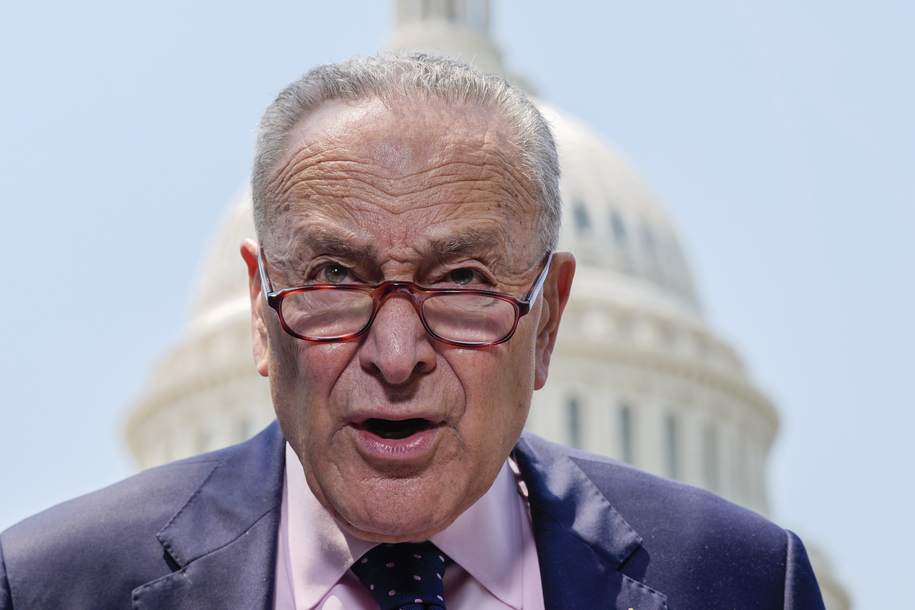
On Tuesday, Senate Republicans moved one step closer to cutting billions in congressionally appropriated funding Dear Leader Donald Trump dislikes, after Vice President JD Vance broke a tie to advance a recissions package that defunds NPR and PBS, and cuts billions in foreign aid. A recissions package is not subject to the filibuster, so Senate Republicans only need a simple majority for it to pass. Three Republicans—Sens. Susan Collins of Maine, Lisa Murkowski of Alaska, and Mitch McConnell of Kentucky—voted against moving the package to debate, requiring Vance to break the tie. Passing this recissions package—which would make permanent some of the cuts former co-President Elon Musk tried to make through his incompetent and destructive Department of Government Efficiency—is problematic for multiple reasons. First and foremost, it would be damaging for rural Americans who both rely on publicly funded PBS and NPR stations for weather warnings and more, and also receive billions in foreign aid money growing crops that are distributed to poor countries across the globe. “For Republicans to turn around and slash local news and public radio in the name of fiscal responsibility is a vindictive swipe at rural America, where these stations are needed so badly. It’ll leave rural communities twisting in the wind,” Senate Minority Leader Chuck Schumer said in a statement Monday night after Vance’s tie-breaking vote. It would also be damaging for Congress’ ability to pass future government funding bills down the road. It shows the Democratic senators—who voted for the government spending bill—that any deals they make in future government funding negotiations are just smoke and mirrors if Republicans will turn around and strip that funding away through the recissions process. Sen. Chris Murphy (D-CT) called the recissions package a “dirty trick” by Republicans. Sen. Chris Murphy calls the package a “dirty trick.” “What they’re doing is cutting out of the budget all the things that DOGE targeted. With this recissions bill they are going after all the foreign aid funding that DOGE hates, and they’re going after PBS and the Corporation for Public Broadcasting. They’re literally going to take Sesame Street off the air,” Murphy said in a video posted on X. “Why would Democrats ever again negotiate a bipartisan budget with Republicans if Republicans two months later can just pass a partisan bill that keeps the spending that Republicans like and cuts the spending that Democrats supported in the bipartisan process? So this isn’t just really bad policy, this is just another way that Republicans are corroding the rule of law, the institutional norms that have held together our democracy for decades.” And Schumer warned that this is just the start for Republicans, who could come after other critical funding in future recissions packages. “Let me be clear, this is not just about foreign assistance, important as that is. This is the playbook that Republicans will use across the board,” Schumer said. “They will do it with healthcare. They will do it with the Department of Education. They will do it with our schools, our veterans, our housing. They will do it to research dollars. I’ve heard of more great research projects that could have saved lives now on hold, that can never be brought back again, because of the greed of the billionaires and the obeisance of Republicans to go along.” Meanwhile, even Senate Republicans who voted to advance the recissions package to debate say it’s problematic, saying that the Trump administration has not given enough information about the exact programs that would be cut. “When George W. Bush proposed Rescissions back in 1992, he listed specific programs that would receive specific amounts of cuts. And it was a rather thick proposal. But members on both sides of the aisle in both houses … had exact information about what programs would be targeted and where the cuts would be made and by what amount. That is not present in the proposal before us tonight. And that troubles me,” Sen. Roger Wicker (R-MS) told Fox News’ Chad Pergram, even though Wicker voted to advance the legislation to debate. But since defying Dear Leader is out of the question for the cultists in the GOP, they are speeding this latest crap sandwich legislation toward passage. God helps us all.
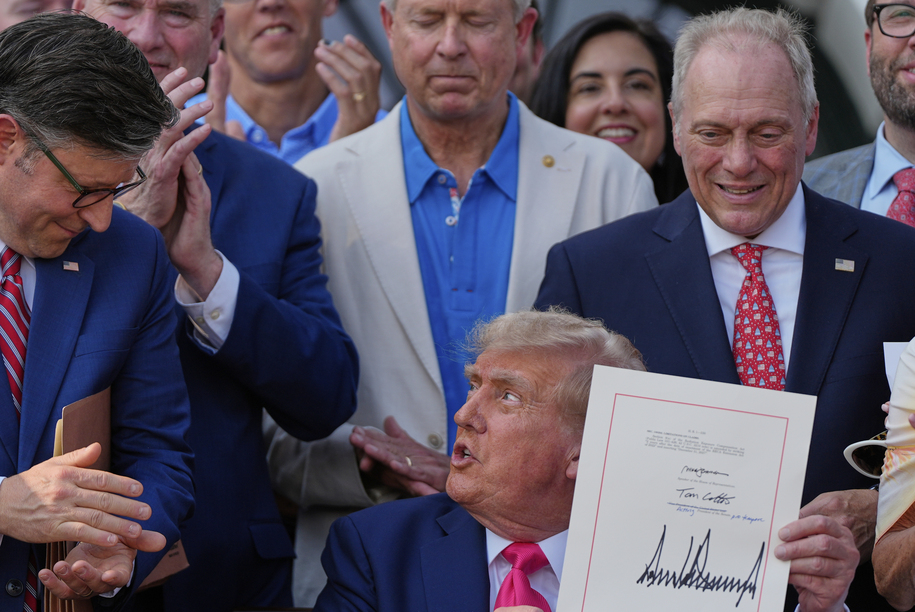
President Donald Trump’s budget is gutting Medicaid—and rural America is on the front lines of the damage. And big shocker: Most of Trump’s fervent supporters refuse to accept reality. A health clinic in McCook, Nebraska, which has a population of 7,446, recently made national headlines after announcing that it’s shutting its doors, unable to survive the massive GOP Medicaid cuts. “Anyone who’s saying that Medicaid cuts is why they’re closing is a liar,” a resident of nearby Curtis, which has a population of 806, told the Washington Post. Another resident brushed it off as people just “trying to blame everything on Trump,” calling it “horse feathers.” Must be a Nebraska thing. And the town’s mayor, who proudly displays an Obama punching bag labeled “Obama stress reliever” on his desk, insisted, “I don’t think the signing of the ‘Big Beautiful Bill’ had one thing to do with the closure of this clinic.” Okay then. Datawrapper Content For years, Trump and the Republican Party have sold rural white voters a story: that the real problem with government isn’t that it fails people like them—it’s that it helps the wrong people. Benefits aren’t going to “deserving” Americans like them but to immigrants, big cities, Black and brown people, and coastal elites. It’s a lie, but a potent one. And it still works. Right-wing message boards are full of people claiming that the only health care being cut is for “illegals” or freeloaders. So when the cuts hit them instead—the “hard-working, God-fearing patriots”—they short circuit. The media must be lying. There has to be another explanation. It can’t be Trump. And, yes, most of those voters are gone. We’re not getting them back. Their political identity is built around the idea that Trump is their champion, even when it’s crystal clear that he’s the one twisting the knife. But not all of them are unreachable. A disabled protester holds a sign that reads, “Medicaid = life 4 disabled,” at the U.S. Capitol. Take Brenda Wheeler, a 61-year-old Republican from Curtis. She voted for Trump in 2016 but then soured on him and sat out of the 2024 election. When the clinic closure hit home, she told the Post, “I’m not in agreement with this bill.” “When we talked about making America great again, I don’t think this is what we all had in mind,” said Wheeler, who is even considering switching her voter registration to independent. People like her are the opening. Not all of them will defect. In fact, most won’t. But we don’t need most. If just 5-10% of Republicans peel off—or if a few million nonvoters finally show up—the math shifts toward Democrats. Our fragile 49-48 Democratic national edge becomes a robust 55-45 majority. That’s not just a win; it’s a buffer. It’s how we build a durable progressive coalition that can weather any right-wing wave. We’re not going to deprogram the cult, but we don’t have to. What we can do is reach the people asking why their mom’s Medicaid got slashed, why their insulin suddenly costs more, or why their town’s only clinic just shuttered. That’s the silver lining of our current dystopian nightmare: there’s no one else to blame. Republicans control everything. They own it. The first step is making that reality stick. The second is flipping at least one congressional chamber in 2026 to stop Trump’s agenda and launch real investigations into the corruption unfolding. And the third is offering something better—visible, tangible, immediate help that voters can actually feel. Or, as I’ve been arguing, cut out the buzzwords and promise to directly and immediately make voters’ lives better. That’s how we win not just in 2026, but for the long haul.

The president’s vilification of political opponents and journalists seeds the ground for threats of prosecution, imprisonment and deportation unlike any modern president has made.

While advancing a bill to claw back $9bn in federal spending, lawmakers spare the Pepfar programme from cuts.

Police in India arrest a man they say was driving the car that hit Fauja Singh in his village on Monday.

The hip-hop star’s killing has been linked to a local gangland conflict.

More than a quarter of large American businesses are considering relocating, survey finds