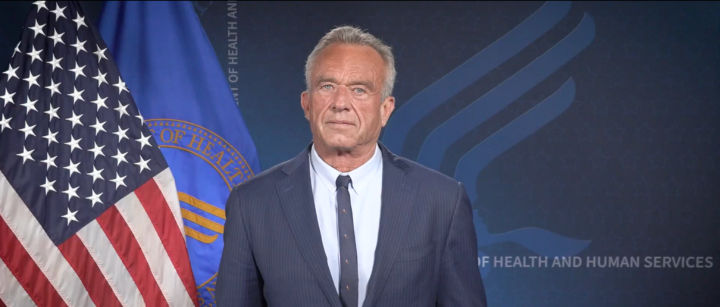
In justifying the government’s termination of $500 million in funding for mRNA vaccine projects, Health and Human Services Secretary Robert F. Kennedy Jr. falsely claimed mRNA vaccines “fail to protect effectively” against COVID-19 and suggested they are unsafe. The mRNA shots saved millions of lives during the COVID-19 pandemic and have shown promise against influenza. The projects had been funded by HHS’ Biomedical Advanced Research and Development Authority, which is tasked with preparing the U.S. for public health emergencies such as pandemics. HHS announced that BARDA also would not be funding any new vaccine projects that use mRNA technology. “We reviewed the science, listened to the experts, and acted. BARDA is terminating 22 mRNA vaccine development investments because the data show these vaccines fail to protect effectively against upper respiratory infections like COVID and flu,” Kennedy said in an Aug. 5 press release. “We’re shifting that funding toward safer, broader vaccine platforms that remain effective even as viruses mutate.” It is unclear which studies or experts Kennedy is citing, but his claims are contradicted by the peer-reviewed scientific literature and are counter to many experts. The mRNA COVID-19 vaccines have been used widely around the world, and studies have repeatedly demonstrated their effectiveness and safety. Moreover, the mRNA vaccines, which can easily be updated to target new virus variants, have continued to provide protection even as the virus mutates. Kennedy’s claim about the ineffectiveness of mRNA vaccines is “simply not true,” Michael Osterholm, director of the Center for Infectious Disease Research and Policy at the University of Minnesota, told us. “We have ample data showing major reductions in serious illness, hospitalizations and deaths even after the virus variants have changed some,” he said. Dr. Peter Hotez, co-director of the Center for Vaccine Development at Texas Children’s Hospital and dean of the National School of Tropical Medicine at Baylor College of Medicine, told us the HHS announcement is “an exercise in disinformation.” Contrary to Kennedy’s claims, the mRNA COVID-19 vaccines “perform extremely well,” Hotez said, referring to the Pfizer/BioNTech and Moderna vaccines. Influenza vaccines using mRNA technology also are in development and have shown promise both against seasonal flu and viruses that could cause a pandemic. BARDA had in May canceled $766 million in funding to Moderna for development of mRNA vaccines against bird flu. Kennedy suggested BARDA would instead invest in “safer” technologies, but mRNA vaccines against COVID-19 have been tested extensively, and serious side effects are very rare. Experts warned that the decision could leave the U.S. without a way to get an adequate supply of vaccines quickly in the event of a pandemic. A major strength of mRNA vaccines is the speed with which they can be produced. “In my 50 years in public health and dealing with a number of very challenging public health problems, I’ve never seen a more misguided and even dangerous decision,” Osterholm said. Dr. Drew Weissman, director of the Institute for RNA Innovation at the University of Pennsylvania, told us in a phone interview that this decision by HHS was “crippling our science for decades to come.” Weissman and Katalin Karikó won the 2023 Nobel Prize in medicine for their discoveries in 2005 that facilitated the development of mRNA COVID-19 vaccines. While HHS’ decision applies to vaccines for respiratory viruses, Weissman sees a larger impact. The technology “has enormous potential,” he said, explaining that government funding is what most researchers use to begin their work — and now the Trump administration is “killing the technology in the United States.” The rest of the world will “very soon, pull way ahead of us” in developing mRNA therapeutics. “We’re going to lose all of our young scientists who are going to go overseas to do this work.” When asked about Kennedy’s decision on Aug. 6, President Donald Trump touted Operation Warp Speed, the federal government’s effort — launched by Trump’s first administration — to support the development of COVID-19 vaccines and quickly deliver them to the public. It was “considered one of the most incredible things ever done in this country,” he said. But, he added, “that was now a long time ago and we’re on to other things, but we are speaking about it,” saying he had a meeting the following day about the issue. We reached out to HHS with various questions, including asking for support for Kennedy’s scientific claims and for more detail on the vaccine platforms HHS will now invest in, but we did not receive a response. Data Demonstrate mRNA COVID-19 Vaccine Effectiveness There have been many studies showing that the mRNA COVID-19 vaccines are effective in preventing symptomatic disease, particularly in preventing severe disease – even as new variants of the virus have emerged. “The goal is to keep you out of the hospital, keep you out of the intensive care unit and keep you out of the morgue, and this vaccine performs very well in that regard,” Dr. Paul Offit, director of the Vaccine Education Center at Children’s Hospital of Philadelphia, told us. One study, led by researchers at the Yale School of Public Health, estimated that COVID-19 vaccines prevented more than 3 million deaths in the U.S. in the first two years alone. The vast majority of Americans received mRNA vaccines. The clinical trials for both the Moderna and Pfizer/BioNTech mRNA vaccines showed that two doses were more than 90% effective in preventing symptomatic and severe COVID-19. Protection against infection and mild disease waned over time and with the emergence of new variants, but many studies continued to show the vaccines, which have been updated every year to better target new variants, worked well in preventing severe disease and death. One Centers for Disease Control and Prevention study, published in March 2022, found a 90% risk reduction for invasive mechanical ventilation or death due to COVID-19 for people who received two or three mRNA doses, compared with those who had not gotten any doses. As time has passed, more people in the population have built immunity to COVID-19 through some