Author name: moderat ereport

Politics

A million veterans gave DNA to aid health research. Scientists worry the data will be wasted.

By Darius Tahir for KFF Health News One of the world’s biggest genetic databases comprises DNA data donated over the years by more than a million retired military service members. It’s part of a project run by the Department of Veterans Affairs. The initiative, dubbed the Million Veteran Program, is a “crown jewel of the country,” said David Shulkin, a physician who served as VA secretary during the first Trump administration. Data from the project has contributed to research on the genetics of anxiety and peripheral artery disease, for instance, and has resulted in hundreds of published papers. Researchers say the repository has the potential to help answer health questions not only specific to veterans — like who is most vulnerable to post-service mental health issues, or why they seem more prone to cancer — but also relevant to the nation as a whole. “When the VA does research, it helps veterans, but it helps all Americans,” Shulkin said in an interview.   Researchers now say they fear the program is in limbo, jeopardizing the years of work it took to gather the veterans’ genetic data and other information, like surveys and blood samples. “There’s sort of this cone of silence,” said Amy Justice, a Yale epidemiologist with a VA appointment as a staff physician. “We’ve got to make sure this survives.” Genetic data is enormously complex, and analyzing it requires vast computing power that VA doesn’t possess. Instead, it has relied on a partnership with the Energy Department, which provides its supercomputers for research purposes. In late April, VA Secretary Doug Collins disclosed to Sen. Richard Blumenthal, the top Democrat on the Senate Veterans’ Affairs Committee, that agreements authorizing use of the computers for the genomics project remained unsigned, with some expiring in September, according to materials shared with KFF Health News by congressional Democrats. Secretary of Veterans Affairs Doug Collins testifies at a Senate subcommittee hearing on June 24. Spokespeople for the two agencies did not reply to multiple requests for comment. Other current and former employees within the agencies — who asked not to be identified, for fear of reprisal from the Trump administration — said they don’t know whether the critical agreements will be renewed. One researcher called computing “a key ingredient” to major advances in health research, such as the discovery of new drugs. The agreement with the Energy Department “should be extended for the next 10 years,” the researcher said. The uncertainty has caused “incremental” damage, Justice said, pointing to some Million Veteran Program grants that have lapsed. As the year progresses, she predicted, “people are going to be feeling it a lot.” Related | Veterans Affairs chief looks to slash agency—even if veterans suffer Because of their military experience, maintaining veterans’ health poses different challenges compared with caring for civilians. The program’s examinations of genetic and clinical data allow researchers to investigate questions that have bedeviled veterans for years. As examples, Shulkin cited “how we might be able to better diagnose earlier and start thinking about effective treatments for these toxic exposures” — such as to burn pits used to dispose of trash at military outposts overseas — as well as predispositions to post-traumatic stress disorder. “The rest of the research community isn’t likely to focus specifically” on veterans, he said. The VA community, however, has delivered discoveries of importance to the world: Three VA researchers have won Nobel Prizes, and the agency created the first pacemaker. Its efforts also helped ignite the boom in GLP-1 weight loss drugs. Yet turbulence has been felt throughout VA’s research enterprise. Like other government scientific agencies, it’s been buffeted by layoffs, contract cuts, and canceled research. “There are planned trials that have not started, there are ongoing trials that have been stopped, and there are trials that have fallen apart due to staff layoffs — yes or no?” said Sen. Patty Murray (D-Wash.), pressing Collins in a May hearing of the Senate Veterans’ Affairs Committee. The agency, which has a budget of roughly $1 billion for its research arm this fiscal year, has slashed infrastructure that supports scientific inquiry, according to documents shared with KFF Health News by Senate Democrats on the Veterans’ Affairs Committee. It has canceled at least 37 research-related contracts, including for genomic sequencing and for library and biostatistics services. The department has separately canceled four contracts for cancer registries for veterans, creating potential gaps in the nation’s statistics. Job worries also consume many scientists at the VA. According to agency estimates in May, about 4,000 of its workers are on term limits, with contracts that expire after certain periods. Many of these individuals worked not only for the VA’s research groups but also with clinical teams or local medical centers. When the new leaders first entered the agency, they instituted a hiring freeze, current and former VA researchers told KFF Health News. That prevented the agency’s research offices from renewing contracts for their scientists and support staff, which in previous years had frequently been a pro forma step. Some of those individuals who had been around for decades haven’t been rehired, one former researcher told KFF Health News. Related | Trump finds a ‘heartless and dangerous’ new way to screw over veterans The freeze and the uncertainty around it led to people simply departing the agency, a current VA researcher said. The losses, the individual said, include some people who “had years of experience and expertise that can’t be replaced.” Preserving jobs — or some jobs — has been a congressional focus. In May, after inquiries from Sen. Jerry Moran, the Republican who chairs the Veterans’ Affairs Committee, about staffing for agency research and the Million Veteran Program, Collins wrote in a letter that he was extending the terms of research employees for 90 days and developing exemptions to the hiring freeze for the genomics project and other research initiatives. Related | Now VA doctors can refuse to treat unmarried veterans and Democrats Holding jobs is one thing — doing them is another. In June,


Politics

How much will the Epstein saga hurt Trump?

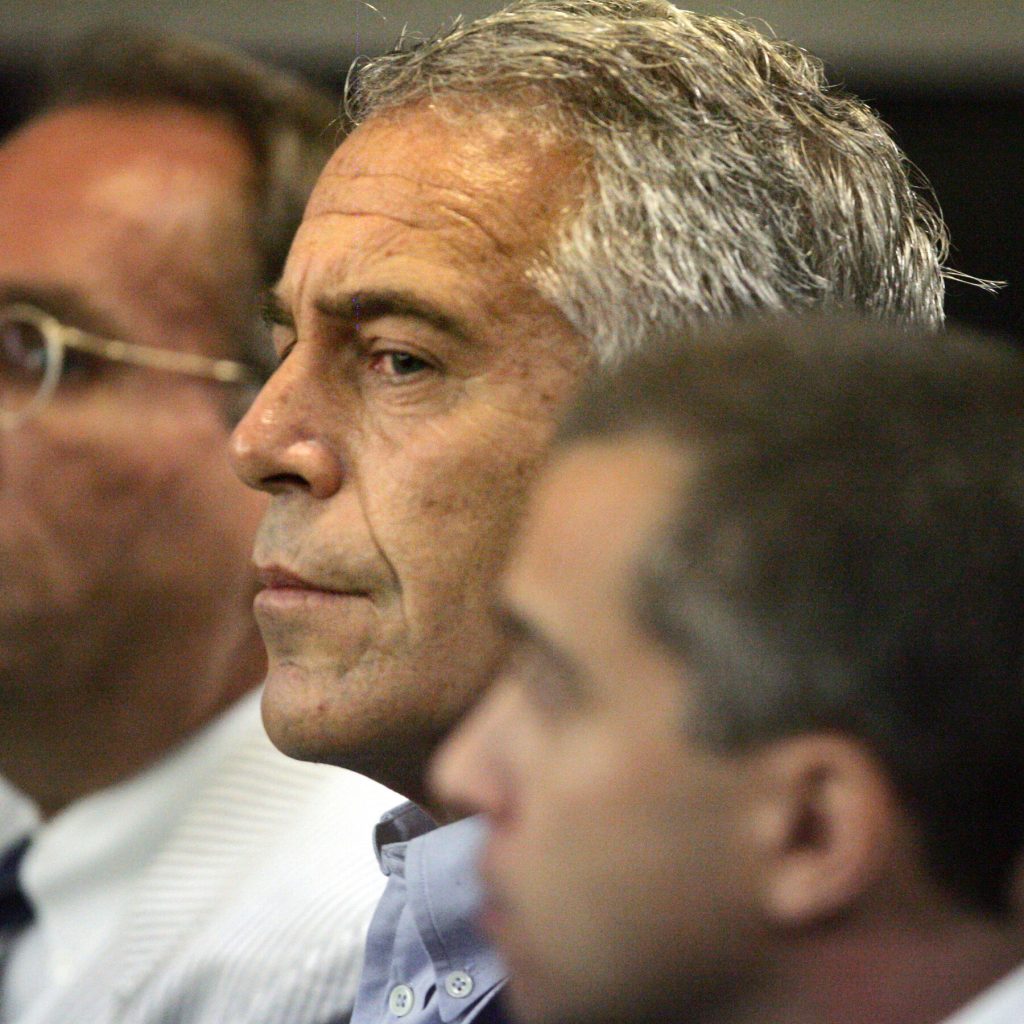
Survey Says is a weekly series rounding up the most important polling trends or data points you need to know about, plus a vibe check on a trend that’s driving politics. It was a bombshell statement from Attorney General Pam Bondi. In early May, she told reporters the FBI was reviewing “tens of thousands of videos” of convicted sex offender Jeffrey Epstein “with children or child porn.” The comment ignited a firestorm. For years, Trump-aligned conspiracy theorists believed he held the key to exposing Epstein’s alleged sex-trafficking network and long-rumored “client list,” which Trump promised to release if he won last year’s election. And Bondi’s remarks raised expectations that damning new evidence was imminent. Attorney General Pam Bondi speaks to the media on June 27 in the briefing room of the White House. But now she is walking it all back. The Justice Department, which she leads, released a memo saying there was no client list, which she publicly claimed in February to have “sitting on my desk right now to review.” And just as suddenly, Trump told his supporters to stop talking about Epstein altogether, calling the issue “a hoax.” That abrupt pivot stunned many MAGA loyalists who had built entire narratives around Trump being the one to blow the Epstein case wide open. Now Trump is trying to recalibrate. While he’s not recommending a special prosecutor in the Epstein case, he reluctantly encouraged Bondi on Wednesday to release any “credible” information regarding it. It’s unclear whether that olive branch will satisfy his base or pour fuel on the fire, though. Even some GOP lawmakers, like House Speaker Mike Johnson, are signaling they want more transparency. And new polling indicates the public feels the same. A CNN/SSRS survey, conducted July 10-13, finds that only 3% of Americans are satisfied with the information released about the Epstein case. Fifty percent are dissatisfied, including 56% of Democrats and 40% of Republicans. Datawrapper Content The dissatisfaction is strongest at the ideological extremes. The poll shows that very conservative Republicans and more liberal Democrats are the most unhappy with the lack of information. Among Republicans, 48% of the very conservative group are dissatisfied, compared with 40% of those who are only somewhat conservative. On the Democratic side, 70% of liberals want more information, compared with 52% of moderates and conservative Democrats.  A separate survey by The Economist/YouGov, conducted July 11-14, finds similar frustrations. Nearly 4 in 5 Americans want the government to release all Epstein-related documents, including 85% of Democrats and 75% of Republicans. Quinnipiac University’s new poll shows that just 17% of voters approve of how the Trump administration is handling the Epstein files, while 63% disapprove. And Republicans are nearly split on the issue. Datawrapper Content This narrative isn’t just background noise, though. It shows a deeper breakdown in how Americans are viewing the Epstein scandal. Both Republicans and Democrats are upset, but the political fallout may run deeper on the right. Trump told his base to move on. Some are listening—but others aren’t. YouGov data reveals that Republicans’ confidence in the Epstein investigation has plummeted since January—a surprising change given that Trump’s administration now oversees it. In early January, 36% of Republicans believed that “all people connected with Jeffrey Epstein who are alleged to have committed sex crimes will be thoroughly investigated,” per the poll’s wording. But as of early July, that number is now just 19%. A right-wing influencer holds up a binder with a cover titled “The Epstein Files: Phase 1” at the White House on Feb. 27. However, nearly none of the information contained therein was new. “Top Trump officials have spent years promoting baseless conspiracy theories about Epstein, and now that they’re in charge, the pressure is on for them to produce,” said Matthew Dallek, a history professor at George Washington University who focuses on the conservative movement. “Trump was supposed to come in and expose [Epstein], and I think the bill is coming due for that savior narrative. They have to deliver on that promise.” YouGov’s data also shows that Democrats’ confidence in the investigation dropped from 41% in January to 16% in July. But Dallek believes Democratic frustration may be more political than principled. If Democratic voters want more information, it’s often because they suspect Trump could be implicated. A July 9 poll from YouGov finds that 69% of Democrats believe Trump was involved in Epstein’s alleged crimes. Just 7% of Republicans hold the same view. This partisan gap gives Democrats a strategic opportunity.  “The fact that Democrats are making an issue of it could suggest they want to fan the flames and exploit the rift within MAGA, so it’s pretty opportunistic,” Dallek said. “But just because it’s shameless doesn’t mean it will fail. It could be shameless and effective at the same time.” This appears to be happening. Axios recently reported that House Minority Leader Hakeem Jeffries surprised some colleagues by fully supporting efforts to exploit GOP divisions over Epstein. And Democrats have proposed measures to force the DOJ to release documents, but Republicans have blocked them. There has long been high public interest in the case. In July 2019, after Epstein’s arrest on charges of child sex trafficking but before his death, The Economist/YouGov found that 37% of adults had heard “a lot” about the case.  Jeffrey Epstein appears in court in West Palm Beach, Florida, in July 2008. In January 2024, YouGov found that 37% believed Epstein was murdered, compared with 20% who thought he died by suicide, which is Epstein’s official cause of death. And these numbers have shifted only slightly since then: As of this month, 39% think Epstein was murdered, and 20% believe he took his own life. While many issues could hurt Republicans heading into the 2026 midterm elections, it’s unclear whether Epstein will be one. Dallek warned that even if some MAGA voters become disillusioned with Trump’s failure to “deliver” on Epstein, it might not outweigh concerns over inflation or immigration. “People have been saying Trump

Politics

Beto O’Rourke Tells Democrats To Be Absolutely Ruthless In Winning Back Power

PoliticusUSA is news that you can rely on, but we need your support. Please consider supporting us by becoming a subscriber. Subscribe now Democrats have long been held back by their desire to be right or to do the right thing, while Republicans are obsessed with gaining and keeping power. It could be argued that the Biden presidency is the most recent example of Democrats attempting to do the right thing through governance while overlooking the politics necessary to maintain power. However, without power, policies can’t be enacted. As the nation is currently witnessing, Democrats can’t protect and enhance democracy or do things that help people without power. The need to get back into power ahead of anything else was something that Beto O’Rourke discussed on CNN. Video: While talking about the proposed Republican gerrymander of Texas, O’Rourke said: Governor Gavin Newsom in California has talked about a redistricting in his state. I think it’s time that we match fire with fire. I think Democrats in the past too often have been more concerned with being right than being in power. Read more

Economic News

“Groceries” under Trump

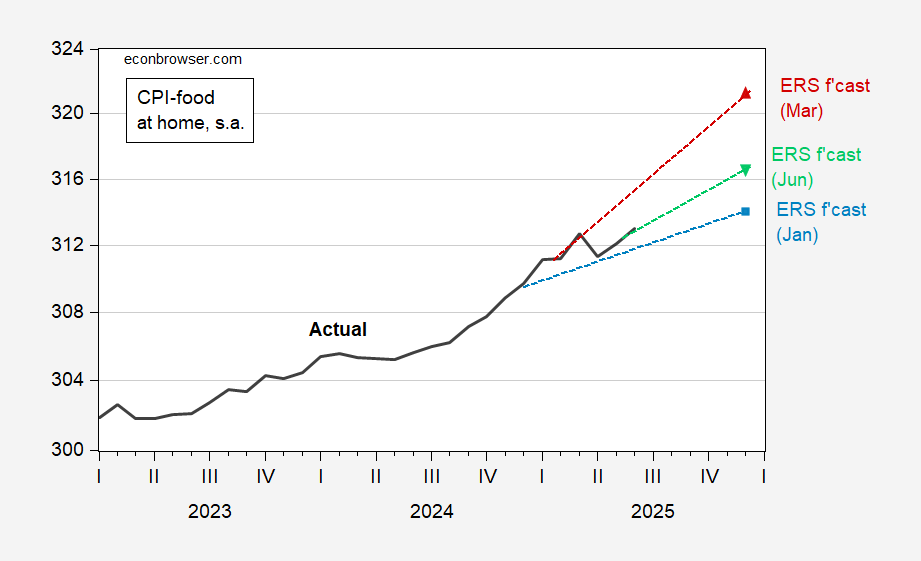
ERS predicts 2.2% increase in food-at-home prices in 2025. Figure 1: CPI food-at-home (black); ERS forecast of January (light blue square), ERS forecast of March (red triangle), ERS forecast of June (inverted green triangle). Source: BLS via FRED, ERS, and author’s calculations. While food-at-home inflation has decreased, it still remains the fact that grocery prices are rising — not falling. Further PPI-food manufacturing continues to rise, so we can be reasonably confidence of continued grocery price increases.    

Scroll to Top