
Pop goes the deficit: The warning signs are all there
On the current path, U.S. debt should grow by $22 trillion over the next decade.


On the current path, U.S. debt should grow by $22 trillion over the next decade.
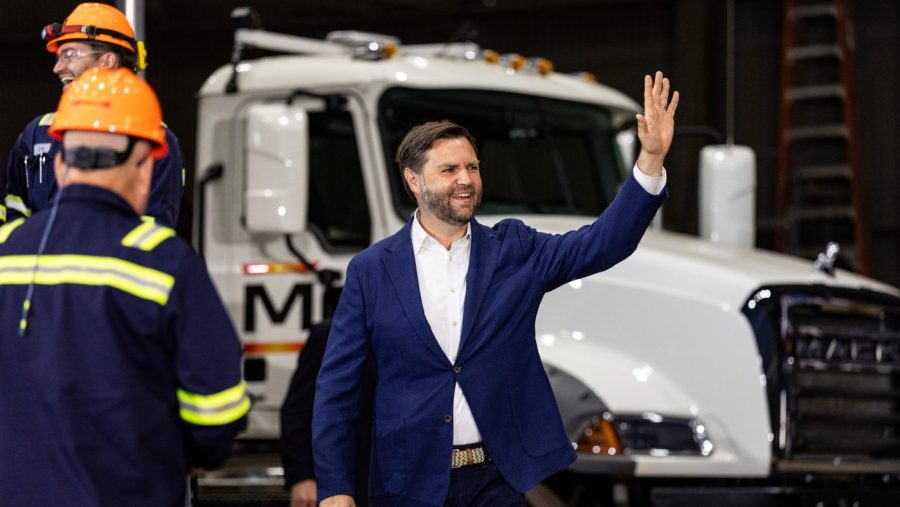
Vice President Vance slammed Rep. Emilia Sykes (D-Ohio) during a stop in her district on Monday touting President Trump’s legislative agenda. “You know who we do not have in the house right now? We do not have Congresswoman Emilia Sykes,” Vance said, speaking in Canton, Ohio. “You know why she’s not here today? Because she’s…

The true cost of this plane won’t be measured in dollars alone. It’ll be measured in what we neglect to fund instead.
by Aliyya Swaby ProPublica is a nonprofit newsroom that investigates abuses of power. Sign up for Dispatches, a newsletter that spotlights wrongdoing around the country, to receive our stories in your inbox every week. One afternoon in mid-September, a group of middle school girls in rural East Tennessee decided to film a TikTok video while waiting to begin cheerleading practice. In the 45-second video posted later that day, one girl enters the classroom holding a cellphone. “Put your hands up,” she says, while a classmate flickers the lights on and off. As the camera pans across the classroom, several girls dramatically fall back on a desk or the floor and lie motionless, pretending they were killed. When another student enters and surveys the bodies on the ground in poorly feigned shock, few manage to suppress their giggles. Throughout the video, which ProPublica obtained, a line of text reads: “To be continued……” Penny Jackson’s 11-year-old granddaughter was one of the South Greene Middle School cheerleaders who played dead. She said the co-captains told her what to do and she did it, unaware of how it would be used. The next day, she was horrified when the police came to school to question her and her teammates. By the end of the day, the Greene County Sheriff’s Department charged her and 15 other middle school cheerleaders with disorderly conduct for making and posting the video. Standing outside the school’s brick facade, Lt. Teddy Lawing said in a press conference that the girls had to be “held accountable through the court system” to show that “this type of activity is not warranted.” The sheriff’s office did not respond to ProPublica’s questions about the incident. Widespread fear of school shootings is colliding with algorithms that accelerate the spread of the most outrageous messages to cause chaos across the country. Social videos, memes and retweets are becoming fodder for criminal charges in an era of heightened responses to student threats. Authorities say harsh punishment is crucial to deter students from making threatening posts that multiply rapidly and obscure their original source. In many cases, especially in Tennessee, police are charging students for jokes and misinterpretations, drawing criticism from families and school violence prevention experts who believe a measured approach is more appropriate. Students are learning the hard way that they can’t control where their social media messages travel. In central Tennessee last fall, a 16-year-old privately shared a video he created using artificial intelligence, and a friend forwarded it to others on Snapchat. The 16-year-old was expelled and charged with threatening mass violence, even though his school acknowledged the video was intended as a private joke. Other students have been charged with felonies for resharing posts they didn’t create. As ProPublica wrote in May, a 12-year-old in Nashville was arrested and expelled this year for sharing a screenshot of threatening texts on Instagram. He told school officials he was attempting to warn others and wanted to “feel heroic.” In Greene County, the cheerleaders’ video sent waves through the small rural community, especially since it was posted several days after the fatal Apalachee High School shooting one state away. The Georgia incident had spawned thousands of false threats looping through social media feeds across the country. Lawing told ProPublica and WPLN at the time that his officers had fielded about a dozen social media threats within a week and struggled to investigate them. “We couldn’t really track back to any particular person,” he said. But the cheerleaders’ video, with their faces clearly visible, was easy to trace. Jackson understands that the video was in “very poor taste,” but she believes the police overreacted and traumatized her granddaughter in the process. “I think they blew it completely out of the water,” she said. “To me, it wasn’t serious enough to do that, to go to court.” That perspective is shared by Makenzie Perkins, the threat assessment supervisor of Collierville Schools, outside of Memphis. She is helping her school district chart a different path in managing alleged social media threats. Perkins has sought specific training on how to sort out credible threats online from thoughtless reposts, allowing her to focus on students who pose real danger instead of punishing everyone. The charges in Greene County, she said, did not serve a real purpose and indicate a lack of understanding about how to handle these incidents. “You’re never going to suspend, expel or charge your way out of targeted mass violence,” she said. “Did those charges make that school safer? No.” When 16-year-old D.C. saw an advertisement for an AI video app last October, he eagerly downloaded it and began roasting his friends. In one video he created, his friend stood in the Lincoln County High School cafeteria, his mouth and eyes moving unnaturally as he threatened to shoot up the school and bring a bomb in his backpack. (We are using D.C.’s initials and his dad’s middle name to protect their privacy, because D.C. is a minor.) D.C. sent it to a private Snapchat group of about 10 friends, hoping they would find it hilarious. After all, they had all teased this friend about his dark clothes and quiet nature. But the friend did not think it was funny. That evening, D.C. showed the video to his dad, Alan, who immediately made him delete it as well as the app. “I explained how it could be misinterpreted, how inappropriate it was in today’s climate,” Alan recalled to ProPublica. It was too late. One student in the chat had already copied D.C.’s video and sent it to other students on Snapchat, where it began to spread, severed from its initial context. That evening, a parent reported the video to school officials, who called in local police to do an investigation. D.C. begged his dad to take him to the police station that night, worried the friend in the video would get in trouble — but Alan thought it could wait until morning. The next day, D.C. rushed to
by ProPublica ProPublica is a nonprofit newsroom that investigates abuses of power. Sign up to receive our biggest stories as soon as they’re published. The continents are rapidly drying out and the earth’s vast freshwater resources are under threat, according to a recently released study based on more than 20 years of NASA satellite data. Here are the report’s key findings and what they portend for humankind: Much of the Earth is suffering a pandemic of “continental drying,” affecting the countries containing 75% of the world’s population, the new research shows. The study, published in the journal Science Advances, examined changes to Earth’s total supply of fresh water and found that nearly 6 billion people live in the 101 countries facing a net decline in water supply, posing a “critical, emerging threat to humanity.” Mining of underground freshwater aquifers is driving much of the loss. According to the study, the uninhibited pumping of groundwater by farmers, cities and corporations around the world now accounts for 68% of the total loss of fresh water at the latitudes where most people live. Much of the water taken from aquifers ends up in the oceans, contributing to the rise of sea levels. Mined groundwater rarely seeps back into the aquifers from which it was pumped. Rather, a large portion runs off into streams, then rivers and ultimately the oceans. According to the researchers, moisture lost to evaporation and drought, plus runoff from pumped groundwater, now outpaces the melting of glaciers and the ice sheets of either Antarctica or Greenland as the largest contributor of water to the oceans. Water From Land Has Become a Leading Driver of Sea Level Rise Most of the water lost from drying regions is from groundwater pumping, which ultimately shifts fresh water from aquifers into the oceans. Note: Glaciers refer to the parts of the continents covered in glaciers but excludes the ice sheets of Greenland and Antarctica. Drying land and aquifers refer to the water lost by the continents in areas not covered by glaciers, including river flow and evaporation. Groundwater loss accounts for 68% of the drying in those places. As droughts grow more extreme, farmers increasingly turn to groundwater. Worldwide, 70% of fresh water is used for growing crops, with more of it coming from groundwater as droughts grow more extreme. Only a small amount of that water seeps back into aquifers. Research has long established that people take more water from underground when climate-driven heat and drought are at their worst. Drying regions of the planet are merging. The parts of the world drying most acutely are becoming interconnected, forming what the study’s authors describe as “mega” regions. One such region covers almost the whole of Europe, the Middle East, North Africa and parts of Asia. Drying of the Earth has accelerated in recent years. The study examines 22 years of observational data from NASA’s Gravity Recovery and Climate Experiment, or GRACE, satellites, which measure changes in the mass of the earth and have been applied to estimate its water content. Since 2002, the sensors have detected a rapid shift in water loss across the planet. Around 2014, the study found the pace of drying appears to have accelerated. It is now growing by an area twice the size of California each year. The Drying of the Earth Accelerated in Recent Years The dramatic depletion of groundwater and surface water plus the melting of glaciers between 2014-24 has connected once-separate arid places, forming “mega-drying” regions that stretch across whole continents. Watch video ➜ Note: Data is for February 2003 to December 2013 and January 2014 to April 2024. The first time period contains seven more months of data than the second. Water pumped from aquifers is not easily replaced, if it can be at all. Major groundwater basins underlie roughly one-third of the planet, including about half of Africa, Europe and South America. Many of those aquifers took millions of years to form and might take thousands of years to refill. The researchers warn that it is now nearly impossible to reverse the loss of water “on human timescales.” As continents dry and coastal areas flood, the risk for conflict and instability increases. The accelerated drying, combined with the flooding of coastal cities and food-producing lowlands, heralds “potentially staggering” and cascading risks for global order, the researchers warn. Their findings all point to the likelihood of widespread famine, the migration of large numbers of people seeking a more stable environment and the carry-on impact of geopolitical disorder. Data Source: Hrishikesh. A. Chandanpurkar, James S. Famiglietti, Kaushik Gopalan, David N. Wiese, Yoshihide Wada, Kaoru Kakinuma, John T. Reager, Fan Zhang (2025). Unprecedented Continental Drying, Shrinking Freshwater Availability, and Increasing Land Contributions to Sea Level Rise. Science Advances. https://www.science.org/doi/10.1126/sciadv.adx0298 Graphics by Lucas Waldron

President Trump and the president of the European Commission, Ursula von der Leyen, unveiled a trade deal over the weekend, with tariffs set at 15 percent for European goods. The European Union is also set to buy $750 billion in American energy in the deal, Trump announced, and agreed to invest an additional $600 billion…
by Patricia Callahan ProPublica is a nonprofit newsroom that investigates abuses of power. Sign up to receive our biggest stories as soon as they’re published. The Food and Drug Administration is cracking down on a generic drugmaker that was the subject of a ProPublica investigation last year, citing problems with safety tests that delayed the recall of a medicine linked to deaths in the U.S. In December, ProPublica reported that a Glenmark Pharmaceuticals factory in central India was responsible for an outsized share of recalls for pills that didn’t dissolve properly and could harm American patients. Among the string of recalls, federal regulators had determined that more than 50 million potassium chloride extended-release capsules sold in the U.S. could be deadly. Yet, federal drug inspectors at that point hadn’t set foot in the Madhya Pradesh factory for more than four years, ProPublica found. Seven weeks after that story was published, FDA inspectors showed up at the plant and found serious problems. Glenmark subsequently recalled an additional two dozen medicines made there and sold to U.S. patients. Now the FDA has sent Glenmark a warning letter, a disciplinary tool the regulator uses to lay out significant violations of federal requirements and demand changes. If Glenmark fails to fix any of the problems outlined, the FDA warned, it may bar drugs made at the factory from entering the U.S. What’s more, the FDA pointed out that the company had made similar serious mistakes at three other manufacturing sites and acknowledged that those factories had been the subject of previous warning letters from the agency since 2019. The problems at one were so severe that federal regulators blocked drugs made there from being imported to Americans. ProPublica’s December investigation highlighted this pattern, noting that three of the five factories where Glenmark made drugs for the U.S. market in recent years had been in trouble with federal regulators. Despite that track record, the FDA — backlogged from the pandemic — waited five years before sending its inspectors back to the Madhya Pradesh plant. In his July 11 warning letter, the director of the FDA’s Office of Manufacturing Quality wrote, “These repeated failures at multiple sites demonstrate that management oversight and control over the manufacture of drugs is inadequate.” (The agency made the letter publiclast week.) “You should immediately and comprehensively assess your company’s global manufacturing operations to ensure that systems, processes, and the products manufactured conform to FDA requirements,” he added. A spokesperson for the company said in a written statement: “Glenmark is actively engaging with the U.S. FDA and has initiated corrective actions to address the agency’s observations. Patient safety, product quality and regulatory compliance are foundational to how we operate.” Citing ongoing litigation the company faces, she declined to comment further. ProPublica has been investigating the FDA’s oversight of foreign factories that make generic drugs for the U.S. market. Since last year, ProPublica repeatedly has asked the FDA why it didn’t send inspectors to the Glenmark factory sooner, given the outsized share of recalls and the company’s troubled track record at its other plants. The agency hasn’t answered the question. After the inspection found problems this year, an FDA spokesperson said the agency can only discuss potential or ongoing compliance matters with the company involved. Among the most serious violations outlined in the FDA letter to Glenmark was the company’s failure to promptly test pills to ensure they dissolve properly during their normal shelf life, the subject of ProPublica’s investigation last year. Companies hold on to samples of pills from batches sold to U.S. customers and test them periodically until they reach their expiration date. Medicines that don’t dissolve properly can cause perilous swings in dosing. This flaw is what made Glenmark’s potassium chloride pills potentially deadly since high potassium levels can stop the heart, according to the June 2024 recall notice. Glenmark’s backlogged testing “was overdue by 3 months or longer for a large proportion of your samples,” the FDA wrote in the warning letter. The failure to perform these tests on time held up Glenmark’s discovery of defective pills and delayed the needed recalls, the agency said. In multiple instances, the FDA found that it took 100 days from the time Glenmark pulled samples of potassium chloride for testing until the company learned the capsules had failed to dissolve correctly. A delay in that recall could factor into a lawsuit that alleges Glenmark’s potassium chloride pills were responsible for the death last year of Mary Louise Cormier, a 91-year-old Maine woman. A letter alerting Cormier that her pills had been recalled arrived three weeks after she died. In court filings, Glenmark has denied responsibility for her death. The company stopped making the drug for U.S. patients. Between July and December last year, Glenmark told the FDA that it had received reports of eight deaths in patients who took the recalled potassium chloride, federal records show. The reports, which companies must file so the FDA can monitor drug safety, contained so few details that ProPublica was unable to independently verify what happened in each case. In general, these adverse event reports reflect the opinions of those who filed them and don’t prove that the drug caused the harm, the FDA says. The agency didn’t mention these deaths in the warning letter. The FDA lambasted Glenmark for failing to thoroughly investigate why pills made at its Madhya Pradesh factory weren’t dissolving properly. The agency listed possible reasons that Glenmark failed to consider, but FDA censors redacted so many passages — citing the protection of trade secrets and confidential business information — that it’s impossible to discern what could have gone wrong. Citing the same confidentiality provision, the FDA kept secret the name of another Glenmark drug that the agency said failed these same tests. When asked why consumers shouldn’t be told which medication had the problem, the FDA didn’t answer. More broadly, the FDA’s warning letter criticized Glenmark for failing to validate the tests it relies on to prove that its
The Trump administration argues that with increased political violence, masks keep law enforcement officers safe. Others say they erode public trust.

Keenan Norris The administration knows that subduing history as it is doing works to keep people of color in this country disunited and at odds with each other. The post It Has Never Been Easy to Be Both Black and American appeared first on The Nation.

As always, if you find value in this work I do, please consider helping me keep it sustainable by joining my weekly newsletter, Sparky’s List! You can get it in your inbox or read it on Patreon, the content is the same. Don’t forget to visit the Tom Tomorrow Merchandise Mall, and, if you’re so inclined, follow me on Bluesky! Related | Guess who’s reportedly named in the Epstein files