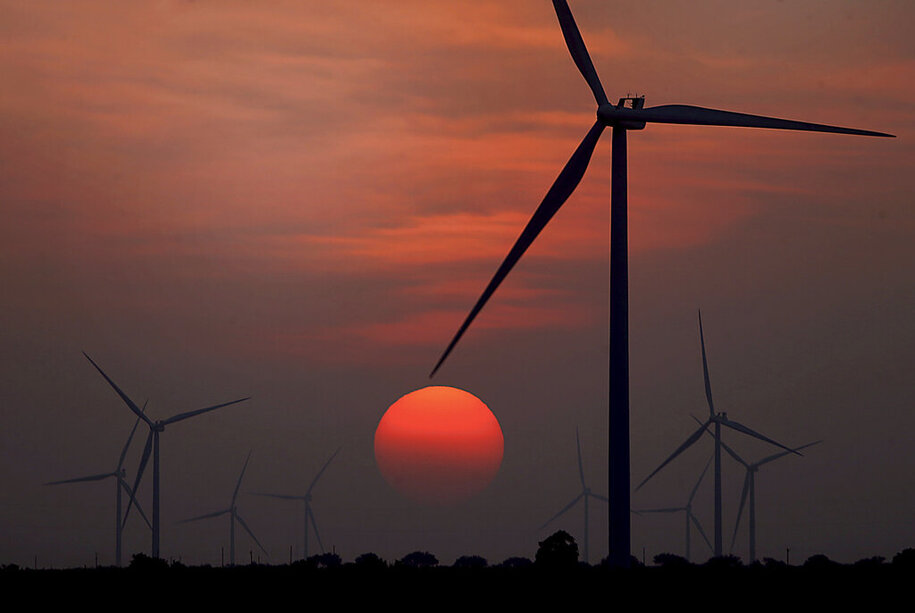
The order reiterates measures included in the recently passed budget reconciliation bill, leading renewable energy advocates to question its significance. By Dan Gearino for Inside Climate News President Donald Trump issued an executive order on July 7 that he said will “end taxpayer support for unaffordable and unreliable ‘green’ energy sources” such as wind and solar. But it’s not clear whether the order will have much of an effect other than to underscore the president’s antipathy for those power sources. Some observers speculate this action is fulfilling a promise to hardline conservative House members in order to win their votes last week for the massive budget reconciliation bill. The order is titled “Ending Market Distorting Subsidies for Unreliable Foreign Controlled Energy Sources.” It directs the Treasury department to “strictly enforce the termination of the clean electricity production and investment tax credits” as specified by the bill. Related | Trump thinks ‘windmills are killing our country’—yes, really The legislation, called the One Big Beautiful Bill Act, which Trump signed on July 4, says that projects must begin construction by mid-2026 or be placed in service by the end of 2027. This is a rapid phaseout compared to the previous law that had a phaseout that was to begin in 2032. The executive order advises the Treasury department to allow no wiggle room on the new deadlines. It also says the department must take prompt action to follow the bill’s new limits on tax credits going to entities with ties to China. In addition, it says the Department of the Interior must revise any policies or practices that give solar and wind power preferential treatment compared to other energy sources. A solar array atop a parking structure in Scottsdale, Ariz., in Jan. 2015. The Treasury and Interior departments also must make reports within 45 days about how they are complying with the order. Analysts, lawmakers and officials from renewable energy industry groups had mixed reactions about the significance of the order. But they do not downplay the effects of the bill that has become law. It is a gutting of incentives from President Joe Biden’s Inflation Reduction Act that will reduce federal government support for renewable energy, electric vehicles and manufacturing of those products and related components. The result, according to reports from Rhodium Group, Princeton University’s REPEAT Project, the think tank Energy Innovation and the Clean Energy Buyers Association, is likely to be a decrease in U.S. jobs and an increase in electricity prices. And yet, the executive order is likely to have minimal additional effect, said Pavel Molchanov, a managing director for the investment firm Raymond James. “Contrary to the EO’s headline, the EO does not abolish any tax credits,” he said in an email. “To state the obvious, only Congress can change tax law—which, in fact, is what Congress did last week via the budgetary megabill.” He expects little or no practical effect from the Interior department provision “It is worth noting that, under the Federal Power Act, the government cannot favor one type of power generation over another,” he said. “Thus, the EO simply restates existing law in that regard.” Derrick Flakoll, a senior policy associate for BloombergNEF, sees much greater potential for harm to the wind and solar industries. “It’s a big deal, but how big a deal it is we don’t know,” he said. He explained that the order is attempting to create uncertainty around the 2026 deadline, which is a crucial deadline for projects to have a smooth path to qualifying for tax credits. “It could push a lot of projects out of eligibility or into such an uncertain state of eligibility that it becomes hard to build and finance them,” he said. Abigail Ross Hopper, president and CEO of the Solar Energy Industries Association, offered this statement: “This executive order appears to target long-standing and well-established tax standards that allow for realistic financing timelines for all sorts of energy projects—including solar, wind, carbon capture and hydrogen projects,” she said. “We will continue to make the case that business certainty, predictability, and even-handedness are bedrocks of federal policy that cannot be undone by the stroke of a pen. We expect the Treasury Department to follow the law.” Datawrapper Content Rep. Sean Casten (D-Illinois), who has a background running clean energy businesses, said the order is about helping the market for fossil fuels by harming competing sources of electricity. “Donald Trump doesn’t hate renewable energy because it is clean,” he said in an email. “He hates it because it’s cheap. His latest executive orders are about making it harder for Americans to access cheap and reliable energy to ensure he keeps profits up for his friends in the fossil fuel industry.” Taylor Rogers, an assistant press secretary for Trump, pushed back on concerns that the president’s actions would lead to higher energy prices. “No one takes disingenuous cost concerns seriously from ‘clean energy’ groups that supported a $200 billion tax hike on the American people to fund the Green New Scam,” she said. “The One Big Beautiful Bill will continue to unleash America’s energy industry, dropping electricity costs that increased dramatically due to Joe Biden’s climate agenda.” She listed the many aspects of the bill that increase oil and gas production and reduce regulations, which she said will cut costs for consumers. Her response to questions did not include any comment about whether the executive order was part of a commitment made to Congressional Republicans. The budget bill passed the House on Friday, 218-214, with all Democrats and two Republicans voting against it. Several fiscally conservative House members initially balked at the spending levels in the bill, but most of them ended up voting for it after meeting with Trump. Related | We’re getting coal, whether we want it or not Asked about how Trump had earned their votes, Rep. Ralph Norman (R-S.C.) told CNBC on Friday that the president had told members he would use executive powers to stop renewable energy sources from being able to use subsidies. “A lot of these subsidies won’t