Economic News

Economic News

Trump’s Willing Enabler

From the NYT: Two days after President Trump fired the top labor official in charge of compiling statistics on employment, Kevin Hassett, the director of the White House National Economic Council, insisted on Sunday that the administration was “absolutely not” shooting the messenger on the heels of a poor jobs report. But Mr. Hassett repeatedly declined to furnish detailed evidence that would substantiate the president’s claims that the data had been rigged or manipulated to hurt him politically. … on “Fox News Sunday,” Mr. Hassett claimed there were “partisan patterns” in the jobless data, and said that “data can’t be propaganda.” It is important to recall that Dr. Hassett both authored Dow 36,000 in 1999, and applied a quadratic specification to predict covid fatalities.

Economic News

Business Cycle Indicators – A Turning Point?

Maybe, maybe not. With the employment release of Friday, here’re the pictures, first of NBER’s BCDC key indicators, and second of alternative indicators (recalling all the most recent data will be revised): Figure 1: Nonfarm Payroll from CES (bold blue), implied NFP Bloomberg consensus as of 7/1 (blue +), civilian employment with smoothed population controls (orange), industrial production (red), personal income excluding current transfers in Ch.2017$ (bold light green), manufacturing and trade sales in Ch.2017$ (black), consumption in Ch.2017$ (light blue), and monthly GDP in Ch.2017$ (pink), GDP (blue bars), all log normalized to 2021M11=0. Source: BLS via FRED, Federal Reserve, BEA 2025Q2 advance release, S&P Global Market Insights (nee Macroeconomic Advisers, IHS Markit) (7/1/2025 release), and author’s calculations.  The big NFP miss, usually not visible, is readily apparent in this graph. That’s because of the revisions to previous months. While small relative to annual benchmark revisions, they are noticeable here. Big downward revisions, if memory serves me correctly, are seen around turning points. If one were looking for succor in the household survey, one won’t find it. The civilian employment series has been flat for months. And if one believes trends in the household employment series presage recessions at an earlier point than the establishment series, then start worrying. Just to recap, consumption, personal income and monthly GDP are all below recent peaks. Here are some alternative monthly indicators (drawn on same vertical scale as Figure 2): Figure 2: Implied Nonfarm Payroll early benchmark (NFP) (bold blue), civilian employment adjusted to nonfarm payroll concept, with smoothed population controls (orange), manufacturing production (red), vehicle miles traveled (teal), real retail sales (black), and coincident index in Ch.2017$ (pink), BTS Freight Services Index (brown), GDO (blue bars), all log normalized to 2021M11=0. Retail sales deflated by chained CPI, seasonally Source: Philadelphia Fed [1], Philadelphia Fed [2], Federal Reserve via FRED, BEA 2025Q2 advance release, DoT BTS, and author’s calculations. As discussed here, Mr. Trump’s assertions of rigged data are wildly unjustified, given private NFP as measured by ADP shows the same pattern as the current BLS private NFP series, but on  a lower trajectory. If anything, the pre-revision series was less plausible, given the ADP series trajectory. Retail sales, civilian employment adjusted to NFP concept, and manufacturing production are all below recent peak (albeit insignificantly in the latter case). The coincident index is the only series that is unambiguously rising. The coincident index is based labor market data, so as long as NFP is rising, it’ll rise. With revised employment data, the next iteration of of the coincident indicator will look noticeably different. So until the establishment series trend downwards, I reserve judgment.        

Economic News

Consumers Vote on Economic Prospects

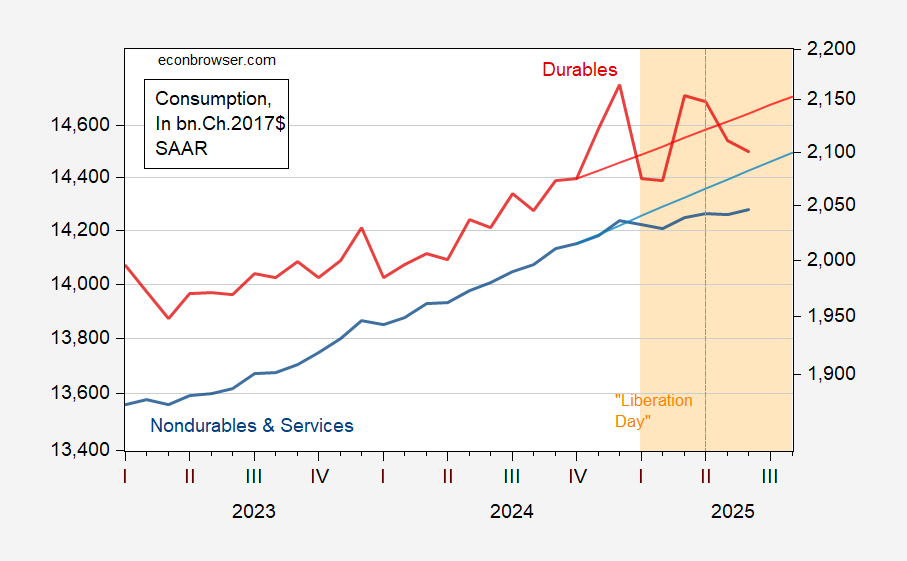
Durables consumption has experienced extreme volatility over the last 9 months (since the election). However, services and nondurables should follow the permanent income hypothesis — at least halfway (DSGE’s usually incorporate about 50% hand-to-mouth consumers). So what do we see? Figure 1: Sum of nondurables and services consumption (blue, left log scale), 2023M11-2024M10 stochastic trend (light blue line, left scale),durables consumption (red, right log scale), 2023M11-2024M10 stochastic trend (light red, right scale), all in bn.Ch.2017$ SAAR. Orange shading denotes Trump 2.0 administration; orange dashed line at 2025M04. Source: BEA, July release, and author’s calculations. The gap between services consumption and trend is even larger. To the extent that services consumption is driven by the permanent income hypothesis (even if up to half of consumers are hand-to-mouth), this means there’s been downshift in perceived future stream of income.

Economic News

Is It Seasonal Adjustment?

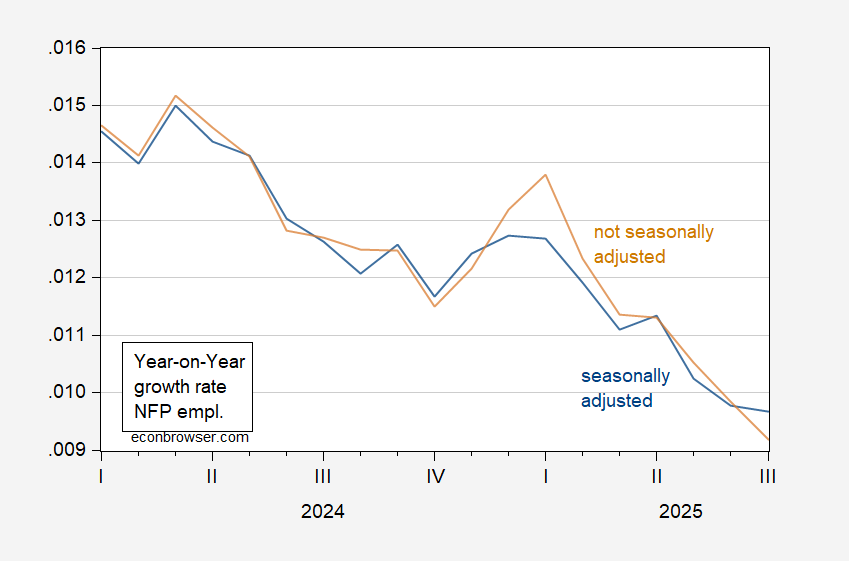
CEA Chair Miran asserts that some of the surprise in the employment numbers is due issues of seasonality. Can we see that? I can’t… Here’s y/y growth rate of the official series and the seasonally adjusted series. Figure 1: Year-on-year growth rate in seasonally adjusted NFP (blue), and in not seasonally adjusted NFP (tan). Growth rates calculated using log differences. Source:  BLS via FRED, and author’s calculations. The seasonally adjusted series is actually above the y/y not seasonally adjusted series! What about the level? Figure 2: Seasonally adjusted NFP (blue),  not seasonally adjusted NFP (tan), not seasonally adjusted NFP adjusted by author using X-13 (in logs, 2021M07-2025M07) (green).  Source:  BLS via FRED, and author’s calculations. Another reason to think the BLS numbers have not been “massaged”: the July release numbers better track ADP, on private NFP. Figure 3: Private nonfarm payroll employment, July release (bold black), Jun release (purple), ADP July release (green), all s.a.,  in logs, 2025M01=0. Source: BLS, ADP via FRED, and author’s calculations. In any case, there are usually big NFP misses around turning points. Civilian employment — which is not revised month to month — peaked in April.    

Economic News

August 1, 2025: A Day that Will Live in Statistical Infamy

As of 1:35PM CT today, the President has fired the Commissioner of Labor Statistics, within 6 hours of the latest employment release. So what all of feared about the safety of the independence of our economic statistical agencies has come to pass. We might as well delegate the employment numbers to Kevin Hassett at the NEC. From NBC: President Donald Trump on Friday ordered the firing of the head of the Bureau of Labor Statistics, hours after a stunning government report showed that hiring had slowed down significantly over the past three months. Taking to Truth Social, he attacked Erika McEntarfer, the commissioner of the BLS. He claimed that the country’s jobs reports “are being produced by Biden appointee” and ordered his administration to terminate her. Needless to say, his assertions that the numbers were manipulated are without merit. With no hint of irony, he wrote: “We need accurate Jobs Numbers,” … “She will be replaced with someone much more competent and qualified. Important numbers like this must be fair and accurate, they can’t be manipulated for political purposes.” At this rate, if a recession occurs within the next 3.5 years, we’ll not see a negative GDP print let alone employment print. And if you thought this was unimportant to you, remember BLS calculates the CPI used for Social Security COLAs, as well as the headline CPI used to calculate TIPS yields. Oh, also the inflation adjustments to the marginal tax rate thresholds…  

Economic News

Downside Surprise in Employment Levels

Tales from the Employment Situation release for July: (1) July Establishment employment change below consensus; (2) Revisions make trends slower; (3) Adds data indicating a slowdown. Figure 1: Nonfarm Payroll Employment, July release (bold black, right log scale), implied Bloomberg consensus (gray +, right log scale), June release (teal, right log scale), Private NFP, July release (blue, left hand log scale), implied Bloomberg consensus (blue +, left hand log scale), June release (tan, left hand log scale), all in 000’s, s.a. Implied Bloomberg estimates calculated by iterating consensus change on top of June release figures. Source: BLS, Bloomberg, and author’s calculations. While one observation doesn’t make a trend (+73K consensus vs. +106K for NFP), three observations might. We don’t make judgments on the basis of one preliminary observation because the Mean Absolute Revision going from first to third revision over the 2022-24 period is about 40K. Hence, it’s very possible that in two month’s time, the 3rd release for July’s data could end up being above consensus. Still, given the revisions in the previous months data, it looks like a deceleration. Here’s a picture of several series depicting the  slowdown along other dimensions of the labor market, and other economic indicators: Figure 2: Monthly GDP (black), private nonfarm payroll employment-ADP (blue), civilian employment w/smoothed population controls (light blue), aggregate hours (light green), consumption (tan), personal income ex-transfers (pink), real retail sales (purple), all in logs 2025M01=0. Real retail sales is 3 month centered moving average of retail sales, divided by chained CPI. Source: S&P Global, ADP-Stanford, BLS, BEA, Census, and author’s calculations. This seems to have been taken by the market as signaling a slowdown. The CME implied Fed funds rate dropped from 4.3% to 4.2% going from yesterday to today at 10AM CT (although admittedly the Trump tariff announcements might have had some impact as well). Betting markets are sending the same message: Source: Kalshi, accessed 8/1/2025 10AM CT. Assuming the greater than 25bps cut group is indicating 50bps, then the implied drop in September is 0.2 percentage points.        

Economic News

Guest Contribution: “Trump’s Taylor Rule”

Today, we present a guest post written by Jeffrey Frankel, Harpel Professor at Harvard’s Kennedy School of Government, and formerly a member of the White House Council of Economic Advisers, and Sohaib Nasim.  A shorter version appeared at Project Syndicate.  Donald Trump has now gone beyond his usual norm-busting habits in his criticism of Federal Reserve Board Chair Jay Powell.  He has harassed him to cut interest rates by 300 basis points, has heaped abuse upon Powell personally, has trumped up accusations regarding the remodeling of the Fed’s building, and has gone so far as to draft a letter to fire him.   [That is, to remove him from the chairmanship.  Even Trump must realize that he doesn’t have the legal power to remove Powell from the Federal Reserve Board altogether.] It is revealing to look statistically at what determines whether Trump criticizes the Fed for interest rates that are too high versus too low.   Does he have a “Taylor Rule” of his own, guiding desirable monetary policy in response to current economic conditions? First, let us recall the standard argument why central banks should be independent.  Then we will look at Trump’s Taylor Rule. 1 The importance of Fed independence Most presidents observe the independence of the Fed scrupulously.  In 1997, soon after I was Senate-confirmed as a Member of Bill Clinton’s Council of Economic Advisers, I was asked by a TV interviewer how the Administration viewed the latest monetary stance of the Federal Reserve.  (Alan Greenspan was Chair at that time.)   I dutifully replied, “We don’t comment on the Fed’s policy, because we have confidence that they will do a good job.” I was soon corrected by a superior: “the first part of your answer was good, but you should have omitted the second part.”  The danger was that, at some future time, one might be asked, are you no longer willing to say that you have confidence in the Fed?  From then on, I did what all Administration officials did and stuck to simply “we don’t comment on the Fed.” Perhaps the most important insight from monetary economics in the last 50 years is the proposition that a country with an independent central bank, shielded from political pressure, can achieve better economic performance than a country where the central bank is under the direct control of the government.  The latter set-up results in an inflationary bias, where the authorities cannot resist the temptation to stimulate the economy, and everybody knows this ahead of time, with the result that money has to expand enough to offset and validate expectations of inflation, without even reaping a bonus of higher real growth. The Federal Reserve was granted independence at its founding.  The Federal Reserve Act of 1913 says that the Chair cannot be removed without cause [i.e., malfeasance] and also that, for example, the Board’s freedom to arrange its own building cannot be second-guessed.  Trump has recently asserted the power to violate both of these provisions.  This even though the Act was recently reaffirmed by the Supreme Court, in recognition of the importance of shielding the Fed from political pressure. Even Richard Nixon, the last president to pressure the Fed chair (Arthur Burns) toward an easier monetary policy [accompanied by wage-price controls], with disastrous results, at least had the sense not to do it in public, let alone amidst insults to the Chair’s competence. Recognizing the value of central bank independence, most other major countries have, in recent decades, adopted this reform. Hypotheses of Trumpian behavior The position of Trump and his supporters is that he is a better judge of what is the appropriate interest rate at any given time than is the Fed.  At Davos on January 23, 2025, he claimed that he understands monetary policy better than Powell. Even those who might not believe Trump’s claims to know more about everything than anybody [more about the tax code than tax lawyers, more about technology than the technologists,  more about ISIS than the CIA, more about the military than the generals, etc.,] might reason that he was a successful businessman, and thus must know more about monetary policy than the intellectuals.  So, does Trump use his experience and wisdom to judge when inflation is high or unemployment low, calling for tighter money (higher interest rates), and when inflation is low or unemployment high, calling for looser money (lower interest rates)? That is, does he have a “Taylor rule” of his own?   Another possible hypothesis: Does Trump believe that interest rates are always too high, regardless of contemporary specifics, perhaps as a result of his real estate background? When does Trump criticize the Fed for interest rates too high? We looked at those days on which Trump criticized Fed policy, as posted on his platform TruthSocial, or Twitter before that.  We also looked at his remarks as reported in the media.  There were 14 such events between January 2013 and June 2025.  (No doubt there are other occasions that this source misses.)  Of these 145, he viewed interest rates as too high and called for easing on 129 occasions, and interest rates too low, calling for tightening on 16 occasions. We used Firth penalized logistic regression and OLS with robust standard errors to examine whether Donald Trump’s public calls for looser monetary policy follow a macroeconomic logic akin to the Taylor Rule. In addition to including the contemporaneous Fed funds rate, we examined the effects of the unemployment rate and CPI inflation rate on the likelihood of him criticizing monetary policy as too tight. A dummy variable indicates whether Trump was in office—defined to include the transition period following an election victory—and helps test whether his critiques are politically motivated or self-interested. Penalized log-likelihood model avoids convergence issues due to separation and allows for more reliable inference.  [The 0-1 character of the dependent variable calls for Probit.  But high multicollinearity prevented meaningful estimation.] In the results for the linear probability model, InOffice is highly significant (coefficient = 0.60, p < 0.001),

Economic News

Trade Policy Uncertainty on the Eve

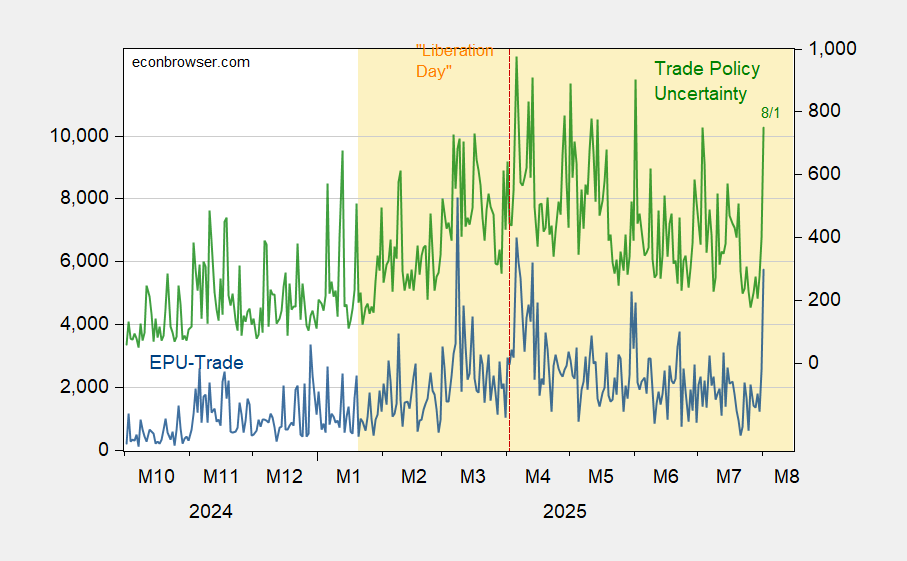
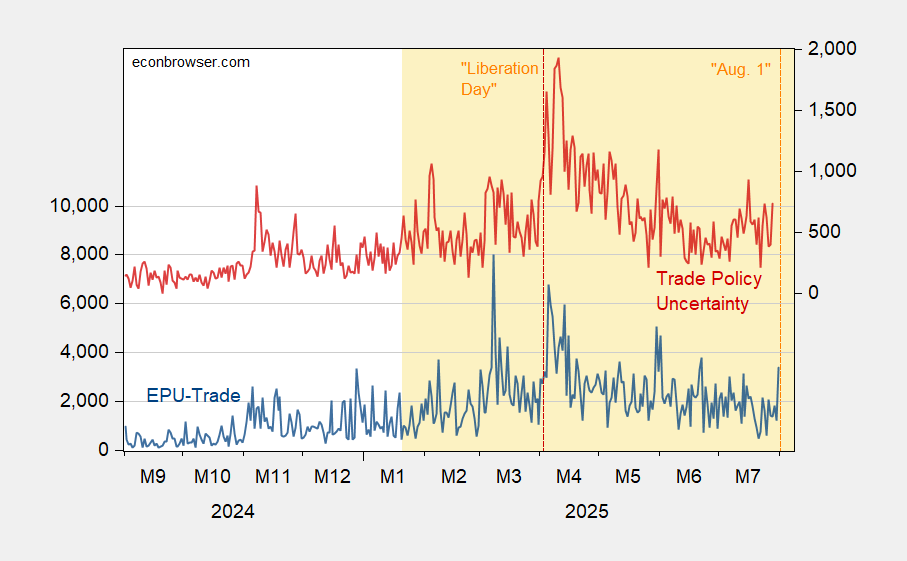
Baker, Bloom and Davis and Caldara et al. measures: Figure 1: EPU-trade category (blue, left scale), and Trade Policy Uncertainty index (red, right scale). Source: Baker, Bloom & Davis policyuncertainty.com, and Caldara et al. TPUD. [updated 7/28] Tariffs will go into effect in 7 days. So still time for TACO (90 days for Mexico).    

Economic News

State of the Macroeconomy: GDP, Key Indicators as of 7/31

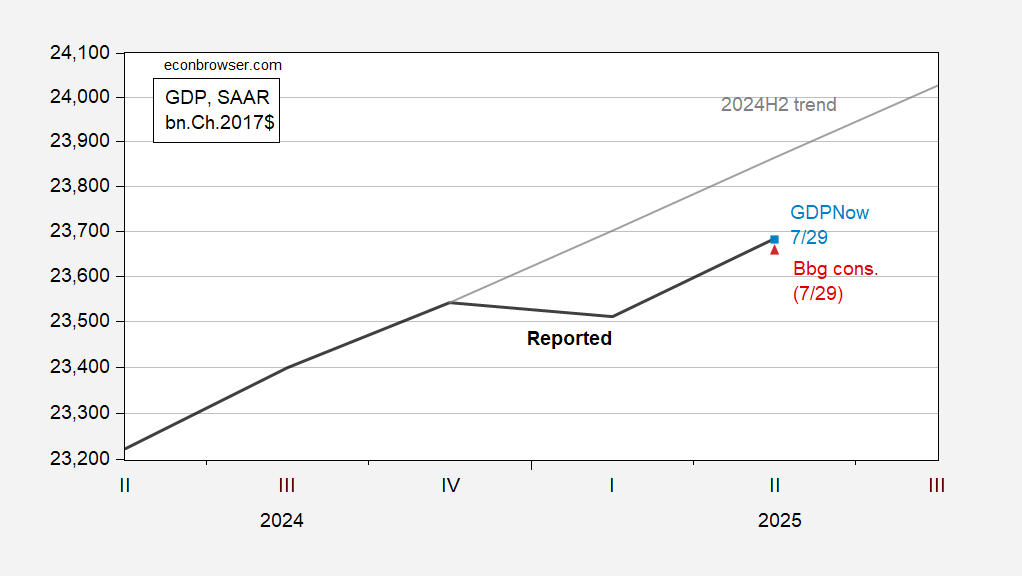
Following up on Jim’s post on the GDP release yesterday, looking at different aspects of economic activity: Quarterly Indicators First, ignoring the self-congratulatory remarks of CEA47, consider the level of GDP relative to the 2024H2 trend: Figure 1: GDP fm Q2 advance (bold black), GDPNow of 7/29 (light blue square), Bloomberg consensus as of 7/29 (red triangle), linear extrapolation using 2024H2 growth rate. Source: BEA, Atlanta Fed, Bloomberg, and author’s calculations. While the CEA might be buoyed by the 3% which exceeded consensus, it’s clear that 3% did not put GDP on its pre-Trump trajectory. Interestingly, on the day before the release, the Atlanta Fed’s GDPNow was essentially on target at 2.9% vs actual 3.0% y/y annualized (4 days before release, it was at then-consensus of 2.4%). Given the distortions in GDP associated with tariff frontloading, I think these are times when it’s particularly useful to use final sales to private domestic purchasers (aka “Core GDP”) as a proxy measure for economic momentum. “Final sales” means stripping out the volatile — and difficult to measure — inventory component, while “private domestic purchasers” means excluding net exports and government spending. Here’s the picture of that series relative to nowcasts. Figure 2: Final sales to private domestic purchasers fm Q2 advance (bold black), GDPNow of 7/29 (light blue square), Bloomberg consensus as of 7/29 (red triangle), linear extrapolation using 2024H2 growth rate. Source: BEA, Atlanta Fed, Bloomberg, and author’s calculations. Figure 2 makes clear that focusing on this proxy measure for private aggregate demand, while surprising on the upside, is still decelerating (1.8% y/y annualized vs. GDPNow 0.8%, and 3% in 2024H2). To highlight the point that private domestic purchases is a smoother series than GDP, see Figure 3 regarding the post-Covid period. Figure 3: GDP Final sales to private domestic purchasers (bold black), GDPNow of 7/29 (light blue square), Bloomberg consensus as of 7/29 (red triangle), linear extrapolation using 2024H2 growth rate. Source: BEA, Atlanta Fed, Bloomberg, and author’s calculations. Over this period, the standard deviation of q/q annualized changes for GDP and final sales are 1.5% vs. 1.0%. What about alternative indicators of aggregate output? We don’t have real GDI for Q2, so we only have GDO through Q1; however we do have implied GDPPlus through Q2, so here’s the picture, along with today’s Atlanta Fed nowcast of Q3 GDP. Figure 4: GDP fm Q2 advance (bold black), GDPNow of 7/31 (light blue square), linear extrapolation of GDP using 2024H2 growth rate, GDO (tan), GDP+ based to 2024Q1 (green). Source: BEA, Atlanta Fed, Philadelphia Fed, and author’s calculations. GDPNow indicates continued growth of 2.3% in Q3, but based on very little information, even though we’re 1/3 of the way through the quarter. Even with this above potential growth rate, the gap between 2024H2 trend and actual GDP will not be closed. Monthly Indicators Today’s releases included consumption, personal income for June, and manufacturing and trade industry sales for May. Taking into account anticipated July employment (Bloomberg), we have the following picture of monthly indicators followed by NBER’s Business Cycle Dating Committee (with employment and income the key ones). Figure 5: Nonfarm Payroll from CES (bold blue), implied NFP Bloomberg consensus as of 7/30 (blue +), civilian employment with smoothed population controls (orange), industrial production (red), personal income excluding current transfers in Ch.2017$ (bold light green), manufacturing and trade sales in Ch.2017$ (black), consumption in Ch.2017$ (light blue), and monthly GDP in Ch.2017$ (pink), GDP (blue bars), all log normalized to 2021M11=0. Source: BLS via FRED, Federal Reserve, BEA 2025Q2 advance release, S&P Global Market Insights (nee Macroeconomic Advisers, IHS Markit) (7/1/2025 release), and author’s calculations.  Here are some alternative monthly indicators (drawn on same vertical scale as Figure 5): Figure 6: Implied Nonfarm Payroll early benchmark (NFP) (bold blue), civilian employment adjusted to nonfarm payroll concept, with smoothed population controls (orange), manufacturing production (red), vehicle miles traveled (teal), real retail sales (black), and coincident index in Ch.2017$ (pink), GDO (blue bars), all log normalized to 2021M11=0. Source: Philadelphia Fed [1], Philadelphia Fed [2], Federal Reserve via FRED, BEA 2025Q2 advance release, and author’s calculations. One observation is that real consumption and personal income ex-transfers were flat, and down respectively in June, while the manufacturing and trade industry sales series has continued a downward trend through May. While Bloomberg consensus is for a continued increase in nonfarm payroll employment, ADP’s private NFP series has been essentially flat through June. Conclusion Taken all together, it’s hard to see a recession in June’s data (keeping in mind all these observations will be revised), and given the consensus unemployment rate increase of 0.1 percentage points, the Sahm rule will not be triggered (exception, see Michaillat’s post). But clearly the economy looks like it’s entering a period of decelerating growth, perhaps even zero growth on key indicators.    

Scroll to Top