Economic News

Economic News

Market Talk – August 18, 2025

ASIA: The major Asian stock markets had mixed day today: • NIKKEI 225 increased 336.00 points or 0.77% to 43,714.31 • Shanghai increased 31.257 points or 0.85% to 3,728.027 • Hang Seng decreased 93.22 points or -0.37% to 25,176.85 • ASX 200 increased 20.70 points or 0.23% to 8,959.30 • SENSEX increased 676.09 points or 0.84% to 81,273.75 • Nifty50 increased 245.65 points or 1.00% to 24,876.95 The major Asian currency markets had a mixed day today: • AUDUSD decreased 0.00086 or -0.13% to 0.64909 • NZDUSD increased 0.00011 or 0.02% to 0.59218 • USDJPY increased 0.598 or 0.41% to 147.742 • USDCNY decreased 0.00041 or -0.01% to 7.18708 The above data was collected around 12:45 EST. Precious Metals: Gold decreased 3.53 USD/t oz. or -0.11% to 3,332.79 Silver decreased 0.016 USD/t. oz or -0.04% to 37.994 The above data was collected around 12:48 EST. EUROPE/EMEA: The major Europe stock markets had a mixed day today: •  CAC 40 decreased 39.40 points or -0.50% to 7,884.05 •  FTSE 100 increased 18.84 points, or 0.21% to 9,157.74 •  DAX 30 decreased 44.53 points or -0.18% to 24,314.77 The major Europe currency markets had a mixed day today: • EURUSD decreased 0.00429 or -0.37% to 1.16584 • GBPUSD decreased 0.00364 or -0.27% to 1.35090 • USDCHF increased 0.00135 or 0.17% to 0.80745 The above data was collected around 12:52 EST. US/AMERICAS: US Market Closings: Dow declined by 34.30 points (-0.08%) to 44,911.82 S&P 500 declined by 0.65 points (-0.01%) to 6,449.15 NASDAQ advanced by 6.80 points (+0.03%) to 21,629.77 Russell 2000 advanced by 8.52 points (+0.37%) to 2,295.04 Canada Market Closings: TSX Composite advanced by 17.11 points (+0.06%) to 27,922.60 TSX 60 advanced by 0.25 points (+0.02%) to 1,654.94 Mexico Market Closing: S&P/BMV advanced by 1.95 points (UNCH) to 58,322.43 Brazil Market Closing: Bovespa advanced by 1,039.80 points (+0.76%) to 137,380.57 ENERGY: The oil markets had a mixed day today: • Crude Oil increased 0.298 USD/BBL or 0.47% to 63.098 • Brent increased 0.375 USD/BBL or 0.57% to 66.225 • Natural gas decreased 0.0213 USD/MMBtu or -0.73% to 2.9000 • Gasoline increased 0.005 USD/GAL or 0.24% to 2.0841 • Heating oil increased 0.0108 USD/GAL or 0.49% to 2.2358 The above data was collected around 12:59 EST. •   Top commodity gainers: Rubber (1.84%), Oat (1.29%), Palladium (1.37%), and Feeder Cattle (0.75%) •   Top commodity losers: Canola (-1.31%), Bitumen (-1.32%), Orange Juice (-2.65%), and Cocoa (-1.75%) The above data was collected around 13:07 EST. BONDS: Japan 1.5720%(+0.63bp), US 2’s 3.77% (+0.008%), US 10’s 4.3380%(+1.7bps); US 30’s 4.94% (+0.022%), Bunds 2.7601% (-1.86bp), France 3.4490% (-1.84bp), Italy 3.5920% (-2.73bp), Turkey 31.330% (+208bp), Greece 3.437% (-2.5bp), Portugal 3.153% (-1.9bp), Spain 3.336% (-1.3bp) and UK Gilts 4.742% (+4.21bp). The above data was collected around 13:11 EST.

Economic News

The best way to get oil price forecasts less wrong

​​​​​​ Leer en Español No commodity is more important for the world economy than crude oil. It, along with coal and natural gas, powers our electricity grids and transport networks, greasing the gears and cogs of our modern life. And when their price shifts, as many readers will painfully remember from the 2021–2023 global energy crisis, the effects on our personal finances and the world economy are considerable. Forecasting what will happen to the price of crude oil and other energy commodities has never been more challenging. The world is destabilizing, with huge implications for oil, gas and coal prices. The U.S.—which, just over 20 years ago, welcomed China into the World Trade Organization—shifts its trade policy erratically, and sometimes via the social media account of its President. Moreover, the nation’s withdrawal from its role as the world’s “policeman” has contributed to the number of conflicts to double globally since 2020, according to the think-tank ACLED, threatening disruption to oil production and shipping. In this fast-moving world, quarterly or even monthly updates to commodity forecasts go out of date quicker than before. Recognizing this, at FocusEconomics, we have expanded our offer to include daily updates of our forecasts via our data platform, harnessing the latest projections from our panel of expert analysts into one number—our Consensus Forecast. Nobody has a crystal ball, but, equally, nobody—businesses, consumers and investors—can afford to wait to see what happens in the future before making investment or spending decisions that need to be made today. Daily Consensus forecasts are the most accurate picture of what the market thinks will happen ahead at any given time.   Oil market  In the past few months, economists have become more bearish about crude oil prices: In 2025, the price of Brent crude oil is projected by our Consensus to decline 14%, and then by a further 1% in 2026, falling to their lowest level since the pandemic in 2020. Two big developments have led to this greater bearishness. After U.S. President Trump announced his tariff plan in April, the International Energy Agency (IEA) slashed its 2025 outlook for worldwide growth of oil demand by 30%. And then, that same month, OPEC+ began what has ended up being so far a six-long set of pledges to accelerate output hikes, leading the IEA to hike its projection for worldwide growth of oil supply by a whopping 75%. Our panelists were quick to respond to these developments, as explained by economists at ING in early May: “OPEC+ is implementing another aggressive supply hike […]. This increase solidifies a shift in policy. With prospects of further large supply increases in the months ahead, we revised our oil forecasts lower.”    Natural gas market  In the natural gas market, things have been different. In recent months, our panelists have become more upbeat about the price outlook for the fuel. Our Consensus projects the main U.S. natural gas benchmark, Henry Hub, to trade 51% higher this year than last, and rise a further 8% in 2026. Analysts at the EIU commented: “The heavy draw on stocks during the 2024-25 winter will contribute to the increase in Henry Hub prices in 2025. Rising demand from LNG exporters and increased production costs arising from Mr Trump’s tariffs will also drive up prices.”  In contrast to oil, in the natural gas market, the political shock of Trump has made investors more optimistic about prices ahead: He’s rushed to approve licenses to export liquified natural gas, the shipments of which hit 9.1 million tonnes in July—over 1,000% higher than at the start of his first term in November 2016. Meanwhile, a relatively cold U.S. winter drained inventories of natural gas to far below seasonal averages. In this case, our panelists also reacted speedily:   Coal market  The coal market, already the black sheep among the energy commodity complex as it is the most polluting, has seen the sharpest downgrade in price forecasts since the start of the year. The prices of both Australian coking and thermal coal—the former used for smelting, the latter for electricity generation—are seen falling roughly 20% in 2025 year on year. Samantha Dart and Hongcen Wei, analysts at Goldman Sachs, explain: “We believe global coal balances remain soft and particularly, softer than our previous expectations, given weaker-than-expected coal consumption in H1 2025, attributed to a warmer-than-expected Q1 in Northeast Asia followed by a cooler-than-expected Q2 in South Asia. We accordingly nudge lower our Aug-Sep/Q4 [benchmark Australian thermal coal] price forecasts by 3.0/5.0 USD per metric ton to 117/113 USD per metric ton.”  Moreover, Trump’s tariffs have hit especially hard North-east Asian economies, like China, Japan, South Korea and Taiwan. These nations depend on exports to fuel growth and are the main consumers of Australia’s coal. Prices have also been dampened by a supply glut in China, plus bad weather impeding exports from Australia. Take a look at how our panelists have reacted to these developments below:   The post The best way to get oil price forecasts less wrong appeared first on FocusEconomics.

Economic News

Lebanon Announces War Will Escalate

Lebanese Prime Minister Nawaf Salam left a six-hour cabinet meeting, whereby it was determined that the Iran-backed militant group Hezbollah must be eliminated by the end of the year. Salam said it is the “state’s duty to monopolise the possession of weapons”, and disarm Hezbollah. Western influence has successfully penetrated Lebanon, and war is guaranteed to escalate. Lebanese President Joseph Aoun called on Hezbollah to abandon its weapons to prevent war—a request that he knew would go unanswered. Such a request would have been unfathomable one year ago when Hezbollah was at the peak of its power. Israel recently accused Hezbollah of expanding its forces, with the US World Factbook estimating that the group had 50,000 active combatants. Yet, Hezbollah leader Hassan Nasrallah warned that he has 100,000 men who are prepared to fight. “The government of Prime Minister Nawaf Salam committed a grave sin by taking a decision to strip Lebanon of its weapons to resist the Israeli enemy… This decision fully serves Israel’s interest,” the militant group said. “This decision undermines Lebanon’s sovereignty and gives Israel a free hand to tamper with its security, geography, politics and future existence. Therefore, we will treat this decision as if it does not exist.” Lebanon is indebted to the West and must expel Hezbollah to secure funding. Lebanese Finance Minister Yassin Jaber announced earlier in the year that the World Bank prepared a “preliminary plan” worth $1 billion to assist in rebuilding efforts. Lebanon is attempting to form a new government, and the West is encroaching on the Middle Eastern nation to ensure it can insert political influence, if not dominance. IMF chief Kristalina Georgieva said that any funding would be “linked to specific steps and procedures with a specific time frame and objective.” The European Union has taken an interest as well, offering to disburse €500 million in aid as part of a deal signed last year that was contingent on reducing the number of migrants. US Special Envoy to the Middle East Steve Witkoff also stated he believes the US may wish to broker a deal. I reported that the US military is building a $1.2 billion mega compound in Awkwar, Lebanon. The location is a mere 10 miles from the center of Beirut and 60 miles away from the Israeli border.  Hezbollah and Israel agreed to a ceasefire on November 27, 2024, but the group is still strong and continues to support Hamas. Lebanon is vulnerable to becoming part of a larger regional crisis, which could involve escalation around its southern border and deeper Turkish influence. Syria was a key supporter of Hezbollah but has been gutted with a new interim puppet government. Iran remains Hezbollah’s top supporter and has said it will not support any efforts to disarm the militant group, blaming the West for interfering in the Middle East once more. Notably, Russia and Iran signed a 20-year treaty back in January to bypass US sanctions. Could Lebanon become the new battlefield for the proxy war?

Economic News

EU, NATO & Zelensky Plotting Against Trump

I am getting an increasing number of questions about how in the world our model forecasts war in advance and targets specific weeks like August 18th, 2025, a year in advance, and then Trump picks that Friday 15th for his peace conference with Putin in Alaska.  You NEVER make such a forecast using a single model. There is a battery of models, and in those arrays, there are 72 models. That top line we call the aggregate because that is the sum of all turning models that align for that target – it is NEVER just one. The computer is monitoring the entire world. You can see all the reports that Socrates is writing every day. There are not enough analysts in the world to cover so many instruments and statistics. On December 3rd, 2013, I formally posted that the tensions would erupt in Ukraine. Ukraine Maybe The Most Important Country To Watch Posted Dec 3, 2013 by Martin Armstrong “We will have the Cycle of War ready shortly updating this development as this cycle turns next year as well and we can see the rising tensions are brewing everywhere. Ukraine may become the focal point with Russia smelling the blood of a weak Europe and United States. This is like the barbarians smelling the weakness of Rome and knew it was time to strike. Russia is all about restoring its national honor. The USA has weakened itself like Rome by fiscal mismanagement.”   This is a model specificly between Russia and the United States. It starts with the 1962 target of the Cuban Missile Crisis set in motion by Nikita Khrushchev, who was overthrown on October 14, 1964, (1964.786) during a Politburo coup orchestrated by his political opponents, including Leonid Brezhnev and Alexei Kosygin, because of his reckless desire to spread communism to the world (We Will Bury You). That was 1.978 years from the Cuban Missile Crisis (721.97 days, 103.13 weeks, or about 24 months later). Here you can see this separate model targeted 2014.408, which was May 4th, 2014. This was the Odessa Genocide when Ukrainians killed Russians on the street and then burned them alive, and then ran into the Trade Union Building for shelter. This was what began the separation movement by the Russians in the Donbas because they were being hunted like animals, and the Western press had no problem with the resumption of Nazi Ethnic Cleansing because they were Russian. Neocons dominate the EU with personal hatred of Russians from generations before. They love to imprison people who just have words against migrants. Still, they have no problem advocating genocide of an entire ethnicity, following in the footsteps of Hitler all over again. May 2: Deadly clashes in Odessa between pro-Ukrainian and pro-Russian groups resulted in over 40 deaths, mainly in a building fire. May 11: Pro-Russian separatists held disputed independence referendums in the Donetsk and Luhansk regions. May 25: Presidential elections were held in Ukraine, with Petro Poroshenko winning decisively. Separatist-controlled areas largely boycotted or disrupted voting. Direct talks between Ukraine and Russia took place in Istanbul, Türkiye, on May 15, 2025, precisely on the turning point, marking the first potential face-to-face negotiations since 2022. However, there is conflicting information about whether the meeting occurred as planned. My sources informed me that both Russian and Ukrainian delegations were present in Istanbul, with the Russian delegation led by Vladimir Medinsky and the Ukrainian delegation headed by Defense Minister Rustem Umerov. The next major turning point is June 13th, 2026. We are now starting to see a Panic Cycle forming at this next Major Target of June 2026. Keep in mind that this ECM is NOT included in the arrays. The more separate models we have, the better the correlation, and we can then rely on these forecasts with more confidence. Russia also now occupies Kherson, Donetsk, Luhansk, and Zaporizhzhia, in the Eastern region, which Putin may ask for. So far, Ukraine’s leadership has opposed ceding any territory to Russia. Zelenskyy wrote on X, “Ukraine is not afraid of meetings and expects the same brave approach from the Russian side. It is time we ended the war.” The NY Post wrote: “European officials rejected Russian President Vladimir Putin’s calls that Ukraine give up territories annexed during the war — instead demanding Saturday an immediate ceasefire from Moscow and NATO membership for Kyiv.” This merely confirms my sources that warn the EU, NATO, and Zelensky want war and they are conspiring to create a false flag to invoke Article % to embarrass Trump into sending troops to Ukraine to annihilate Russia completely. They want to conquer Russia entirely, and they seek to steal all its wealth so that the EU, desperate to survive, will become the next Roman Empire, subordinating the United States once again to a mere colony. I do have contact with people close to Trump who I at least trust are NOT Neocons, which I cannot say for everyone surrounding him. Will they get Trump to listen? Probably not. The frustrating part is I tend to get called in when they F-up everything that I warned would take place, and then they expect me to be like Merlin the Sorcerer, wave my magic wand, and it’s all gone. If the EU had honored the peace deal that they signed and allowed the Donbas to vote and separate as took place in Chechoslovakia and Yugoslavia, which both split along ethnic lines, this war would NEVER have taken place. The EU has conspired from day one to sacrifice the Ukrainian people on the NEOCON altar of hatred for Russians who are no longer communists, and their hated leader, Stalin, was not even a Russian. He was from Georgia. It was all the cross-treaties that compelled nations to join World War I. NATO was established to result in the very same mistake that caused that war, and they are licking their lips, drooling over the thought of finally defeating and obliterating their enemy Russia, even though communism fell all by


Economic News

Marcus Vetter on War

A German INTERVIEW of Marcus Vetter on War If you look back today: What has become of Angela Merkel’s statement “We can do this”? Has this vision been fulfilled or has it fractured? Unfortunately, in my view, today this vision lies completely in ruins. It was the last stand of a truly humanistic approach, one that deeply divided Germany. Those who viewed the statement critically were often unfairly labeled as “right-wing” by those who applauded it. But a societal challenge of such magnitude can only be mastered together, because the truth, as always, lies somewhere in the middle. Both sides had a point, and should have approached the motto “We can do this” with much more prudence and solidarity. Today, we are faced with a social landscape in shambles. A large part of society supports an unprecedented rearmament of Europe. Those who warn against it are often silenced. War rhetoric is now coming from parties that once had a pacifist orientation. The world is upside down and hardly recognizable anymore. In your films you often talk about reconciliation, identity, and social change. What stories should be told today to rethink integration and social cohesion? We should tell the same kinds of stories. Stories that show the cycle of violence can be broken. On an individual level, people are still open to such stories and can still be moved by them. At the same time, they are influenced by seemingly convincing arguments – for example, that a Russian war of aggression can only be decided on the battlefield and that one can only respond to it with strength. Other opinions are no longer truly allowed in the media. In my view, this is fundamentally wrong. War itself is the greatest war crime, as Ben Ferencz – once the youngest prosecutor in the Nuremberg Trials – put it. And he was right. In war, there is no morality, no humanity. Truth is the first casualty of any war. Through propaganda slogans we are conditioned to believe that strength is the only answer, because otherwise the enemy will overrun us. When Hermann Göring was asked in Nuremberg how they had managed to unite all of Germany for a war of aggression, he said: “Of course, the people don’t want war… But… the people can always be driven to the bidding of the leaders. That’s easy. All you have to do is tell them they are being attacked and denounce the pacifists for lack of patriotism and for endangering the country. It works the same in every country.” It is very hard for me to endure the current developments. We are ready to take increasingly extreme positions. Some want to raze Gaza to the ground and root out evil entirely, others place all the blame solely on Israel and are just as extreme in their rhetoric. There are only a few left who are willing to build bridges. That is why I have re-edited a trilogy of films I shot in Palestine and Israel between 2008 and 2012, and expanded it with a fourth film about the International Criminal Court. This last one – WAR AND JUSTICE – is a profoundly pacifist film. When people see it, they are often willing to rethink their stance on war. https://www.war-and-justice.de THE HEART OF JENIN tells the story of Palestinian father Ismael Khatib from Jenin, whose son was killed by Israeli soldiers and who, despite his deep grief, decided to donate his son’s organs to Israeli children as a gesture of peace. CINEMA JENIN – THE STORY OF A DREAM tells how hundreds of volunteers from all over the world came to Jenin to join Ismael Khatib – from The Heart of Jenin – in restoring an old cinema that had been closed during the First Intifada. Cinema Jenin opened in the summer of 2011 and was operated as a cinema for 5 years before being demolished in December 2016 and replaced by a shopping mall. AFTER THE SILENCE tells the story of Israeli Yael Armanet, who lost her husband in a suicide bombing carried out by a Palestinian from Jenin. Inspired by Ismael Khatib’s gesture, she sets out to visit the family of the attacker in Jenin to find answers to what happened. The film was made possible and co-produced by the Palestinian cinema Cinema Jenin. https://marcus-vetter.com/product/trilogie-der-hoffnung

Economic News

“And you want to be my latex salesman?” (BLS edition)

I hear that Bannon is pushing Heritage Chief Economist EJ Antoni for BLS Commissioner. EJ Antoni: Source: Heritage Foundation, accessed 8/7/2025.  If he is nominated, I’ll just observe that he declared (with St. Onge) a recession starting in 2022 [1]. And another recession in starting in July or August 2024 –[2], [3]– without ever having declared the recession of 2022 ended. Taken literally, he believes we have been — and remain even today — in recession.   For the record: EJ Antoni/Heritage: “Back from the Brink: Trump’s Economy Soars Instead of Crashing” The Great Replacement “Theory” * Comes to Economics at Heritage                  

Economic News

Manufacturing on the Ropes?

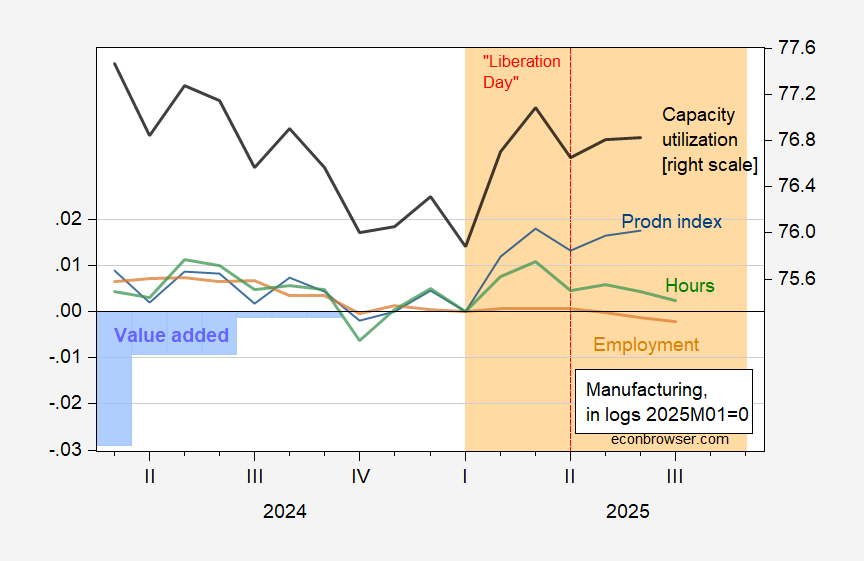
Manufacturing employment, hours, capacity utilization down since March 2025 (pre-“Liberation Day”); manufacturing production (Fed index) flat since March. Figure 1: Manufacturing employment, all employees (brown), manufacturing aggregate hours (green), manufacturing production (blue), real value added in manufacturing (blue bars), all in logs,  2025M01=0; manufacturing capacity utilization (bold black line, right scale). Aggregate hours calculated by multiplying average weekly hours times employment of production and nonsupervisory workers. Source: BLS, Federal Reserve, BEA, and author’s calculations.  Notice that since we are indexing to 2025M01=0, the fact that it’s difficult to see the value added series over the last two quarters means that value added has been essentially flat over that period. These are all backwards looking indicators. The ISM manufacturing PMI – new orders component doesn’t look too promising. And all this is before the tariffs take full effect, and retaliation (aside from China). Source: ISM, accessed 8/7/2025.

Economic News

CalculatedRisk (Still) on Recession Watch

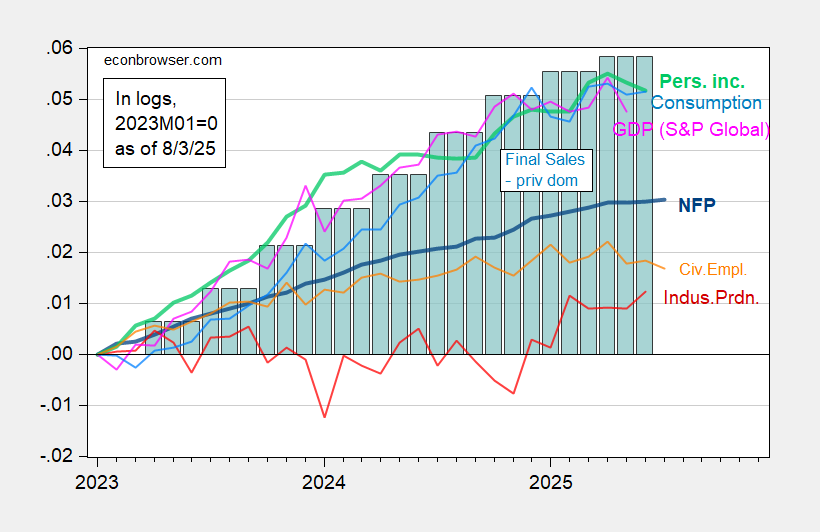
Bill McBride’s assessment here. In early April, I went on recession watch, but I’m still not yet predicting a recession for several reasons: the U.S. economy is very resilient and was on solid footing at the beginning of the year, and perhaps the tariffs are not enough to topple the economy. In the short term, it is mostly trade policy that will negatively impact the economy. However, there other aspects of policy that bear watching – especially immigration. Yesterday, Mark Zandi was stating his case for being wary: Moody’s Analytics chief economist Mark Zandi said the U.S. economy is “on the precipice of recession,” citing indicators from last week’s economic data releases. In a social media post Monday, Zandi pointed to stagnant consumer spending, contracting construction and manufacturing sectors and projected employment declines. Rising inflation makes it difficult for the Federal Reserve to provide economic stimulus, the economist said While unemployment remains low, Zandi attributed this to declining labor force growth rather than economic strength. “The foreign-born workforce is shrinking and labor force participation” is falling, he wrote. Here’s my picture of the state of the economy, with series not restricted to NBER BCDC’s key indicators, and substituting in final sales to private domestic purchasers for GDP: Figure 1: Nonfarm payroll employment (bold blue), personal income excluding current transfers (bold light green), civilian employment, experimental series with smoothed population controls (orange), industrial production (red), S&P Global monthly GDP (pink), and final sales to private domestic purchasers (teal bars), all in logs 2023M01=0.  Personal income, consumption, civilian employment, and monthly GDP are all below recent peaks. Industrial production is up, but nonfarm payroll employment is essentially flat over the last three months (33K/mo). NBER BCDC places highest emphasis on employment (presumably NFP) and personal income. Because the Sahm rule hasn’t been triggered and nonfarm payroll employment continues to rise, I — like CR — don’t think the downturn has arrived as of July (recalling we’re in August, and all the July numbers will be revised).  

Scroll to Top