
Africa’s top garment exporter could fold under US tariffs, minister says
Lesotho, which supplies Levi’s and Wrangler, declares ‘state of disaster’ as Trump threat triggers job cuts

Lesotho, which supplies Levi’s and Wrangler, declares ‘state of disaster’ as Trump threat triggers job cuts

Fund managers and bankers cast doubt on bets US president will back down from most severe threats
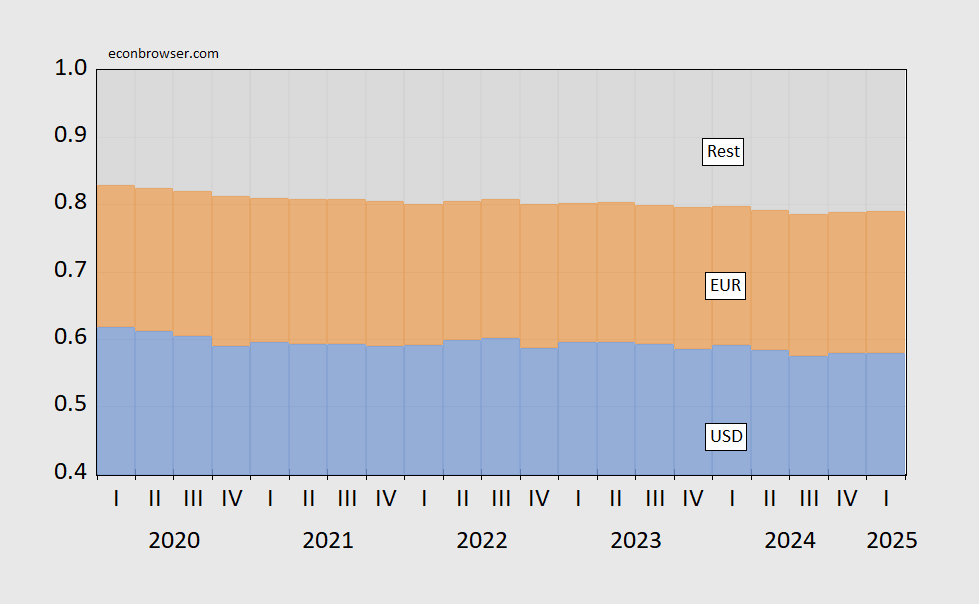
Based on IMF data (COFER, IFS): Figure 1: USD shares of fx (blue bars), EUR (tan), all other (gray). USD(EUR) share assumes 60%(35%) of unallocated reserves are in USD(EUR). Source: IMF COFER, and author’s calculations. The drop in USD reserves out of total FX reserves is not apparent. However, gold has taken on a heightened importance in recent years. Taking this into account, we have Figure 2. Figure 2: USD shares of fx and gold reserves (blue bars), EUR (tan), all other (gray), and gold (yellow). USD(EUR) share assumes 60%(35%) of unallocated reserves are in USD(EUR). Assumes quantity of gold holdings stay constant in 2025Q, and observed . Source: IMF COFER, World Gold Council, and author’s calculations. To the extent that total reserves are the relevant measure, the dollar has dropped by 1.4 percentage points in 2025Q1; the standard deviation of changes is 0.6 ppts. If central banks on net acquired gold in Q1 (World Gold Council suggests 50 tonnes whereas I assumed 0 tonnes), then the drop would be even larger.

Donald Trump’s tariff threats are just part of a much wider shift. Gillian Tett explains why commerce is being subordinated to statecraft — and how we can adapt

From (1) Reich and Prussian Minister of Economics and General Plenipotentiary (1937), and (2) President of the Reichsbank (1939) (discussion, Kopper (1998)). While it’s an inexact analogy, it’s of interest to recall it was Hermann Göring. I thought of this when I saw Russell Vought on TV today: Office of Management and Budget Director Russell Vought vowed Friday to press an investigation into renovations at the Federal Reserve building, which he called a “palace” where costs are running amok. A great line from the Wikipedia entry on Schacht: [Schacht] had grown increasingly dissatisfied with Göring’s near-total ignorance of economics, and was also concerned that Germany was coming close to bankruptcy. The main points of disagreement were the Goering’s demand for rearmament despite fiscal strains, aiming for autarky/self-reliance, and dismissal of concerns about deficit spending. Sounds familiar to me. <small>* Aside: Walther Funk succeeded Schlacht as President of the Reichsbank. I spent half a year living in Funk’s house, on the Wannsee, currently the home of the American Academy in Berlin (as a guest of my wife, a fellow there).</small>
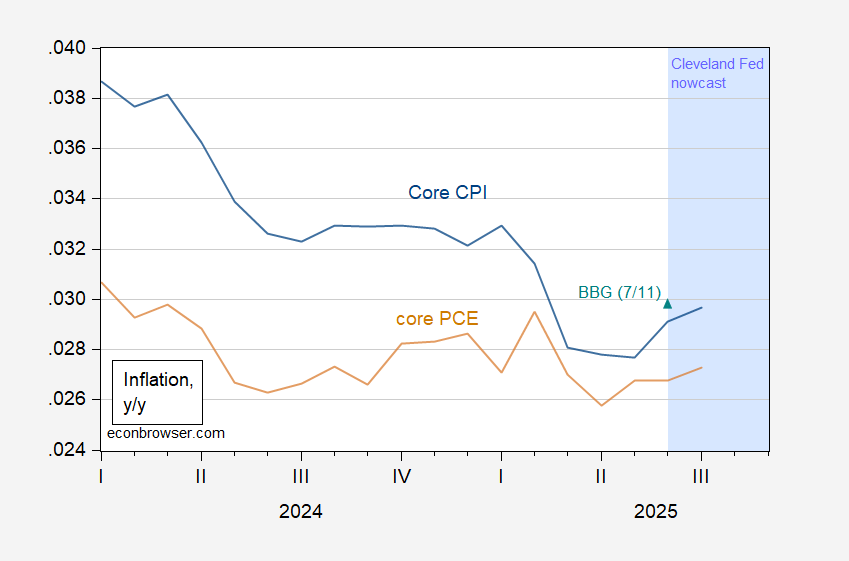
From Cleveland Fed today: Figure 1: Year on year core CPI inflation (blue), core PCE (tan), Bloomberg consensus of 7/11 (teal triangle). June, July 2025 observations are Cleveland Fed nowcasts as of 7/11. Source: BLS, Cleveland Fed, Bloomberg.

The exorbitant burden of exporting dollars makes it hard for America to govern at home

Long-term frameworks are necessary to lock in the desired effects of the US administration’s most controversial policies

EU’s controversial levy adds to momentum on pricing emissions

Energy advisory body expects global consumption to increase by 700,000 barrels a day this year