Germany and France push EU to prepare trade reprisals against US
Chancellor Friedrich Merz’s government wants to threaten a strong response if US is not prepared to compromise

Chancellor Friedrich Merz’s government wants to threaten a strong response if US is not prepared to compromise
There are lessons for central banks from past episodes of high inflation combined with weak growth
Also in this newsletter: Why Brussels and Beijing want to keep a united front against the US despite differences
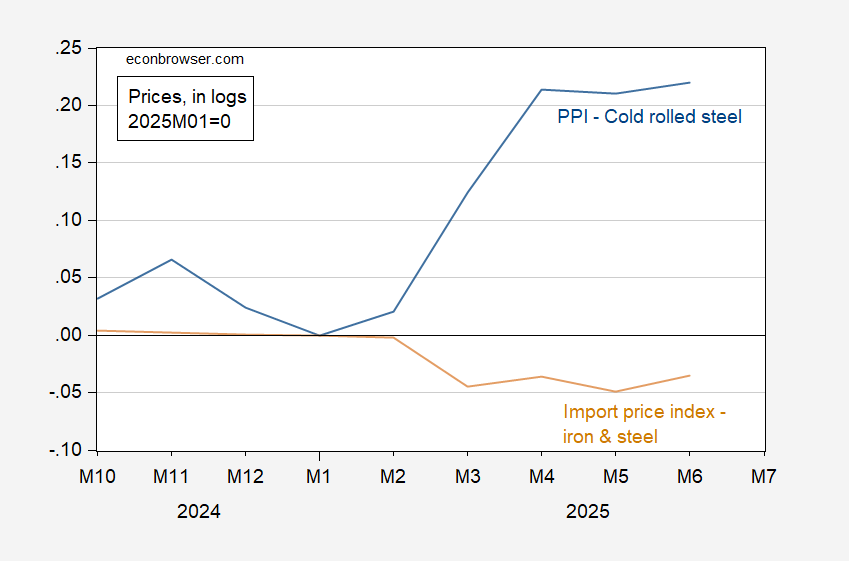
Recall CEA has asserted that imported goods prices (incl tariffs) have fallen relative to domestically produced, based on conjoining 2017 IO tables and PCE data. I wondered whether imported goods prices and prices of close substitutes have fallen. To investigate, I do something simpler: look at steel import prices (ex-tariffs) and steel PPI (incl. tariffs). Figure 1: Import price index for iron and steel (tan), PPI for cold rolled steel (blue), both in logs 2025M01=0. Source: BLS, and author’s calculations. Effective June 4, a 50% Section 232 tariff has been in effect, rising from the previous 25%. Since January 2025, the import price index has fallen 3.5%, while the steel/iron PPI has risen 22% (log terms). So as the 50% tariff comes into play, we should expect — on net — continued increases in the price of steel. More discussion at NYT.
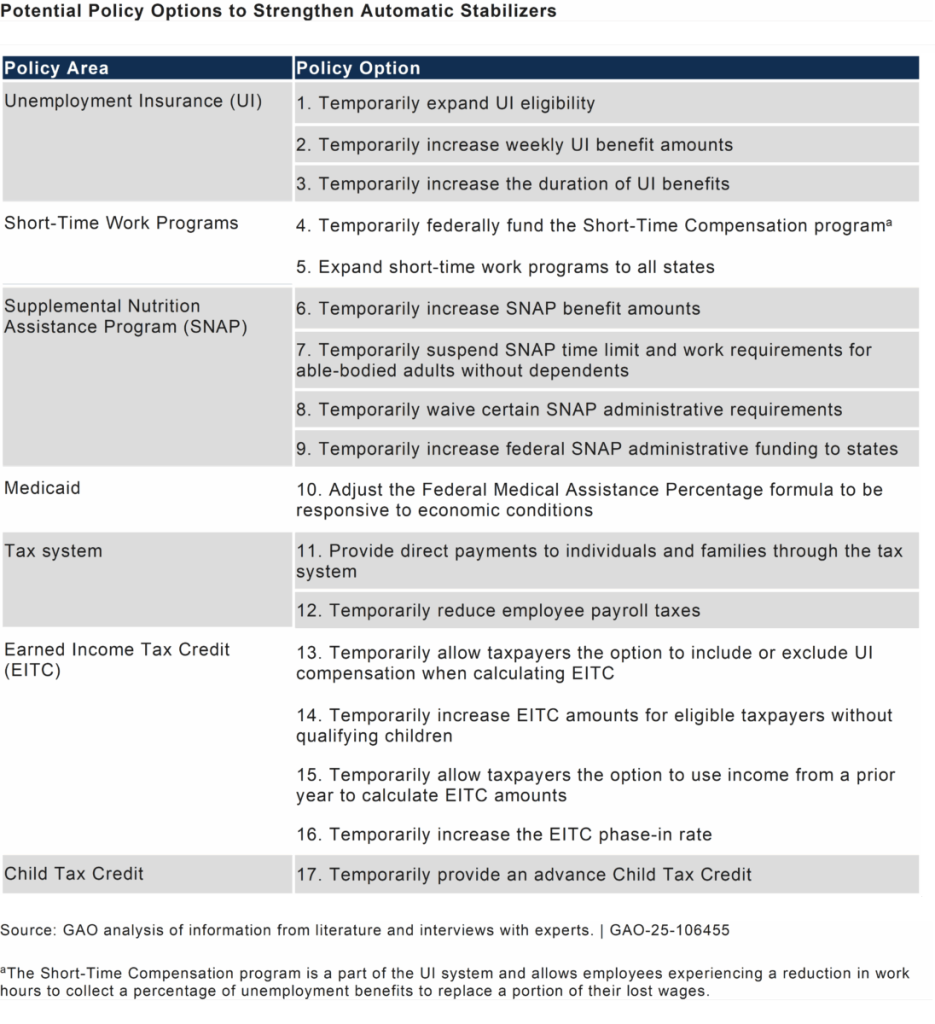
I think we’ll need these sooner than you think. But legislation has just been passed to disable these supports. From GAO, “During Past Recessions and Economic Downturns, These Factors Supported an Effective Fiscal Response,” July 15, 2025. GAO identified four principles that could be used to assess the design or reform of automatic stabilizers. Information from literature and economic and social policy experts suggests that effective automatic stabilizers are timely, temporary, targeted, and predictable. Within those four broad principles, GAO identified eight factors that contribute to the effective design of automatic stabilizers (see table). To my knowledge, recent legislation goes the other direction, at least insofar as Medicaid and SNAP are concerned. Entire report here.
Jakarta and Washington release deal framework while US president says Philippines will pay 19% rate
Ursula von der Leyen and António Costa prepare to meet Xi Jinping in Beijing amid geopolitical turmoil
Japanese Prime Minister Shigeru Ishiba says he will ‘examine the details’ as US president announces 15% tariff