Economic News

Economic News

Scary Picture?

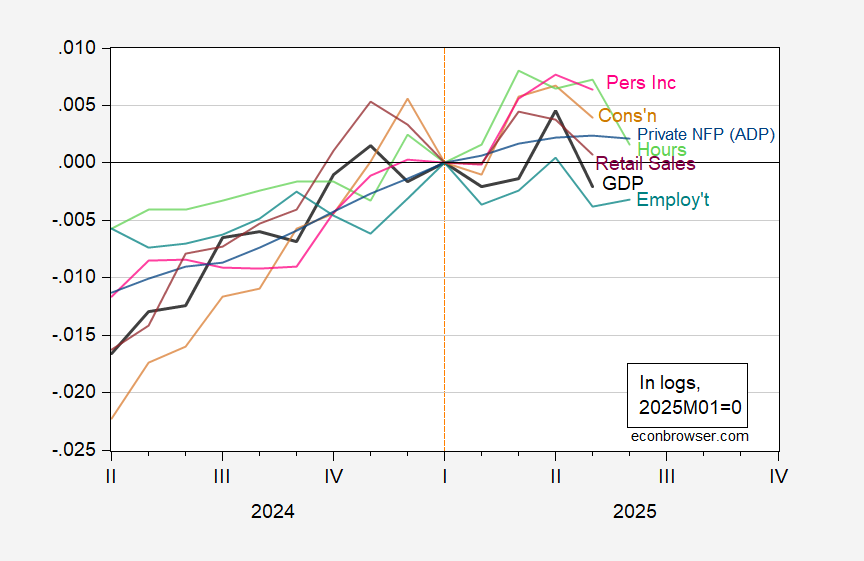
Some macro series. One observation does not make a trend – but still… Figure 1: Monthly GDP (black), private nonfarm payroll employment-ADP (blue), civilian employment w/smoothed population controls (light blue), aggregate hours (light green), consumption (tan), personal income ex-transfers (pink), real retail sales (purple), all in logs 2025M01=0. Real retail sales is 3 month centered moving average of retail sales, divided by chained CPI. Source: S&P Global, ADP-Stanford, BLS, BEA, Census, and author’s calculations. Note that NBER’s Business Cycle Dating Committee places primary emphasis on employment and income. Series that continue to rise include the Philadelphia Fed’s coincident index. For a more complete tabulation of series, see this post.  

Economic News

West Coast Port Traffic Down

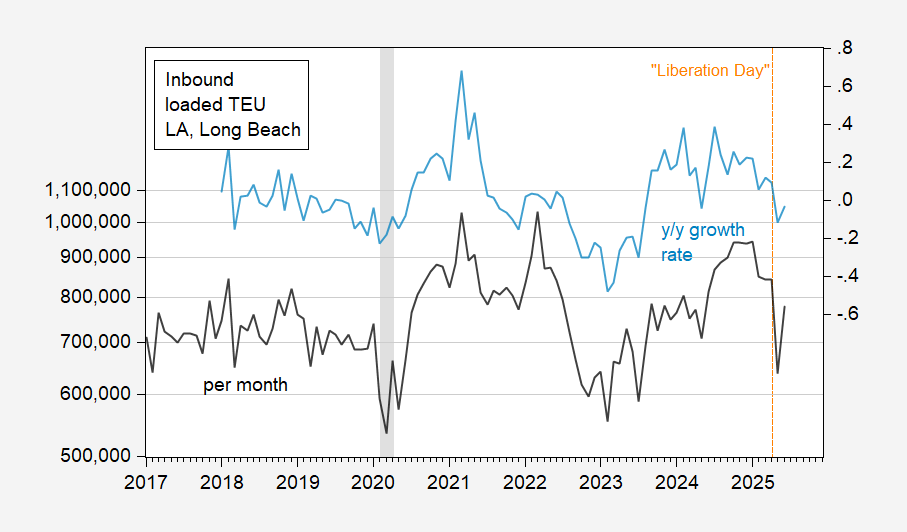
Or at least Long Beach and LA: Figure 1: Inbound loaded TEU’s at Long Beach and LA ports, n.s.a. (black, left scale), year-on-year growth (light blue, right scale). NBER defined peak-to-trough recession dates shaded gray. Source: Ports of Long Beach, LA, NBER and author’s calculations. Inbound traffic is down 3.5% y/y, and down 32.7% q/q AR.  

Economic News

Nowcasts of GDP and “Core GDP”

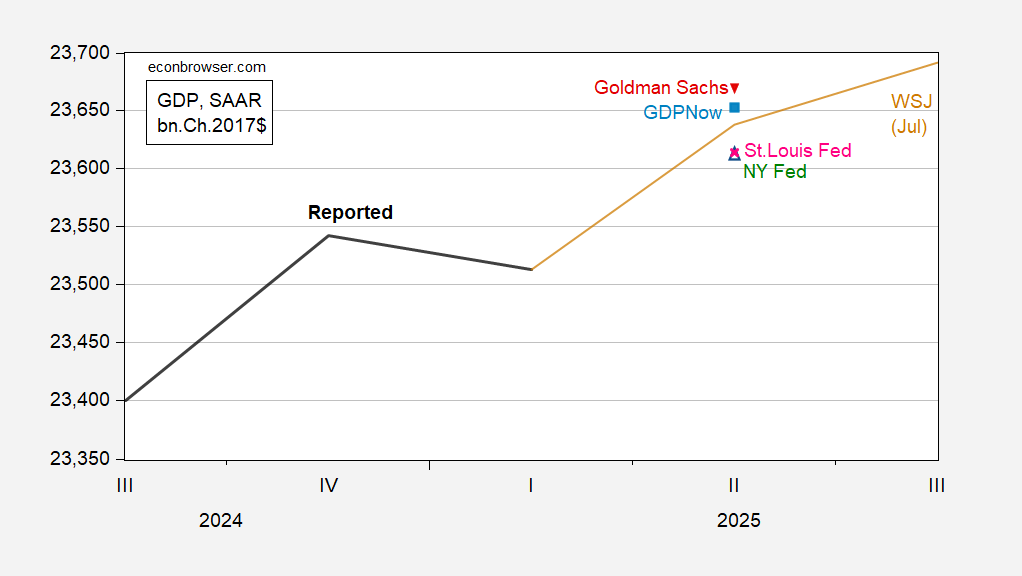
As of today, GDP nowcasts split, but final sales to private domestic purchasers (coined “Core GDP” by Furman) consensus is deceleration. Figure 1: GDP, 3rd release (bold black), WSJ July survey mean (tan), GDPNow (light blue square), Goldman Sachs (inverted red triangle), NY Fed (open green triangle), St. Louis (pink *). All nowcasts are as of 7/25. Source: BEA, WSJ survey, Atlanta Fed, NY Fed, St. Louis Fed, Goldman Sachs and author’s calculations. At 5 days to the 2025Q2 advance release (on July 30), the Atlanta Fed’s GDPNow has been about as accurate as the Bloomberg consensus, at least in pre-pandemic days. Here’s DeutscheBank’s 2019 comparison. Source: Luzzetti, et al. “Tracking the GDP trackers,” Deutsche Bank US Economic Perspectives, 24 July 2019. The NY Fed nowcast has been substantially revamped, so the MAE numbers shown above are no longer relevant. Kalshi betting is on 2.5% as of today, close to GDPNow’s 2.4% q/q AR. As is by now well known, the GDP measure has been distorted by tariff front-running combined with difficulties in accurately measuring inventory accumulation. Hence, it makes sense to look to domestic private demand for all goods and services. This is proxied by final sales to private domestic purchasers, aka “Core GDP”. Figure 2: Final sales to private domestic purchasers, 3rd release (bold black), GDPNow (light blue square), Goldman Sachs (inverted red triangle). All nowcasts are as of 7/25. Source: BEA, Atlanta Fed, Goldman Sachs and author’s calculations. Since the series are drawn on a log scale, the flattening slope is equivalent to decreasing growth rates. Both predictions are for 0.9% q/q AR growth, down from 1.9% in Q1, and 2.9% in 2024Q4.    

Economic News

Signs of a Slowing Russian Economy: CBR Drops Rate 200 bp

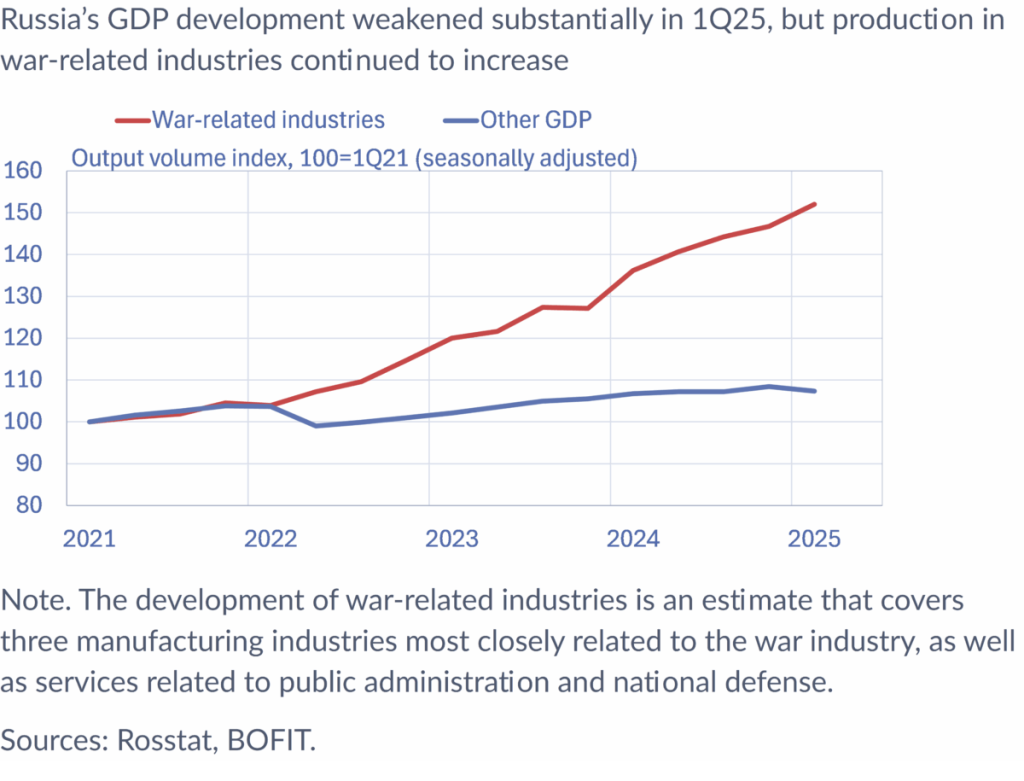
Three weeks ago, Bofit remarks “Concerns emerge over Russia’s slowing growth”: Rosstat this week affirmed its preliminary first-quarter GDP growth estimate of 1.4 % y-o-y, bolstering the view that a substantial slowing of Russia’s economic growth is underway. 1Q25 GDP shrank from the previous quarter by 0.6 % – the first on-quarter decline in GDP since spring 2022 following the invasion of Ukraine. Annual GDP growth was still supported by war-related manufacturing industries and services. In contrast, mining and quarrying production, for example, contracted clearly in January-March, and the volume of wholesale and retail sales also decreased slightly. … Russia’s GDP forecasts have generally been lowered in recent months due to the worsening economic imbalances and the fall in oil prices. The World Bank’s forecast published in June expects GDP growth of 1.4% this year and 1.2% next year. Consensus Economics’ June report predicts GDP growth of 1.4% this year and 1.3% next year. And so in some sense not surprising that the Central Bank of Russia drops the interest rate, today: It’s not clear to me that this will do anything much except accelerate inflation; that’s because of the reasoning in the Bofit piece as well as Hilgenstock and Ribakova (PIIE): By the end of 2024 and in early 2025, signs of economic deceleration had become evident. Even the military-industrial sector began to stagnate. The economy had butted up against its supply-side constraints and the Bank of Russia was focused on reining in inflation. In the first quarter of 2025, annual growth slowed to an estimated 1.4 percent year-on-year (from 4.5 percent in the last quarter of 2024). This actually means a 0.6 percent contraction of activity compared to the previous quarter—the first quarterly contraction since the second quarter of 2022 (figure 1). Monetary policy can’t do much if the supply side is constrained. Maybe there’ll be a respite in commodity (oil) prices. It could be that Trump relaxes sanctions. However, even Brent prices remain low so it’s not clear that this would save the Russian economy. One implication: Now is not a time to relent in terms of pressuring the Russian economy. Moscow’s ability to continue to wage war is being more and more constrained, even as resources continue to be directed to that endeavor.        

Scroll to Top