
European stocks rise to 4-month high after US and EU strike tariff deal
Agreement removes threat of full-blown trade war between Washington and Brussels

Agreement removes threat of full-blown trade war between Washington and Brussels

Agreement reduces uncertainty over tariffs that has stalked markets

No economy rises or falls for just one reason, even a shock as big as Trump’s trade policy

US officials have been warned to avoid tough moves against Beijing as Stockholm hosts third round of negotiations
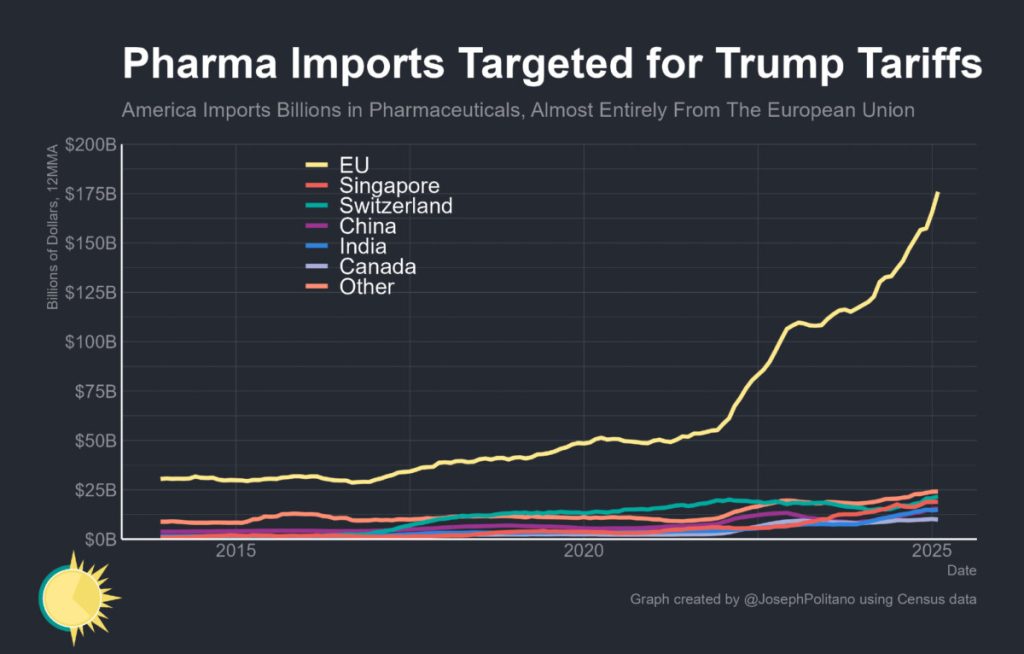
The just-announced trade “deal” (what’s the enforcement mechanism?) apparently covers pharmaceuticals. Where do we get most of our pharma (by value)? From Joey Politano, the answer: Source: Politano. I don’t think there’s anything on paper (and even if there were, would it mean much?). So, not the 50% I pondered back in May, but still 15% is above 10%. * To be clear, we do not know if Mr. Trump is taking a GLP-1. ** Back of the envelope calculation of tax increase. Effective tariff rate rises from 1.2% to 15%; 2024 imports from EU equals approx 600 bn. Assuming no price response (price elasticity is 0), and US as small country, this is a tax increase of $83bn/year, or $70 bn/year assuming a price elasticity of demand of unity.

Also in today’s newsletter, Taiwanese voters reject attempt to recall KMT lawmakers, and China proposes global body to govern AI

Relief at avoiding trade war is tinged with regret at not taking firmer stand from the start
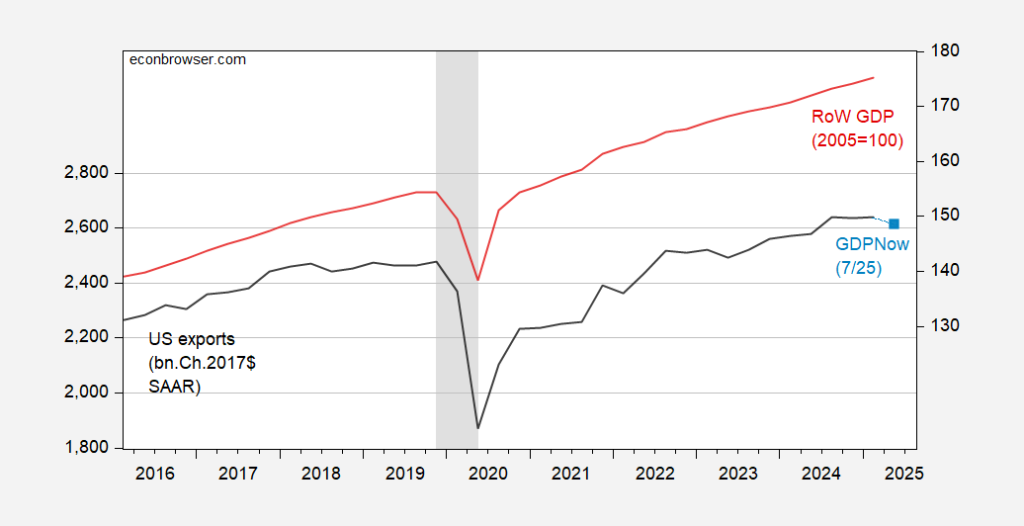
What else did you expect? Figure 1: US exports of goods and services (black, left log scale), GDPNow nowcast (light blue square, left log scale), both in bn.Ch.2017$ SAAR; export weighted rest-of-world GDP, 2005=100 (red, right scale). NBER defined peak-to-trough recession dates shaded gray. Source: BEA 2025Q1 3rd release, Atlanta Fed, Dallas Fed, NBER and author’s calculations. So in Q1, RoW GDP rose but real US exports fell; more telling, the dollar depreciated in inflation adjusted term from January to March, which would have in normal times induced an increase in exports…(dollar depreciation January to June is 6.5% in log terms). The Atlanta Fed’s 7/25 nowcast indicates 3.3% q/q annualized (0.9% q/q) decline in Q2 real exports (incorporates monthly trade data through May’s numbers).

Jay Powell expected to widen rift with Trump by keeping monetary policy unchanged at Wednesday’s meeting