Economic News

Economic News

Trade Policy Uncertainty on the Eve

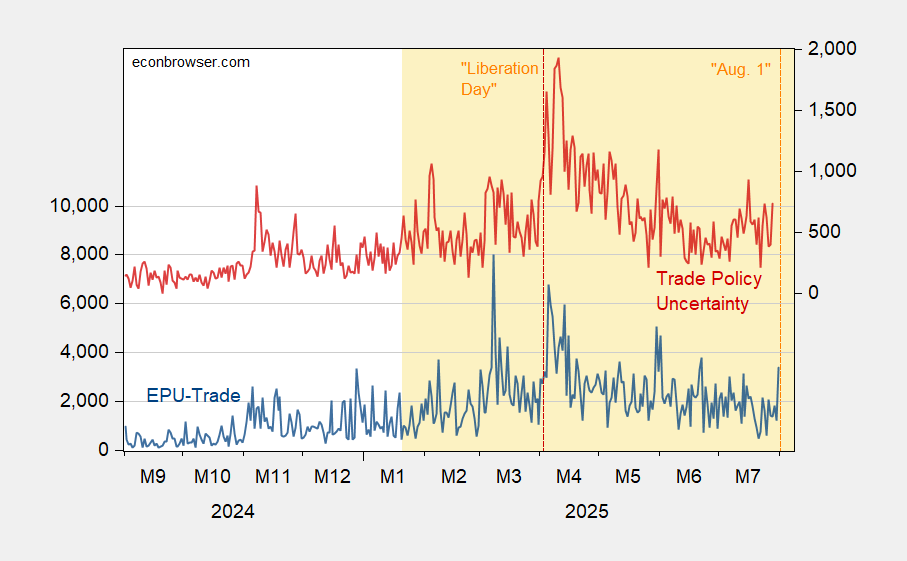
Baker, Bloom and Davis and Caldara et al. measures: Figure 1: EPU-trade category (blue, left scale), and Trade Policy Uncertainty index (red, right scale). Source: Baker, Bloom & Davis policyuncertainty.com, and Caldara et al. TPUD. [updated 7/28] Tariffs will go into effect in 7 days. So still time for TACO (90 days for Mexico).    

Economic News

State of the Macroeconomy: GDP, Key Indicators as of 7/31

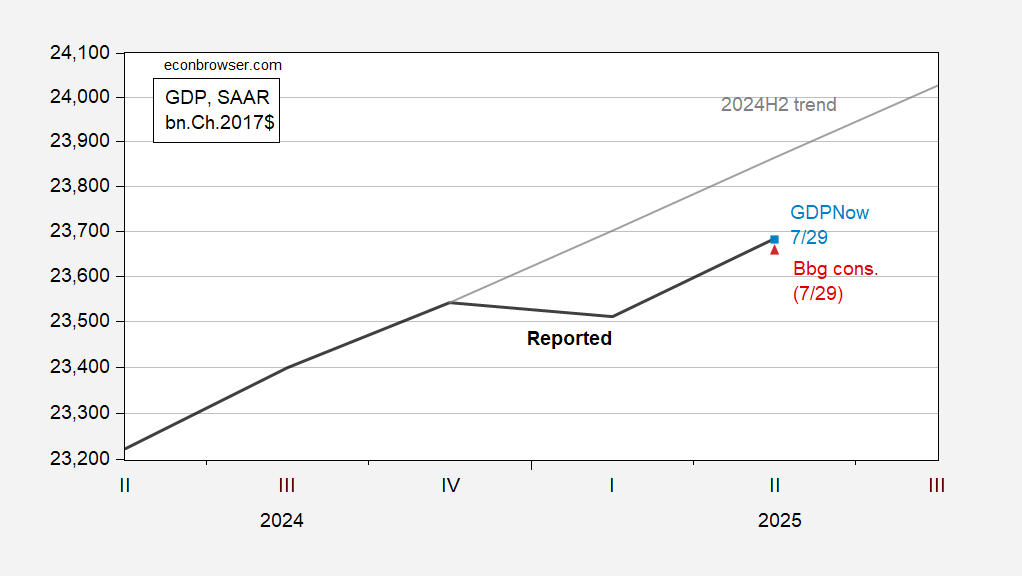
Following up on Jim’s post on the GDP release yesterday, looking at different aspects of economic activity: Quarterly Indicators First, ignoring the self-congratulatory remarks of CEA47, consider the level of GDP relative to the 2024H2 trend: Figure 1: GDP fm Q2 advance (bold black), GDPNow of 7/29 (light blue square), Bloomberg consensus as of 7/29 (red triangle), linear extrapolation using 2024H2 growth rate. Source: BEA, Atlanta Fed, Bloomberg, and author’s calculations. While the CEA might be buoyed by the 3% which exceeded consensus, it’s clear that 3% did not put GDP on its pre-Trump trajectory. Interestingly, on the day before the release, the Atlanta Fed’s GDPNow was essentially on target at 2.9% vs actual 3.0% y/y annualized (4 days before release, it was at then-consensus of 2.4%). Given the distortions in GDP associated with tariff frontloading, I think these are times when it’s particularly useful to use final sales to private domestic purchasers (aka “Core GDP”) as a proxy measure for economic momentum. “Final sales” means stripping out the volatile — and difficult to measure — inventory component, while “private domestic purchasers” means excluding net exports and government spending. Here’s the picture of that series relative to nowcasts. Figure 2: Final sales to private domestic purchasers fm Q2 advance (bold black), GDPNow of 7/29 (light blue square), Bloomberg consensus as of 7/29 (red triangle), linear extrapolation using 2024H2 growth rate. Source: BEA, Atlanta Fed, Bloomberg, and author’s calculations. Figure 2 makes clear that focusing on this proxy measure for private aggregate demand, while surprising on the upside, is still decelerating (1.8% y/y annualized vs. GDPNow 0.8%, and 3% in 2024H2). To highlight the point that private domestic purchases is a smoother series than GDP, see Figure 3 regarding the post-Covid period. Figure 3: GDP Final sales to private domestic purchasers (bold black), GDPNow of 7/29 (light blue square), Bloomberg consensus as of 7/29 (red triangle), linear extrapolation using 2024H2 growth rate. Source: BEA, Atlanta Fed, Bloomberg, and author’s calculations. Over this period, the standard deviation of q/q annualized changes for GDP and final sales are 1.5% vs. 1.0%. What about alternative indicators of aggregate output? We don’t have real GDI for Q2, so we only have GDO through Q1; however we do have implied GDPPlus through Q2, so here’s the picture, along with today’s Atlanta Fed nowcast of Q3 GDP. Figure 4: GDP fm Q2 advance (bold black), GDPNow of 7/31 (light blue square), linear extrapolation of GDP using 2024H2 growth rate, GDO (tan), GDP+ based to 2024Q1 (green). Source: BEA, Atlanta Fed, Philadelphia Fed, and author’s calculations. GDPNow indicates continued growth of 2.3% in Q3, but based on very little information, even though we’re 1/3 of the way through the quarter. Even with this above potential growth rate, the gap between 2024H2 trend and actual GDP will not be closed. Monthly Indicators Today’s releases included consumption, personal income for June, and manufacturing and trade industry sales for May. Taking into account anticipated July employment (Bloomberg), we have the following picture of monthly indicators followed by NBER’s Business Cycle Dating Committee (with employment and income the key ones). Figure 5: Nonfarm Payroll from CES (bold blue), implied NFP Bloomberg consensus as of 7/30 (blue +), civilian employment with smoothed population controls (orange), industrial production (red), personal income excluding current transfers in Ch.2017$ (bold light green), manufacturing and trade sales in Ch.2017$ (black), consumption in Ch.2017$ (light blue), and monthly GDP in Ch.2017$ (pink), GDP (blue bars), all log normalized to 2021M11=0. Source: BLS via FRED, Federal Reserve, BEA 2025Q2 advance release, S&P Global Market Insights (nee Macroeconomic Advisers, IHS Markit) (7/1/2025 release), and author’s calculations.  Here are some alternative monthly indicators (drawn on same vertical scale as Figure 5): Figure 6: Implied Nonfarm Payroll early benchmark (NFP) (bold blue), civilian employment adjusted to nonfarm payroll concept, with smoothed population controls (orange), manufacturing production (red), vehicle miles traveled (teal), real retail sales (black), and coincident index in Ch.2017$ (pink), GDO (blue bars), all log normalized to 2021M11=0. Source: Philadelphia Fed [1], Philadelphia Fed [2], Federal Reserve via FRED, BEA 2025Q2 advance release, and author’s calculations. One observation is that real consumption and personal income ex-transfers were flat, and down respectively in June, while the manufacturing and trade industry sales series has continued a downward trend through May. While Bloomberg consensus is for a continued increase in nonfarm payroll employment, ADP’s private NFP series has been essentially flat through June. Conclusion Taken all together, it’s hard to see a recession in June’s data (keeping in mind all these observations will be revised), and given the consensus unemployment rate increase of 0.1 percentage points, the Sahm rule will not be triggered (exception, see Michaillat’s post). But clearly the economy looks like it’s entering a period of decelerating growth, perhaps even zero growth on key indicators.    

Economic News

Instantaneous Core Inflation Again Rising

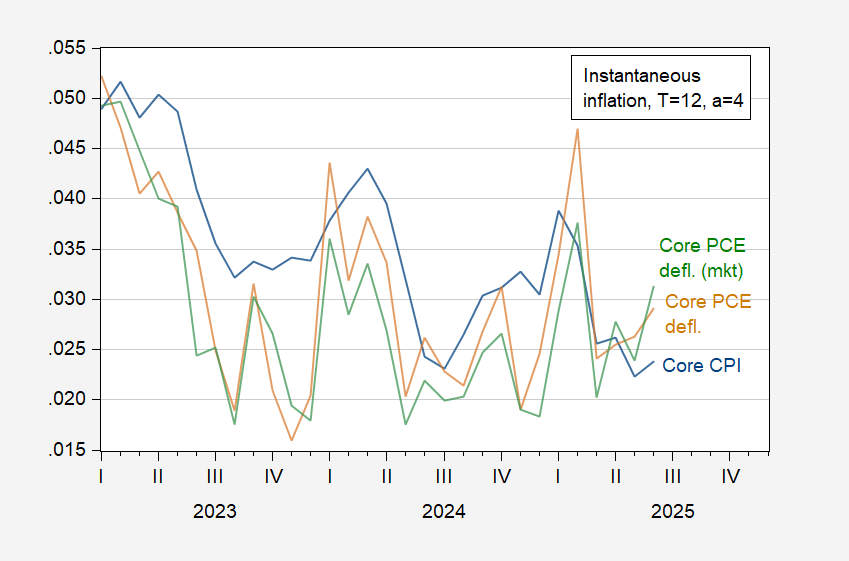
Though not quite to February rates: Figure 1: Instantaneous inflation for core CPI (blue), core PCE deflator (brown), core PCE deflator (market) (green) per Eeckhout (2023), T=12, a=4.  Source: BLS, BEA, via FRED, and author’s calculations.  How has inflation evolved for people changed, as compared to the CPI. I plot the CPI inflation for the 2nd quintile of households by income, and AIER’s Everyday Price Index (EPI) inflation below in Figure 2. Figure 2: Instantaneous inflation for CPI (blue), for CPI for 2nd quintile by household income (brown), for AIER’s Everyday Price Index  (green), per Eeckhout (2023), T=12, a=4.  Source: BLS, BLS, via FRED, AIER,  and author’s calculations.  The instantaneous inflation rate of the EPI is above 5%, substantial above the 2.7% recorded using the headline CPI, and rising.  

Economic News

CRFB CEA Watch

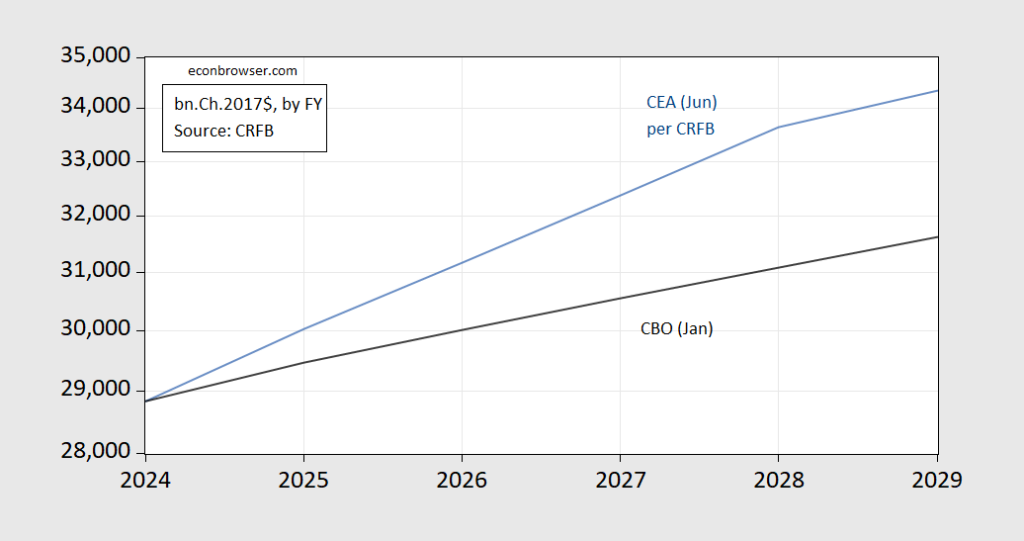
CRFB spreadsheet here for now; to be updated. Figure 1: CBO GDP projection from January 2025 (black), implied CEA June forecast (blue), both in bn.Ch.2017$, by fiscal year. Source: CRFB. A quarterly look at the CEA implied forecast calculated by me here. The difference between the two seems to be attributable to the faster growth CRFB attributed to the CEA’s near term growth, than mine where I distributed evenly growth.        

Economic News

Economy back to growing

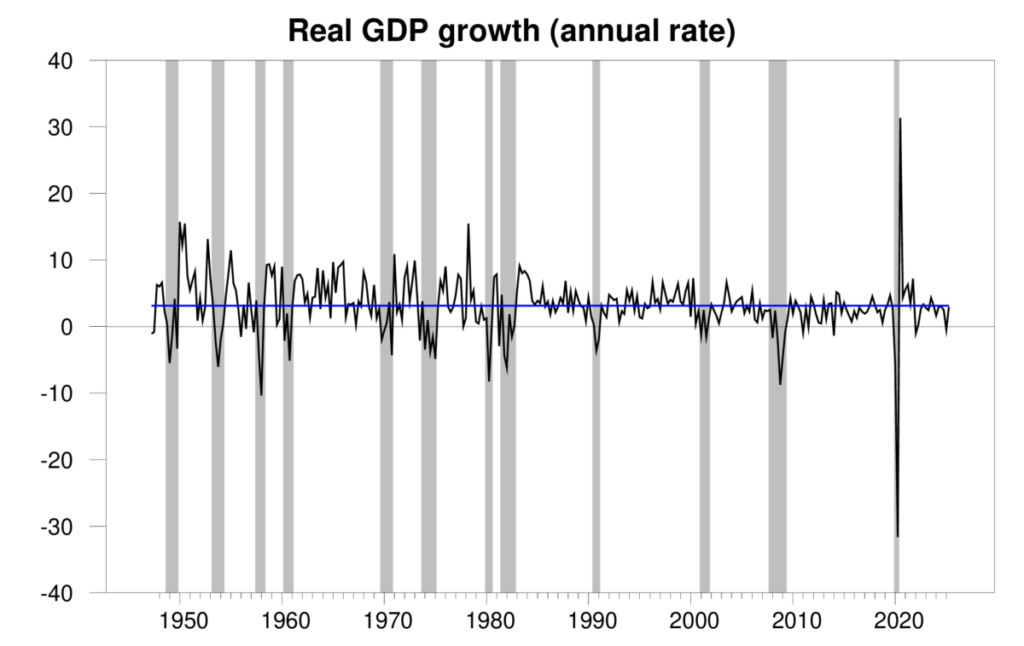
The Bureau of Economic Analysis announced today that seasonally adjusted U.S. real GDP grew at a 3.0% annual rate in the second quarter. I have some concerns, but it looks better than many economists had been anticipating. Quarterly real GDP growth at an annual rate, 1947:Q2-2025:Q2, with the historical average since 1947 (3.1%) in blue. Calculated as 400 times the difference in the natural log of real GDP from the previous quarter. With the new numbers the Econbrowser recession indicator index is up to 11.7%. This primarily reflects the drop in GDP that we observed in the first quarter. The index offers an assessment of where the economy was as of 2025:Q1. Since we started reporting this measure in 2005, Econbrowser reports the index with a one-quarter lag to allow for data revisions and to aid the algorithm in pattern recognition. Though up slightly, the latest value of 11.7% is not alarming. GDP-based recession indicator index. The plotted value for each date is based solely on the GDP numbers that were publicly available as of one quarter after the indicated date, with 2025:Q1 the last date shown on the graph. Shaded regions represent the NBER’s dates for recessions, which dates were not used in any way in constructing the index. The story in the second-quarter GDP report was the flip of the first quarter. In Q1 there was a surge in imports (which other things equal means lower GDP) as businesses built up inventories of imported goods in anticipation of tariffs. In Q2, imports fell dramatically (which accounts for much of the strength in GDP in Q2) with firms drawing down those inventories. Both residential and nonresidential fixed investment were weak in the second quarter. Inventories are also the wild card in watching the effects of the tariffs on inflation. Some businesses may still be setting prices based on the historical cost of goods, meaning some of the inflationary effects are yet to come. Still, let us count our blessings that the actual current average effective tariff rate is lower than originally threatened. As of this morning, anyway.

Economic News

Final Nowcast for Q2

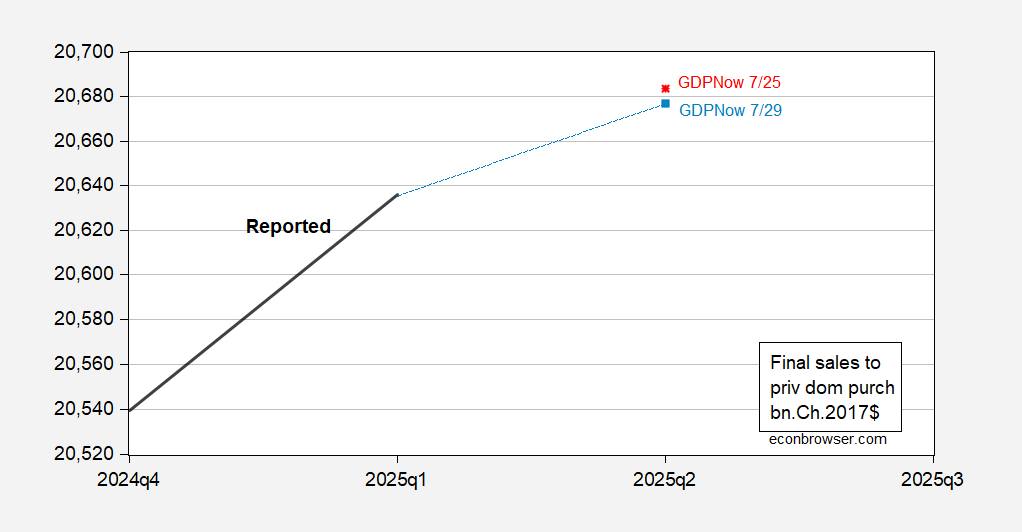
Atlanta Fed nowcast incorporating advance economic indicators indicates 2.9% q/q AR, up from 2.4%. The news is in final sales to private domestic purchasers. Figure 1: Final sales to private domestic purchasers (bold black), GDPNow of 7/25 (red *), GDPNow of 7/29 (light blue square), all in bn.Ch.2017$ SAAR.  Source: BEA 2025Q1 3rd release, Atlanta Fed, and author’s calculations. Since this series excludes imports and exports as well as inventories, it should be less affected by distortions associated with tariff front-running. That nowcasted final sales growth in Q2 is  0.8% SAAR, down from 0.9% just four days ago. Moreover, this Q2 growth rate is less than half the 1.9% in Q1, and 2.9% in 2024Q4. So, don’t be overly focused on GDP.

Economic News

Conference Board: Economic Confidence Up (a Little)

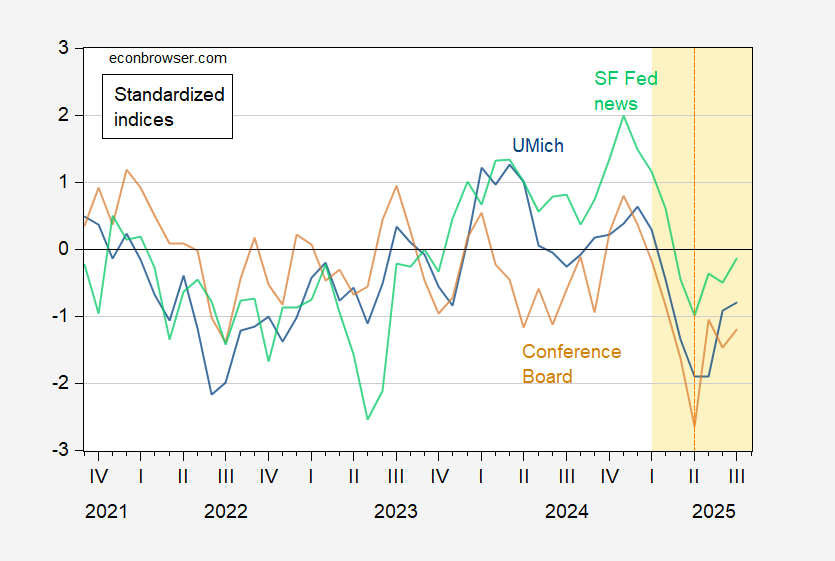
The Conference Board today: The Conference Board Consumer Confidence Index® improved by 2.0 points in July to 97.2 (1985=100), from 95.2 in June (revised up by 2.2 points). The Present Situation Index—based on consumers’ assessment of current business and labor market conditions—fell 1.5 points to 131.5. The Expectations Index—based on consumers’ short-term outlook for income, business, and labor market conditions—rose 4.5 points to 74.4. But expectations remained below the threshold of 80 that typically signals a recession ahead for the sixth consecutive month. The cutoff date for preliminary results was July 20, 2025. “Consumer confidence has stabilized since May, rebounding from April’s plunge, but remains below last year’s heady levels,”  … Figure 1 shows the Conference Board’s measure vs. the MIchigan measure, and a text based news sentiment index. Figure 1: University of Michigan Consumer Sentiment (blue), Conference Board Consumer Confidence (tan), and Shapiro, Sudhof and Wilson (2020) SF Daily News Sentiment Index (light green) , all demeaned and normalized by standard deviation (for the 2021-2025M02 sample period); and Shapiro, Sudhof and Wilson (2020) SF Daily News Sentiment Index (black, right scale). The News Index observation for July is through 7/27/2025. Orange shading denotes Trump 2.0 administration. Orange dashed line at “Liberation Day” in 2025M04. Source: U.Mich via FRED, Conference Board via Investing.com, SF Fed, and author’s calculations. The Conference Board measure is TWO standard deviations lower than November 2024, and ONE standard deviation below January 2025. Note the distinction between current conditions vs. expected. Source: Conference Board, accessed 7/29/2025. As CB observes, the expectations measure remains below the recession threshold. Finally, as for individual households’ views regarding their own expected situation in the future, this figure is relevant. Source: Conference Board, accessed 7/29/2025. While the “better”-“worse” differential has shifted to slightly more positive relative the nadir in April, it is substantially below the January 2025 high point.  

Economic News

Forecasts: CEA >> IMF > WSJ

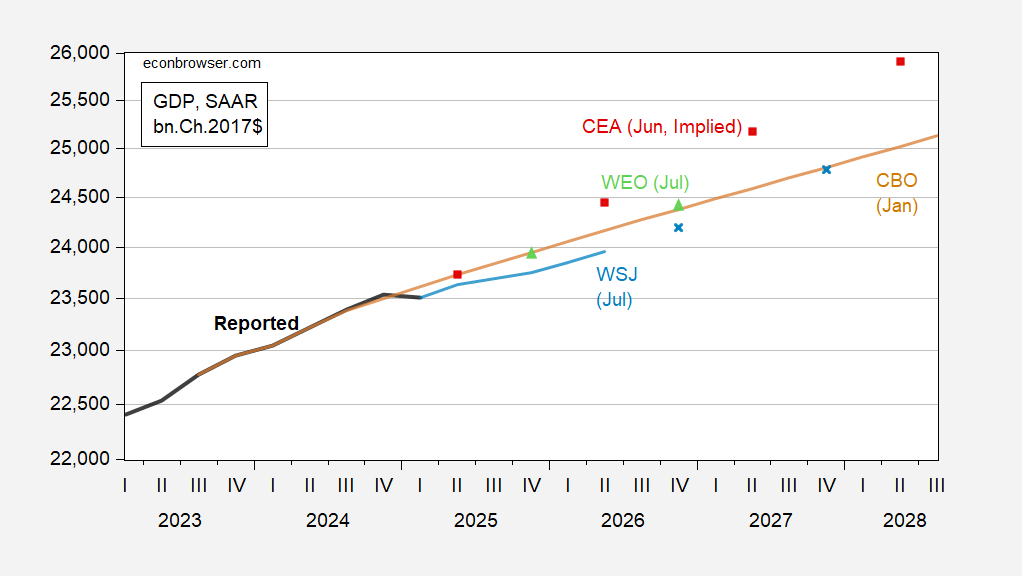
From IMF’s July World Economic Outlook, released today: Figure 1: GDP (bold black), CBO current law projection of January (tan), implied CEA forecast using CBO current law (red squares), mean forecast from July WSJ survey (light blue line, x), July WEO (light green triangle), all in bn.Ch.2017$ SAAR. Source: BEA 2025Q1 3rd release, CBO January 2025, CEA (2025), WSJ survey, and author’s calculations. The IMF WEO trajectory is based on this forecast: Source: IMF, WEO July 2025 update. From the report: Global growth is projected at 3.0 percent for 2025 and 3.1 percent in 2026. The forecast for 2025 is 0.2 percentage point higher than that in the reference forecast of the April 2025 World Economic Outlook (WEO) and 0.1 percentage point higher for 2026. This reflects stronger-than-expected front-loading in anticipation of higher tariffs; lower average effective US tariff rates than announced in April; an improvement in financial conditions, including due to a weaker US dollar; and fiscal expansion in some major jurisdictions. Global headline inflation is expected to fall to 4.2 percent in 2025 and 3.6 percent in 2026, a path similar to the one projected in April. The overall picture hides notable cross-country differences, with forecasts predicting inflation will remain above target in the United States and be more subdued in other large economies. Risks to the outlook are tilted to the downside, as they were in the April 2025 WEO. A rebound in effective tariff rates could lead to weaker growth. Elevated uncertainty could start weighing more heavily on activity, also as deadlines for additional tariffs expire without progress on substantial, permanent agreements. Geopolitical tensions could disrupt global supply chains and push commodity prices up. Larger fiscal deficits or increased risk aversion could raise long-term interest rates and tighten global financial conditions. Combined with fragmentation concerns, this could reignite volatility in financial markets. On the upside, global growth could be lifted if trade negotiations lead to a predictable framework and to a decline in tariffs. Policies need to bring confidence, predictability, and sustainability by calming tensions, preserving price and financial stability, restoring fiscal buffers, and implementing much-needed structural reforms.

Economic News

A Quasi-Real Time Measure of the Average Effective Tariff Rate

The Yale Budget Lab regularly (’cause… Trump) updates the stated effective tariff rate. But what’s the actual effective tariff rate in effect given all the threats, pauses, etc.? Not sure? Fortunately, Paweł Skrzypczyński is on the case: Source: Paweł Skrzypczyński, accessed 7/29/2025. As of June July, the average effective tariff rate is 9.1%. Note that as of today (noon CT), Yale Budget Lab indicates the average effective tariff rate given policies announced through 7/27 is 16.6% (pre-substitution, before August 1 tariffs are in effect).            

Scroll to Top