
The market is looking through the tariffs
And it is right to do so (for now)


Consumer goods giant reports sales growth helped by rising prices of personal care and household products

Information overload may be contributing to the S&P 500’s resilience
Brad Swanson Rather than deporting millions of migrants, this Republican president opted for the opposite strategy—legalizing them. The post What We Can Learn About Immigration From an Unlikely Source: Ronald Reagan appeared first on The Nation.
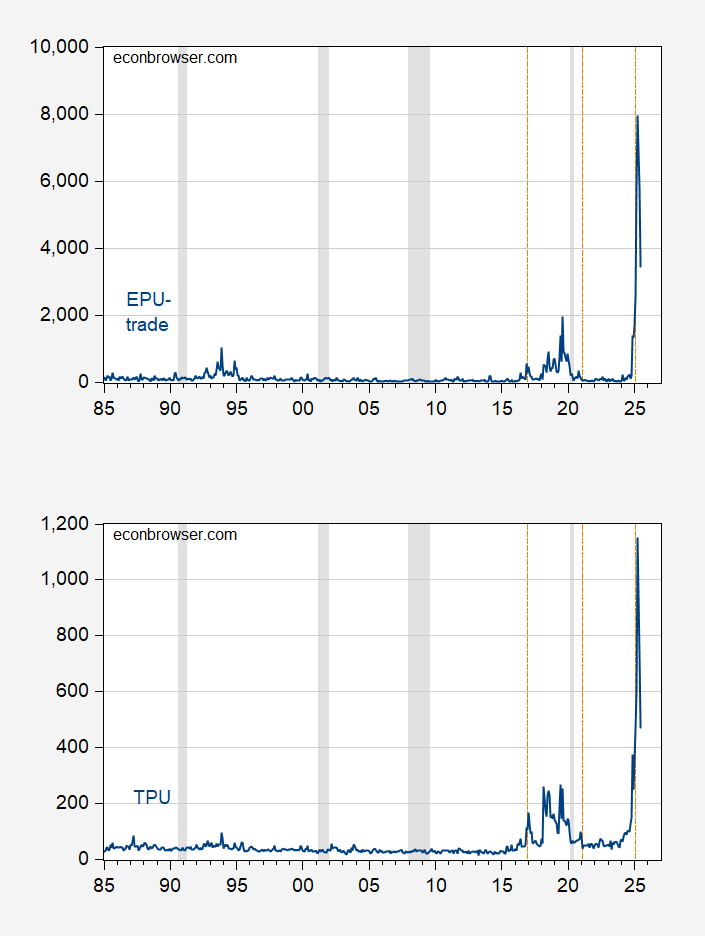
Oral arguments before the appellate court take place this week. Suppose the tariffs invoked under IEEPA are struck down, then that decision would likely be appealed to the Supreme Court (eventually). From CNBC: The case, known as V.O.S. Selections v. Trump, is the furthest along of more than half a dozen federal lawsuits challenging Trump’s use of the emergency-powers law. It’s set for oral argument before the Federal Circuit on Thursday morning. “I think the tariffs are at risk,” said Ted Murphy, partner and head of global trade practice at law firm Sidley Austin, in an interview with CNBC. The law has “never been used for this purpose,” and it’s “being used quite broadly,” Murphy said. “So I think there are legitimate questions.” What about at the Supreme Court? The article continues: “Trump will probably continue to lose in the lower courts, and we believe the Supreme Court is highly unlikely to rule in his favor,” U.S. policy analysts from Piper Sandler wrote in a research note Friday morning. The analysts wrote that such a loss would effectively mean the collapse of almost every trade development that Trump has held up as an accomplishment during his first six months in office. “If the Supreme Court rules against Trump, all of the trade deals Trump has reached in recent weeks — and those he will reach in the coming days — are illegal,” the analysts wrote. “So are his letters informing countries of their new tariffs, the current 10% minimum, and the reciprocal tariffs he has proposed or threatened,” they added. If the analyst is correct, then the question would be whether Mr. Trump complies. Abolishing the tariffs would then mean a massive hit on the US and global economy would have been for naught, while elevating policy uncertainty to capital investment-reducing levels. (Of course, better to get rid of the tariffs than to keep them.) Figure 1: Top Panel: EPU-Trade, Bottom Panel: EPU. NBER defined peak-to-trough recession dates shaded gray. Source: policyuncertainty.com, Iacoviello, NBER. More on the cases from the CRS. By the way, I’m not certain what “national emergency” we’re in. GDP, core GDP are growing, inflation is for the moment below 3% (albeit accelerating), unemployment is at 4.1%.
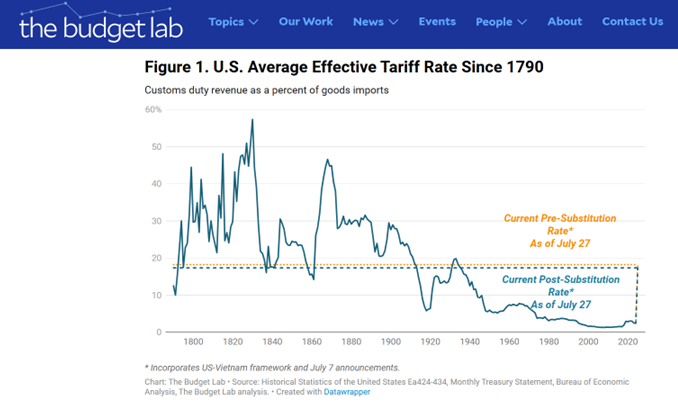
That question was posed in the WSJ, and poses three possible answers: There are three possible answers: First, it’s too early to tell. Most of the tariffs announced haven’t been in place long. … Which leads us to the second possibility—the tariffs thus far have just not been big enough to cause the harm economists warned us about from full-on protectionism. The U.S. is a relatively closed economy … So third, and tantalizingly, perhaps the conventional wisdom is wrong. Or, more precisely, since no one can deny the effect of taxes are real, perhaps, in their rush to emphasize the negatives, economists have overlooked the countervailing forces at work with tariffs: The redistribution of the burden of duties between foreign exporters, U.S. importers and consumers may be reordering the balance of benefit between domestic and foreign businesses and between companies and consumers. Federal tariff revenue up to $300 billion a year will produce gains for Americans. On count 1, I’d remark that most of the tariffs haven’t into play yet. See the effective tariff rate as calculated by the Budget Lab. Source: Budget Lab, accessed 7/28/2025. Baker also doesn’t mention the buffering effect of pre-tariff inventory accumulation, which is strange as most of the economics commentary mentions this factor. On the second point, it’s true the US economy is relatively closed as compared to say UK, or Singapore in an extreme example. But it’s more open than it was just 50 years ago, and more of the trade is of differentiated goods, included in value chains. That magnifies the impact of tariffs. So I think when the tariffs are actually in place, we will see effects (although with USMCA exemptions still in place, we won’t have it as bad as it could be). The third point is one where Baker is trying to channel the optimal tariff theory. There is a tariff rate that — given the elasticities — maximizes welfare for the country imposing tariffs. But in general such tariff rates are not typically 10-15%, since the US is not a large economy in the context of other countries’ exports. Moreover, empirically, in the 2018 trade war, prices did not behave in a way consistent with this thesis. Most of the burden was borne by US consumers (broadly defined as domestic households, firms, workers). See pp. 133-34 in Chinn and Irwin, International Economics (CUP, 2025).

Analysts dismiss plan but executives welcome sign of more support for fossil fuel exports

Also in today’s newsletter, Cambodia and Thailand agree ceasefire, and Germany and France hit out at EU-US deal

Jeet Heer The doom-obsessed Democratic Party remains as unpopular as ever—but there is another path. The post Zohran Mamdani Is Keeping Hope Alive appeared first on The Nation.

Euro slides as investors bet that long-awaited trade agreement will hurt Eurozone economy