Economic News

Economic News

Marcus Vetter on War

A German INTERVIEW of Marcus Vetter on War If you look back today: What has become of Angela Merkel’s statement “We can do this”? Has this vision been fulfilled or has it fractured? Unfortunately, in my view, today this vision lies completely in ruins. It was the last stand of a truly humanistic approach, one that deeply divided Germany. Those who viewed the statement critically were often unfairly labeled as “right-wing” by those who applauded it. But a societal challenge of such magnitude can only be mastered together, because the truth, as always, lies somewhere in the middle. Both sides had a point, and should have approached the motto “We can do this” with much more prudence and solidarity. Today, we are faced with a social landscape in shambles. A large part of society supports an unprecedented rearmament of Europe. Those who warn against it are often silenced. War rhetoric is now coming from parties that once had a pacifist orientation. The world is upside down and hardly recognizable anymore. In your films you often talk about reconciliation, identity, and social change. What stories should be told today to rethink integration and social cohesion? We should tell the same kinds of stories. Stories that show the cycle of violence can be broken. On an individual level, people are still open to such stories and can still be moved by them. At the same time, they are influenced by seemingly convincing arguments – for example, that a Russian war of aggression can only be decided on the battlefield and that one can only respond to it with strength. Other opinions are no longer truly allowed in the media. In my view, this is fundamentally wrong. War itself is the greatest war crime, as Ben Ferencz – once the youngest prosecutor in the Nuremberg Trials – put it. And he was right. In war, there is no morality, no humanity. Truth is the first casualty of any war. Through propaganda slogans we are conditioned to believe that strength is the only answer, because otherwise the enemy will overrun us. When Hermann Göring was asked in Nuremberg how they had managed to unite all of Germany for a war of aggression, he said: “Of course, the people don’t want war… But… the people can always be driven to the bidding of the leaders. That’s easy. All you have to do is tell them they are being attacked and denounce the pacifists for lack of patriotism and for endangering the country. It works the same in every country.” It is very hard for me to endure the current developments. We are ready to take increasingly extreme positions. Some want to raze Gaza to the ground and root out evil entirely, others place all the blame solely on Israel and are just as extreme in their rhetoric. There are only a few left who are willing to build bridges. That is why I have re-edited a trilogy of films I shot in Palestine and Israel between 2008 and 2012, and expanded it with a fourth film about the International Criminal Court. This last one – WAR AND JUSTICE – is a profoundly pacifist film. When people see it, they are often willing to rethink their stance on war. https://www.war-and-justice.de THE HEART OF JENIN tells the story of Palestinian father Ismael Khatib from Jenin, whose son was killed by Israeli soldiers and who, despite his deep grief, decided to donate his son’s organs to Israeli children as a gesture of peace. CINEMA JENIN – THE STORY OF A DREAM tells how hundreds of volunteers from all over the world came to Jenin to join Ismael Khatib – from The Heart of Jenin – in restoring an old cinema that had been closed during the First Intifada. Cinema Jenin opened in the summer of 2011 and was operated as a cinema for 5 years before being demolished in December 2016 and replaced by a shopping mall. AFTER THE SILENCE tells the story of Israeli Yael Armanet, who lost her husband in a suicide bombing carried out by a Palestinian from Jenin. Inspired by Ismael Khatib’s gesture, she sets out to visit the family of the attacker in Jenin to find answers to what happened. The film was made possible and co-produced by the Palestinian cinema Cinema Jenin. https://marcus-vetter.com/product/trilogie-der-hoffnung

Economic News

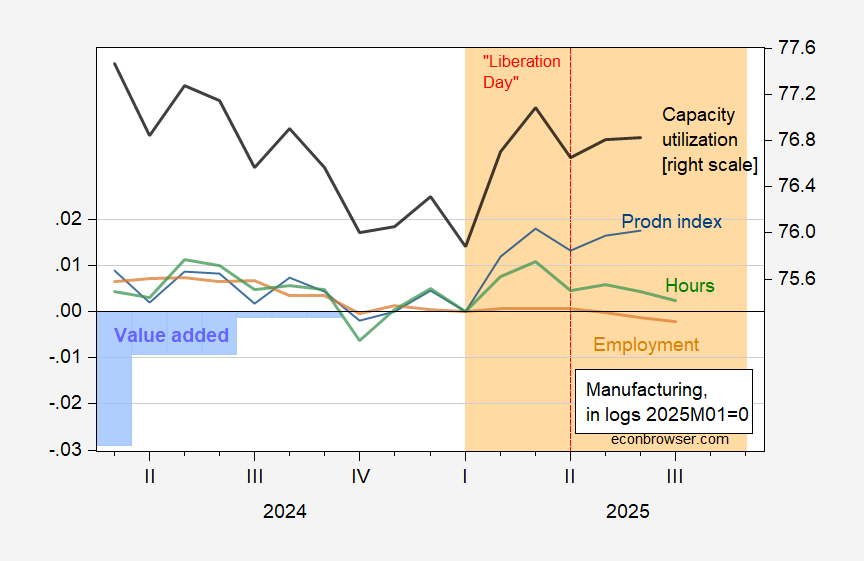
Manufacturing on the Ropes?

Manufacturing employment, hours, capacity utilization down since March 2025 (pre-“Liberation Day”); manufacturing production (Fed index) flat since March. Figure 1: Manufacturing employment, all employees (brown), manufacturing aggregate hours (green), manufacturing production (blue), real value added in manufacturing (blue bars), all in logs,  2025M01=0; manufacturing capacity utilization (bold black line, right scale). Aggregate hours calculated by multiplying average weekly hours times employment of production and nonsupervisory workers. Source: BLS, Federal Reserve, BEA, and author’s calculations.  Notice that since we are indexing to 2025M01=0, the fact that it’s difficult to see the value added series over the last two quarters means that value added has been essentially flat over that period. These are all backwards looking indicators. The ISM manufacturing PMI – new orders component doesn’t look too promising. And all this is before the tariffs take full effect, and retaliation (aside from China). Source: ISM, accessed 8/7/2025.

Economic News

“And you want to be my latex salesman?” (BLS edition)

I hear that Bannon is pushing Heritage Chief Economist EJ Antoni for BLS Commissioner. EJ Antoni: Source: Heritage Foundation, accessed 8/7/2025.  If he is nominated, I’ll just observe that he declared (with St. Onge) a recession starting in 2022 [1]. And another recession in starting in July or August 2024 –[2], [3]– without ever having declared the recession of 2022 ended. Taken literally, he believes we have been — and remain even today — in recession.   For the record: EJ Antoni/Heritage: “Back from the Brink: Trump’s Economy Soars Instead of Crashing” The Great Replacement “Theory” * Comes to Economics at Heritage                  

Economic News

CalculatedRisk (Still) on Recession Watch

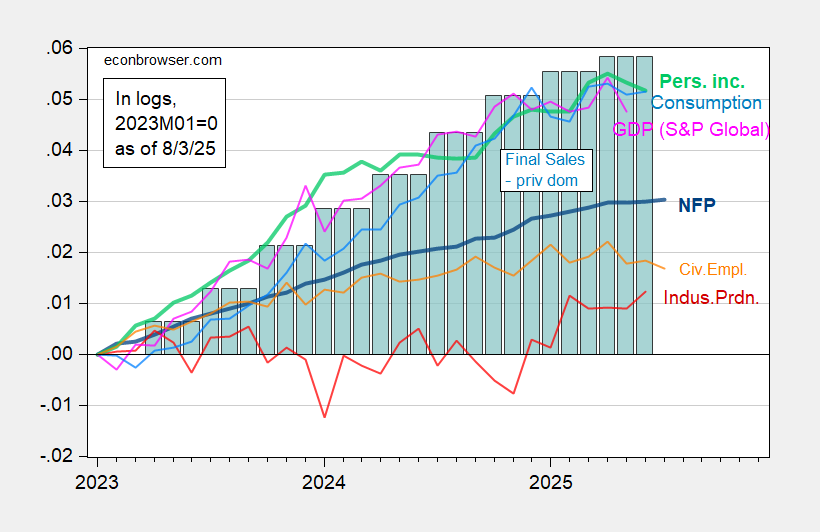
Bill McBride’s assessment here. In early April, I went on recession watch, but I’m still not yet predicting a recession for several reasons: the U.S. economy is very resilient and was on solid footing at the beginning of the year, and perhaps the tariffs are not enough to topple the economy. In the short term, it is mostly trade policy that will negatively impact the economy. However, there other aspects of policy that bear watching – especially immigration. Yesterday, Mark Zandi was stating his case for being wary: Moody’s Analytics chief economist Mark Zandi said the U.S. economy is “on the precipice of recession,” citing indicators from last week’s economic data releases. In a social media post Monday, Zandi pointed to stagnant consumer spending, contracting construction and manufacturing sectors and projected employment declines. Rising inflation makes it difficult for the Federal Reserve to provide economic stimulus, the economist said While unemployment remains low, Zandi attributed this to declining labor force growth rather than economic strength. “The foreign-born workforce is shrinking and labor force participation” is falling, he wrote. Here’s my picture of the state of the economy, with series not restricted to NBER BCDC’s key indicators, and substituting in final sales to private domestic purchasers for GDP: Figure 1: Nonfarm payroll employment (bold blue), personal income excluding current transfers (bold light green), civilian employment, experimental series with smoothed population controls (orange), industrial production (red), S&P Global monthly GDP (pink), and final sales to private domestic purchasers (teal bars), all in logs 2023M01=0.  Personal income, consumption, civilian employment, and monthly GDP are all below recent peaks. Industrial production is up, but nonfarm payroll employment is essentially flat over the last three months (33K/mo). NBER BCDC places highest emphasis on employment (presumably NFP) and personal income. Because the Sahm rule hasn’t been triggered and nonfarm payroll employment continues to rise, I — like CR — don’t think the downturn has arrived as of July (recalling we’re in August, and all the July numbers will be revised).  

Economic News

Even *More* Depressing Pictures from the Labor Market

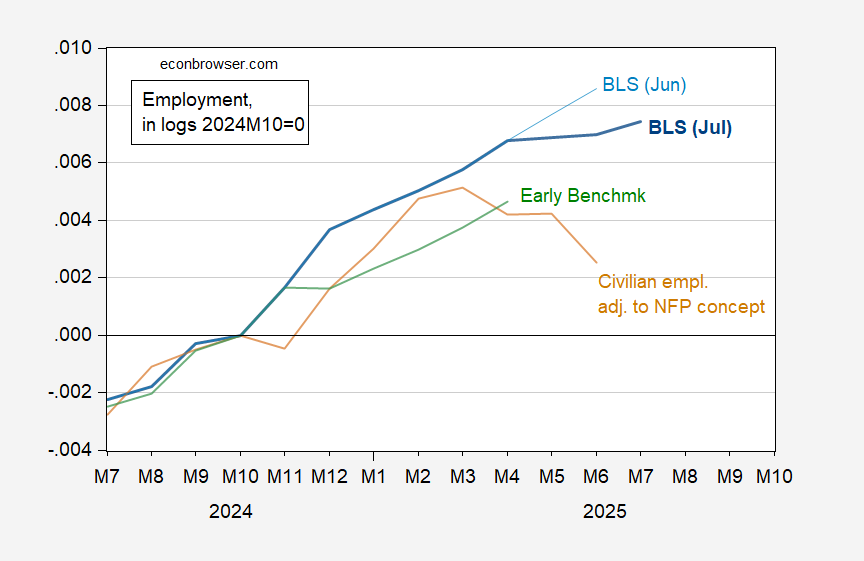
You think the official BLS NFP series is worrying, consider the alternatives: Figure 1: BLS establishment nonfarm payroll (NFP) July series (bold blue), Jun series (light blue), Philadelphia Fed early benchmark (green), and experimental BLS household series adjusted to NFP concept, with smoothed population controls, centered 3 month moving average (tan), all in logs 2024M10=0. Source: BLS via FRED, BLS, Philadelphia Fed, and author’s calculations. Figure 2: BLS establishment private nonfarm payroll (NFP) July series (bold blue), June series (light blue), and ADP series (tan), all in logs 2024M10=0. Source: BLS, ADP via FRED, and author’s calculations. Finally, the household series: Figure 3: Experimental BLS household series, with smoothed population controls, (bold black), and centered 3 month moving average (tan), all in logs 2024M10=0. Source: BLS via FRED, and author’s calculations.

Economic News

How Are Wisconsin Exports, Manufacturing Doing under Trump Trade War 2.0?

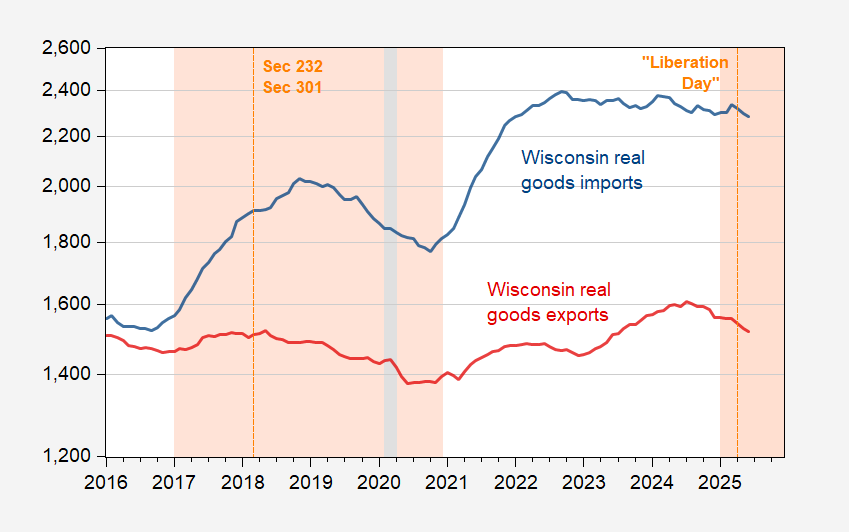
Discussed the employment numbers on WPR this morning. One question came up, which inspired this post – how’s Wisconsin doing, tradewise, given the states’ trade/manufacturing dependence. Figure 1: 12 month trailing moving average of Wisconsin goods exports deflated by US goods export price index (red), imports deflated by US goods imports price index (blue), both in millions 2000$, monthly. Source: Census, BLS, via FRED, and author’s calculations. Real exports were declining even before the election, but showed a drop in in November, onward. Imports started dropping in March. Note that for a variety of reasons, the state level imports and exports are subject to some additional error (e.g., grain exports might be attributed to Louisiana rather than Wisconsin because that’s where they’re exported from; still, there’s little reason to believe the bias has changed since before “Liberation Day”. What about manufacturing? Figure 2: Wisconsin manufacturing employment,000’s (black line, left log scale), Wisconsin real manufacturing value added, mn Ch.2017$, SAAR (blue bars, right log scale). Source: BLS, BEA. We don’t have value added – the most comprehensive indicator – for the 2nd quarter, which would include post-“Liberation Day” data. However, growth seems to have tailed off. Manufacturing employment is now declining in June (preliminary). Since (3 month) changes in Wisconsin manufacturing employment are correlated with changes in US manufacturing employment with a coefficient of 0.91 (R2 of 0.48, 2022-2025), it’s likely that

Scroll to Top