Politics

Politics

Trump is desperate to erase any sign of Musk

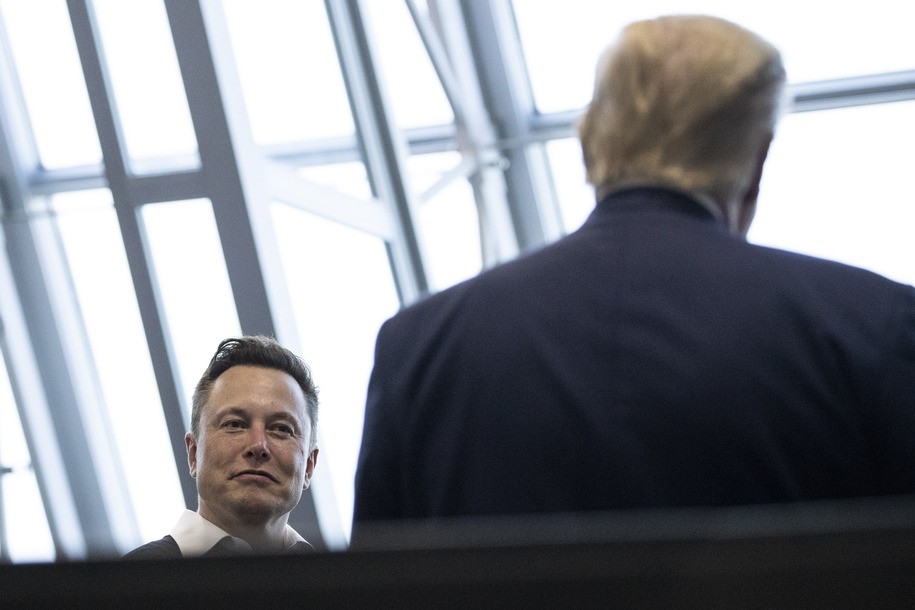
President Donald Trump is still trying to distance himself from Elon Musk. On Tuesday, his administration ended one of Musk’s most ridiculed initiatives: a mandate requiring federal workers to send weekly emails listing their accomplishments or face termination. The Office of Personnel Management announced the end of the so-called “5 things” emails, an initiative that was launched by Musk during his time at the Department of Government Efficiency and quickly became a bureaucratic punchline. Elon Musk wears a DOGE shirt. “We communicated with agency HR leads that OPM was no longer going to manage the 5 things process nor utilize it internally,” OPM Director Scott Kupor said in a statement. “At OPM, we believe that managers are responsible for staying informed about what their team members are working on and have many other existing tools to do so.” He added that the agency would support departments “as they transition to rigorous performance management to include regular check-ins.” While some agencies, including the Defense Department, already stopped requiring the emails, the formal move makes clear that the Trump administration is distancing itself from one of Musk’s more unpopular ideas—and, by extension, the Musk era in federal government. The “5 things” directive was one of Musk’s signature DOGE initiatives. Rolled out in February under the guise of increasing accountability, it caught agency heads off guard and confused federal workers. Emails with subject lines like “What did you do last week?” were often flagged as high priority, directing employees to list five accomplishments. Musk claimed it was at Trump’s direction, warning that failure to respond would be considered a resignation. But within days, OPM quietly loosened the policy. Agencies were told that responses were voluntary and that ignoring the emails wouldn’t cost anyone their jobs. The entire scheme never recovered. Confusing, mocked, and largely ignored, the initiative came to symbolize the overreach—and dysfunction—of Musk’s short-lived career in public service.  Its formal end now serves as a definitive break, or at least the performance of one. The shift comes just months after Musk’s stint in the Trump administration ended in controversy. What had started as a close alliance between Trump and his “first buddy” quickly turned into a bitter, public split.  Musk criticized Trump’s “One Big, Beautiful Bill” as an “abomination,” while Trump withdrew Musk’s NASA nominee, Jared Isaacman, and later threatened to pull billions in federal contracts from Musk’s companies. And Musk didn’t hold back. He accused Trump of being named in the Epstein files, claiming that’s “the real reason they have not been made public.” President Donald Trump and Elon Musk are seen hawking Teslas at the White House. Since then, Trump has fluctuated between criticizing Musk publicly and extending olive branches. He once hawked Teslas on the White House lawn—even buying one for the White House—only to float the idea of selling or giving it away a few months later. After Musk announced plans to launch a third party, Trump called it “ridiculous,” saying that such ventures never work. For once, he might be right. Even Trump’s allies are eager to distance themselves. Kupor, who took over OPM in July, made sure to emphasize during a press appearance that, “I have zero personal relationship with Elon Musk. I have talked to Elon Musk once on the phone in my life.” And while Musk claims he’s stepping back from politics, his retreat hasn’t been without issues. Tesla is struggling, his political prospects have dimmed, and now one of his core workplace policies has been officially scrapped. Though the White House didn’t respond to Daily Kos’ request for comment, the message is clear: Trump’s team is trying—at least for now—to disconnect from Musk and everything he brought to the Trump administration. Whatever happens next in the Musk-Trump saga, at least for now federal workers can finally breathe a sigh of relief.
Politics

Education secretary heckled by mysterious voice—and circus music

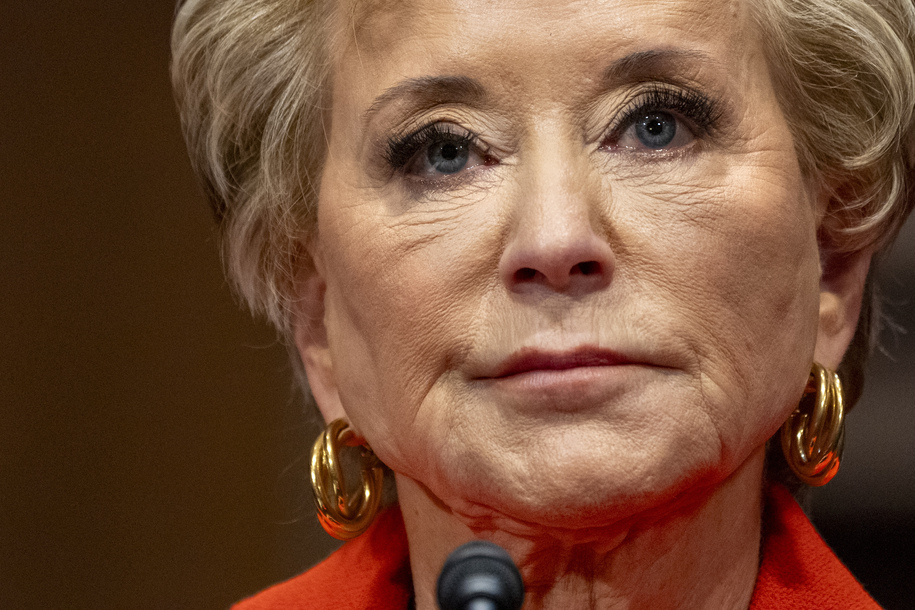
Linda McMahon, the secretary of education and former professional-wrestling magnate, was being interviewed Wednesday at a conservative conference when the event’s audio system was seemingly hacked. “Linda McMahon is a corrupt billionaire [inaudible] who knows nothing,” a voice announced over the loudspeaker at the Young America’s Foundation conference in Washington, D.C. In response, interviewer Scott Walter, the corrupt former Wisconsin governor and YAF’s current president, claimed that the sound system had been infiltrated by the Chinese Communist Party, in a possible attempt at humor. YouTube Video Things got worse when the apparent hero-hackers added an appropriate circus-style soundtrack to accompany McMahon’s remarks at this IQ-depleting event. YouTube Video McMahon is part of President Donald Trump’s ultrarich Cabinet, and like her clueless colleagues, she has shown a screaming ineptitude for her job, all while she hollows out the Department of Education, which she was tasked by Trump to destroy.

Politics

She’s a raging bigot, and Trump thinks she’s ‘very nice’

Depending on who you ask, Laura Loomer is a far-right conspiracy theorist and extremist who holds the ear of President Donald Trump. To others, however, and to Loomer herself, she hails herself as a brave “investigative journalist” breaking her back for the good of the White House.  “I view myself as an extra set of eyes, like a watchdog, for the administration to help them so they don’t get totally screwed,” she told the Telegraph in an interview published Wednesday. Even her friends, she told the outlet, refer to her as Trump’s Rasputin—referencing an age-old mystic who similarly held the affection of a Russian leader, having sway at the time until he was later assassinated. “Loony Loomer” by Clay Jones And sway, she definitely has. In July, the failed Republican candidate who has turned into an online squawkbox played a role in the firing of a top lawyer at the National Security Agency. According to Loomer and an article at far-right, Ben Shapiro-owned Daily Wire, April Falcon Doss was a plant by the Biden administration to undermine Trump. After Loomer spread the story online and then met with her unofficial boss in the Oval Office, Doss was fired the next day.  The social media sensationalist even claimed she’s been advising the Pentagon’s own Pete Hegseth, according to reporting by CNN. And with Hegseth in hot water recently for allegedly firing men for leaking information when they were innocent all along, associating with Loomer is an interesting choice. Loomer has taken credit for the ouster of former national security adviser Mike Waltz who was involved with Signalgate, a security breach by high-ranking Trump administration officials, including Hegseth, to discuss sensitive military plans.   Then again, Hegseth’s spokesperson told the outlet that he “appreciates” Loomer’s “outside advocacy.” Of course, all of this fits the narrative. Loomer has been a shadow in the White House hallways and on Trump’s campaign trail for quite some time.  From holding meetings with Vice President JD Vance to gloating over various other firings or resignations that she has something to do with—which appears to tally to at least 15—Loomer’s “Loomered” tagline has merit. And that doesn’t include nominations that Trump has rescinded due to her advice or details Loomer deems unnecessary and Trump approves, like Hunter Biden’s Secret Service detail pull. And yet, even when she disagreed with him and publicly criticized him, as she did when he accepted a $400 million Boeing jet from the Qatari government, she has kept his ear. For Trump himself, however, he hails Loomer as a tried-and-true patriot. “I know she’s known as a ‘radical right,’ but I think Laura Loomer is a very nice person,” Trump said to reporters Sunday. “I think she’s a patriot, and she gets excited because of the fact she’s a patriot, and she doesn’t like things going on that she thinks are bad for the country. I like her.” And with Trump’s favor, the self-identified journalist may be sticking around the White House for a little while longer.

Politics

Democrats Tell Trump F-You And Vow To Fight Fire With Fire

PoliticusUSA is independent news that tells it like it is. Please support us by becoming a subscriber. Subscribe now After Joe Biden was elected president, Democrats tried to restore rules and norms. Democrats thought that voters would reward them for governing with honesty and decency while trying to put working people first. Instead, just enough Americans voted to send Donald Trump back to the White House. The Democratic rank and file have known since the 2024 election that it was time for a new approach, but it seems to have taken the president’s attempt to gerrymander the state of Texas in a bid to protect the House Republican majority that woke the party leadership up. Politico reported: Pritzker, also a potential presidential contender, welcomed Texas Democratic legislators fleeing their state to avoid voting on the GOP plan — and parlayed the attention into an appearance on “The Late Show” with Stephen Colbert. Hochul is pursuing options to enable New York to redraw its lines. “The fact is that collectively we’re just tired of playing by the rules,” said John Anzalone, a Democratic pollster who works with Democrats across the country. “This is a ‘fuck you, we’re going to match your scorched earth with our scorched earth.’” With the way the national mood is trending against Trump and his party, there aren’t enough districts for Republicans to gerrymander to keep the House. PoliticusUSA is a reader-supported publication. To receive new posts and support our work, consider becoming a free or paid subscriber. It doesn’t matter if Democrats can match all of the districts that Republicans can gerrymander. It matters that Democrats get the memo and fight. The worst course of action for Democrats would have been to sit back and do nothing while Republicans mess with the election map in Texas. Too often, Democrats and Republicans have gotten used to the Democratic Party doing nothing in response, so they likely view the f-you attitude as a welcome reply to Trump. Democrats are serious about getting power back, and their f-you shows that they have learned the lesson from the Biden era that voters don’t reward Democrats for playing by the rules. What do you think of the f-you attitude toward Trump? Share your thoughts in the comments below. Leave a comment

Politics

Rachel Maddow Shows Why No One Should Cave To Trump’s Bogus Lawsuits

PoliticusUSA is independent media that needs your help. Please support our work by becoming a subscriber. Subscribe now After Rachel Maddow did segments on her MSNBC show talking about Devin Nunes and the Russia scandal, Nunes, who was then a member of Congress, sued Maddow for defamation in 2021. Instead of doing what so many large media companies and high-priced talents did when Donald Trump sued them for defamation in 2024, Rachel Maddow and NBC/Universal fought the case, and a funny thing happened. Maddow and NBC won. Reuters reported: In a 24-page decision, Castel said Nunes, a longtime supporter of U.S. President Donald Trump, failed to show Maddow was aware of a July 2020 article in Politico saying the FBI had received the package. The judge found no clear and convincing evidence that Maddow had a “high degree of awareness of probable falsity,” or any evidence that “defendant’s admitted political bias caused defendant to act with a reckless disregard of the truth.” Nunes’ lawyers and Trump Media did not immediately respond on Monday to requests for comment. Lawyers for NBCUniversal did not immediately respond to similar requests. There should not have been anything unusual about this outcome. Maddow and NBC did what media companies used to do when faced with bogus defamation lawsuits from subjects of stories. They fought the case. Read more

Politics

Trump Is So Worried About Mamdani That He Is Looking To Interfere In NYC Mayor Race

PoliticusUSA is 100% reader-supported news, and we could use your help. Please support our work by becoming a subscriber. Subscribe now Donald Trump appears to be very worried about the rise of Zohran Mamdani, but why is the President Of The United States so concerned about a mayoral race when he is supposed to be governing an entire nation? The New York Times reported: President Trump may have moved out of New York City, but he has privately discussed whether to intercede in its fractious race for mayor to try to stop Zohran Mamdani, the Democratic nominee, according to eight people briefed on the discussions. In recent weeks, Mr. Trump has quizzed a Republican congressman and New York businessmen about who in the crowded field of candidates, which includes Mayor Eric Adams and former Gov. Andrew M. Cuomo, has the best chance of beating Mr. Mamdani, the leftist front-runner. PoliticusUSA is a reader-supported publication. To receive new posts and support our work, consider becoming a free or paid subscriber. Electorally speaking, an endorsement from Trump for either Adams or Cuomo would likely be the kiss of death in the current political environment. Donald Trump is historically unpopular, and his endorsement would be likely to hurt more than help Adams or Cuomo. Electorally speaking, as long as the non-Mamdani vote is split, no one will have a good chance of beating him. The Trump-friendly NYT story paints the president’s concern as being based on his history of being a New Yorker, which is so clearly BS that it is unfathomable that it was printed without an LOL beside it. Trump was convicted of 34 felonies in New York and did nothing but trash the city while he was on trial. Trump loves New York so much that he changed his residency to Florida. What Trump is truly worried about can be found in the Gallup poll of newsmaker approval ratings that I wrote about for The Daily. The most popular politician among the 14 newsmakers in the poll was Sen. Bernie Sanders, who has already loudly endorsed Mamdani. Trump is worried not because of Mamdani himself, but because of the energy on the left that people like Sanders and Mamdani represent. That energy could defeat a significant number of Republicans in 2026 and render Trump a lame-duck president. This isn’t about New York. It’s about America changing and rejecting Trump and his party. Trump’s interference could backfire and ultimately lead to Mamdani’s election. What do you think about Trump interfering to stop Mamdani? Share your thoughts in the comments below. Leave a comment

Politics

The War Over America’s Birthday Party

President Donald Trump’s attempted takeover of America’s 250th-anniversary celebration began this past spring when his team drew up a $33 million fundraising plan for a series of events starring the president, including a military parade in Washington. America250 had been founded by Congress as a bipartisan effort, with a mission to engage “350 million Americans for the 250th.” But Trump kicked off the final year of preparations with a political rally at the Iowa State Fairgrounds, attacking Democrats before a crowd that waved America250 signs. “I hate them,” Trump proclaimed July 3. “I cannot stand them, because I really believe they hate our country.” Around the same time, Trump’s top political appointee at America250, a former Fox News producer named Ariel Abergel, moved to gain greater influence over the bipartisan commission. He called four Republican commissioners, who had been appointed years ago by then–Speaker of the House Paul Ryan and then–Senate Majority Leader Mitch McConnell, with a blunt request: Consider resigning to make way for new appointees. That request was reiterated by current House Speaker Mike Johnson, who applied pressure to one appointee at the request of the White House. But rather than solidify Trump’s control over the organization, the calls appear to have backfired, setting off a struggle for control of the organization, according to interviews with eight people briefed on the recent turmoil in the organization, who spoke with me on the condition of anonymity because they were not authorized to speak publicly. The four targeted commissioners ultimately refused to resign, despite two initially signaling their intent to comply. Johnson’s office decided to back off, and Senate Majority Leader John Thune has indicated that he seeks no changes to the commission, according to people familiar with their thinking. Then other members of the commission, which Abergel works for, began discussing efforts to push him out of his job, arguing that his decision to ask for the resignations demonstrated his lack of judgement. “This position should have been reserved for a much more experienced and substantive candidate,” one of the commissioners told me, reflecting the views expressed by others. “The 250th is too important as a milestone for our country to jeopardize it with someone who doesn’t take it seriously.” [T. H. Breen: Trump’s un-American parade] Abergel defended his actions and argued that he had been acting in concert with the House speaker to request that “certain inactive members of the commission” resign. “The speaker has every right to make his own appointments to the commission,” he told me in a statement. “While some anonymous individuals are focused on lying to the fake news, my focus remains the same: to make America250 the most patriotic celebration in American history.” The nation’s leaders have been planning since 2016 for next year’s celebrations to mark the 250th anniversary of the signing of the Declaration of Independence, which are expected to involve events in each of the states, including a ball drop in Times Square on July 4, organized in partnership with the commission. The Republican tax bill that Trump signed into law this summer included an additional $150 million for the Department of Interior, which is expected to be spent by the commission in partnership with a new White House task force to celebrate the anniversary, with additional private fundraising from companies such as Coca-Cola and Stellantis. But now, even as the festivities are unfolding, the commission that was established to oversee them is in turmoil. Since winning reelection, Trump has moved swiftly to take control of the federal government’s cultural institutions, including the Kennedy Center and the National Portrait Gallery. But the United States Semiquincentennial Commission answers largely to the legislative branch, not the White House, and has a sprawling leadership structure that includes sitting senators, members of Congress, and ex officio members such as the secretary of defense and the secretary of state. [Ryan Miller: Why I played the Kennedy Center] The power to direct the operation resides with an additional 16 “private citizen” commissioners, who are appointed in equal numbers by the Republican and Democratic leaders of the House and Senate for lifetime terms until the completion of the celebrations. Under the law, the forcible removal of commissioners requires a two-thirds vote of the commission, and the president’s main power is his ability to appoint a chair from among the private citizens already serving. According to four people familiar with the conversations, the four commissioners whom Abergel asked to resign are the Washington and Lee University professor Lucas Morel, the Hillsdale College professor Wilfred M. McClay, the educator Val Crofts, and Tom Walker, the founder of American Village, a historical-replica development in Alabama. Morel and McClay declined to comment. Crofts and Walker could not be reached for comment. Two people familiar with the commission’s work described all four as regular participants in America250 oversight. For the moment, there does not appear to be public pressure from Capitol Hill for a shake-up. “Johnson is not seeking the resignation of any of the speaker’s appointees,” a person familiar with his thinking, who requested anonymity to discuss the sensitive situation, told me. Someone familiar with Thune’s thinking gave me a similar response: “Thune supports his appointees.” People familiar with the White House planning for America250 have argued that the commission needs more commitment of time and energy from its commissioners for the final year before next summer’s festivities. They told me that the attempt to encourage resignations was blocked, ultimately, by commission bylaws that limit the ability of congressional offices to push out a commissioner. And they made clear that efforts to change the commission makeup could continue. “So far, the best work they have done is being part of this loyal cabal,” one person familiar with the White House thinking on the sitting commission told me. “There has been tremendous frustration with the lack of programmatic purpose, planning, and production.” Others involved in the commission say that such arguments are merely a pretext for political control. Some of the

Politics

How Democrats Tied Their Own Hands on Redistricting

As New York Governor Kathy Hochul denounced the GOP’s aggressive attempt to gerrymander Democrats into political oblivion this week, she lamented her party’s built-in disadvantage. “I’m tired of fighting this fight with my hand tied behind my back,” she told reporters. As political metaphors go, it’s not a bad one. Hochul omitted a key detail, however: Democrats provided the rope themselves. For more than a decade, they’ve tried to be the party of good government on redistricting. But Democrats’ support for letting independent commissions draw legislative maps has cost them seats in key blue states, and their push to ban gerrymandering nationwide flopped in the courts and in Congress. Now that Republicans, at the behest of President Donald Trump, are moving quickly to redraw district lines in Texas and elsewhere in a bid to lock in their tenuous House majority, Democrats want to match them seat for seat in the states that they control. But the knots they’ve tied are hard to undo. To boost the GOP’s chances of winning an additional five House seats in Texas next year, all Governor Greg Abbott had to do was call the state’s deeply conservative legislature back to Austin for an emergency session to enact new congressional maps. The proposed changes carve up Democratic seats in Texas’s blue urban centers of Dallas, Houston, and Austin, as well as two seats along the U.S.-Mexico border, where Republicans are betting they can retain support among Latino voters who have moved right during the Trump era. Democratic lawmakers are trying to block the move by leaving the state and denying Republicans a required quorum in the legislature. [Read: Republicans want to redraw America’s political map] By comparison, Democrats face a much longer and more arduous process to do the same in California and New York. Voters in both states would have to approve constitutional amendments to repeal or circumvent the nonpartisan redistricting commissions that Democrats helped enact. In California, Democrats hope to pass legislation this month that would put the question to voters this November. If the amendment is approved, the legislature could implement the new districts for the 2026 election. In New York, the legislature must pass the change in two separate sessions, meaning that a newly gerrymandered congressional map could not take effect until 2028 at the earliest. By then, some Democrats fear it may be too late. Republicans want to gain seats through mid-decade redistricting not only in Texas but in GOP-controlled states such as Florida, Missouri, Ohio, and Indiana. The GOP goal is to secure enough seats to withstand an electoral backlash to Trump’s presidency in next year’s midterms. That imbalance has caused Democrats to reassess—and in some cases, abandon altogether—their support for rules they long championed as essential to maintaining a fair playing field on which both parties could compete. “What is at stake here is nothing less than the potential for permanent one-party control of the House of Representatives, and the threat of that to our democracy absolutely dwarfs any unfortunately quaint notions about the value of independent redistricting,” Micah Lasher, a New York State assembly member who represents Manhattan’s Upper West Side, told me. It’s a reversal for Lasher, a former Hochul aide who won office last year while endorsing independent redistricting. Lasher is the author of legislation that would allow New York to redraw its congressional maps in the middle of a decade if another state does so first. Lawmakers there could consider the bill when they return to Albany in January. The proposal is limited in scope: It does not throw out the state’s decennial post-Census redistricting process and merely creates an exception allowing New York to respond to other states’ moves. This is partly due to worries that voters might reject a more aggressive plan; in 2021, New York Democrats and election reformers failed to win approval of a series of statewide referenda aimed at expanding access to voting. (Republicans don’t face the same concerns, because voters in red states won’t have a direct say in the maps they draw.) [Read: The decision that could doom Democrats for a decade] Proposals like Lasher’s have won the support of Democrats who previously led the fight to ban gerrymandering. On Monday, the Democratic Legislative Campaign Committee became the first party organization to formally call for Democrats to redraw congressional maps in states where they have the power to do so. “We’re looking at a country where everything has changed, quite frankly, and the things that you thought could not happen happen,” Andrea Stewart-Cousins, the majority leader of the New York state Senate and the chair of DLCC’s board, told me. Even as they pursued a national ban on gerrymandering, Democrats never forswore the practice entirely. Indeed, their ability to respond to Republicans now is constrained in part by the fact that district lines in blue states such as Illinois and Maryland are already skewed heavily in their favor. (Democrats control the legislature and governorships of far fewer states than do Republicans, which further limits their power to match the GOP in gerrymandering.)   Yet Republicans’ recent moves, aided by a Supreme Court ruling that sidelined federal courts from striking down purely partisan (as opposed to racial) gerrymanders, represent an escalation that has stunned Democrats. I asked Stewart-Cousins whether the party’s push to take politics out of redistricting, which has succeeded in protecting one out of five congressional seats from the threat of gerrymandering, was misguided. “It wasn’t a mistake,” she insisted, casting the party’s new posture more as a temporary shift than a permanent reorientation. Lasher, however, wasn’t so sure. “It is fair to say that Democrats in New York and around the country vastly underestimated the willingness of the Republican Party to cross every line, break every norm, and do so with enormous speed,” he said. “We’re in a period of adjustment. We better adjust really damn quickly.”

Scroll to Top