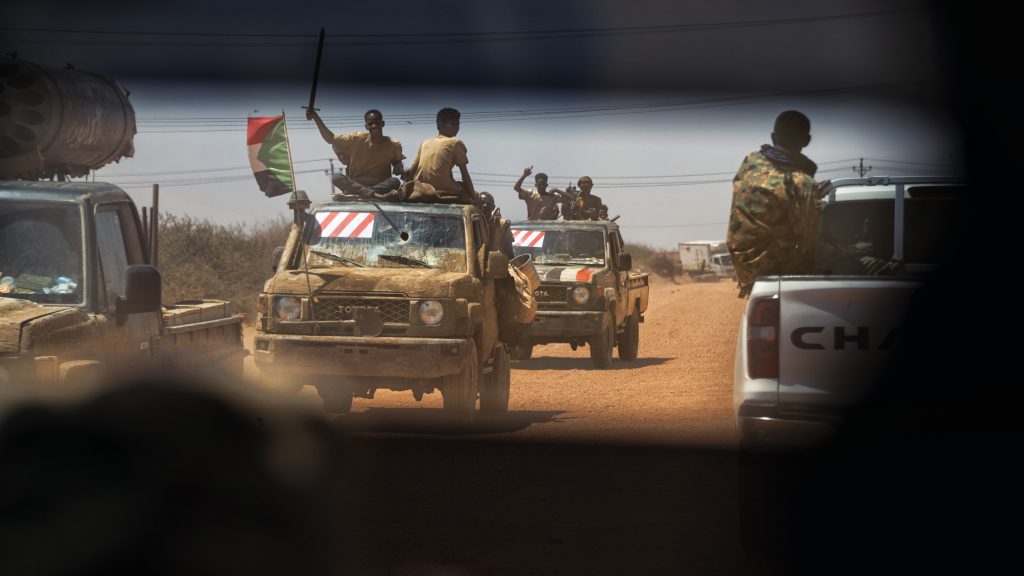
Photographs by Lynsey Addario In the weeks before they surrendered control of Khartoum, the Rapid Support Forces sometimes took revenge on civilians. If their soldiers lost territory to the Sudanese Armed Forces during the day, the militia’s commanders would turn their artillery on residential neighborhoods at night. On several consecutive evenings in March, we heard these attacks from Omdurman, on the other side of the Nile from the Sudanese capital. From an apartment that would in better times have been home to a middle-class Sudanese family, we would hear one explosion. Then two more. Sometimes a response, shells or gunfire from the other side. Each loud noise meant that a child had been wounded, a grandmother killed, a house destroyed. Just a few steps away from us, grocery stores, busy in the evening because of Ramadan, were selling powdered milk, imported chocolate, bags of rice. Street vendors were frying falafel in large iron skillets, then scooping the balls into paper cones. One night someone brought out folding chairs for a street concert, and music flowed through crackly speakers. The shelling began again a few hours later, probably hitting similar streets and similar grocery stores, similar falafel stands and similar street musicians a couple dozen miles away. This wasn’t merely the sound of artillery, but the sound of nihilism and anarchy, of lives disrupted, businesses ruined, universities closed, futures curtailed. In the mornings, we drove down streets on the outskirts of Khartoum that had recently been battlegrounds, swerving to avoid remnants of furniture, chunks of concrete, potholes, bits of metal. As they retreated from Khartoum, the Rapid Support Forces—the paramilitary organization whose power struggle with the Sudanese Armed Forces has, since 2023, blossomed into a full-fledged civil war—had systematically looted apartments, offices, and shops. Sometimes we came across clusters of washing machines and furniture that the thieves had not had time to take with them. One day we followed a car carrying men from the Sudanese Red Crescent, dressed in white hazmat suits. We got out to watch, handkerchiefs covering our faces to block the smell, as the team pulled corpses from a well. Neighbors clustered alongside us, murmuring that they had suspected bodies might be down there. They had heard screams at night, during the two years of occupation by the RSF, and guessed what was happening. Another day we went to a crossing point, where people escaping RSF-occupied areas were arriving in Sudanese-army-controlled areas. Riding on donkey carts piled high with furniture, clothes, and kitchen pans, they described a journey through a lawless inferno. Many had been deprived of food along the way, or robbed, or worse. In a house near the front line, one woman told me that she and her teenage daughter had both been stopped by an RSF convoy and raped. We were sitting in an empty room, devoid of decoration. The girl covered her face while her mother was talking, and did not speak at all. At al-Nau Hospital, the largest still operating in the Khartoum region, we met some of the victims of the shelling, among them a small boy and a baby girl, Bashir and Mihad, a brother and sister dressed in blue and pink. The terror and screaming of the night before had subsided, and they were simply lying together, wrapped in bandages, on a cot in a crowded room. I spoke with their father, Ahmed Ali. The recording of our conversation is hard to understand because several people were gathered around us, because others were talking loudly nearby, and because Mihad had begun to cry. Ali told me that he and his family had been trying to escape an area controlled by the RSF but had been caught in shelling at 2 a.m., the same explosions we had heard from our apartment in Omdurman. The children had been wounded by shrapnel. He had nowhere else to take them except this noisy ward, and no plans except to remain at the hospital and wait to see what would happen next. Lynsey Addario for The Atlantic Medical staff at al-Nau Hospital treat children injured in shelling by RSF forces in Omdurman. Like a tsunami, the war has created wide swaths of physical wreckage. Farther out of town, at the Al-Jaili oil refinery, formerly the largest and most modern in the country—the focus of major Chinese investment—fires had burned so fiercely and for so long that giant pipelines and towering storage tanks, blackened by the inferno, lay mangled and twisted on the ground. At the studios of the Sudanese national broadcaster, the burned skeleton of what had been a television van, its satellite dish still on top, stood in a garage near an accounting office that had been used as a prison. Graffiti was scrawled on the wall of the office, the lyrics to a song; clothes, office supplies, and rubble lay strewn across the floor. We walked through radio studios, dusty and abandoned, the presenters’ chairs covered in debris. In the television studios, recently refurbished with American assistance, old tapes belonging to the Sudanese national video archive had been used to build barricades. Statistics are sometimes used to express the scale of the destruction in Sudan. About 14 million people have been displaced by years of fighting, more than in Ukraine and Gaza combined. Some 4 million of them have fled across borders, many to arid, impoverished places—Chad, Ethiopia, South Sudan—where there are few resources to support them. At least 150,000 people have died in the conflict, but that’s likely a significant undercounting. Half the population, nearly 25 million people, is expected to go hungry this year. Hundreds of thousands of people are directly threatened with starvation. More than 17 million children, out of 19 million, are not in school. A cholera epidemic rages. Malaria is endemic. But no statistics can express the sense of pointlessness, of meaninglessness, that the war has left behind alongside the physical destruction. I felt this most strongly in the al-Ahamdda displaced-persons camp just outside Khartoum—although the