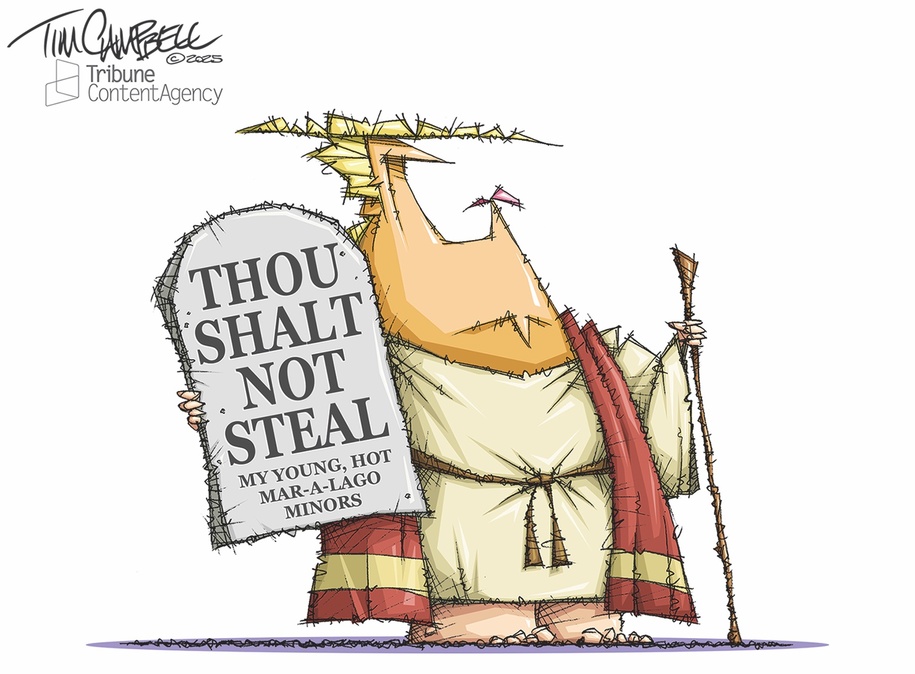
Cartoon: Thou shalt not steal
A cartoon by Tim Campbell. Related | Trump has Epstein files on the brain as presser goes off the rails

A cartoon by Tim Campbell. Related | Trump has Epstein files on the brain as presser goes off the rails
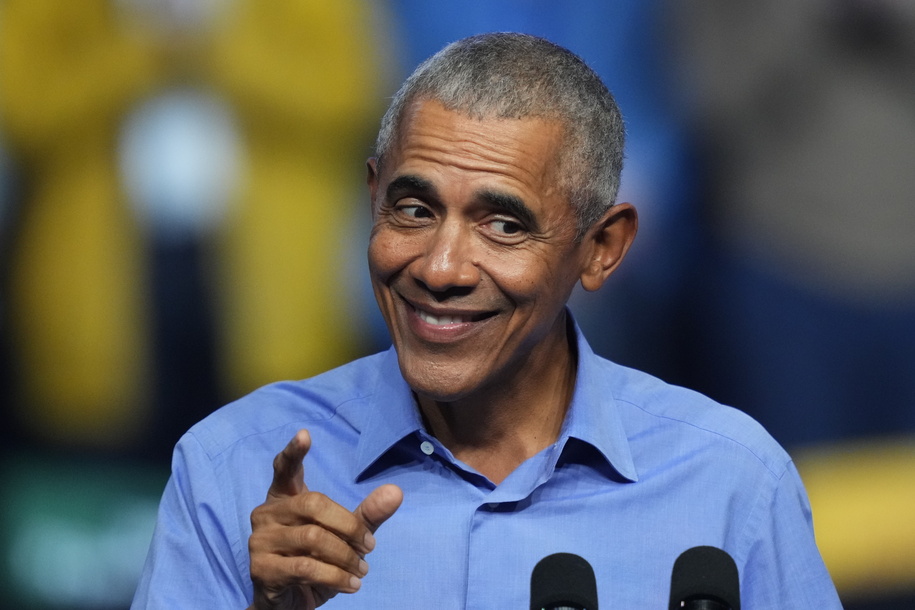
Black Music Sunday is a weekly series highlighting all things Black music, with over 270 stories covering performers, genres, history, and more, each featuring its own vibrant soundtrack. I hope you’ll find some familiar tunes and perhaps an introduction to something new. Music lovers and appreciators have been speaking out forcefully against a bill to rename the Kennedy Center for the Performing Arts for the Orange Inhabitant, and another to rename the Opera House for Melania Trump, while much of the nation is revolted by the ludicrous and bogus “treason” attacks on former President Barack Obama, along with those on former Vice President Kamala Harris, Oprah Winfrey, Al Sharpton and Lawd have mercy on Beyoncé too. (The BeyHive will be on his butt.) Given that Obama’s birthday is on Monday (he was born Aug. 4, 1961, in Hawaii), and since official “Obama Day” celebrations will take place in Illinois, I thought I’d take you on a trip down a musical memory lane with some of his favorite tunes and some memorable musical moments he hosted (and performed) throughout his two terms in office. I don’t know about you, but I appreciated having a POTUS who publishes his playlists, went to the Apollo Theater, had great musical acts at the White House, and supported musical artists so many of us could relate to. I have never forgotten the moment on Jan. 19, 2012, when during Obama’s campaign for reelection, he paid tribute to the Rev. Al Green by singing a line from “Let’s Stay Together”: YouTube Video Just in case there is anyone reading who doesn’t know the song, here’s a link. During his first campaign for the presidency, candidate Obama inspired a very special song. Will.I.Am: A Song To Inspire A Nation William James Adams, a.k.a. will.i.am, has recorded his share of hits as the frontman for Black Eyed Peas. But he’s arguably better known for putting a campaign speech to music last year and creating a hit. The song, titled “Yes We Can,” was inspired by the words of Barack Obama during his presidential campaign. The video, a YouTube sensation, features celebrity appearances by will.i.am, Scarlett Johansson, Common, John Legend and Herbie Hancock, all singing Obama’s now-famous words. Interestingly, Obama didn’t deliver that particular speech in a moment of victory, but after his loss to Hillary Clinton in the New Hampshire Democratic primary. YouTube Video In 2010, for Black History Month, Obama celebrated music from the Civil Rights Movement. A Freedom Singer Shares The Music Of The Movement This week, the White House programmed a series of evenings celebrating the music that tells the story of America. “In Performance at the White House: A Celebration of Music From the Civil Rights Movement”, a concert celebrating Black History Month, captured the hardships and hopes of those fighting for equal rights in America during the 1960s. The event brought together numerous guest speakers to showcase readings and songs from the civil rights movement, including legendary Motown singer Smokey Robinson, Bob Dylan and one of the original Freedom Singers, Bernice Johnson Reagon. When Bernice Johnson Reagon joined the ancestors last year, we paid tribute to her here: “Black Music Sunday: Bernice Johnson Reagon used music to mobilize.” We had previously featured the Student Nonviolent Coordinating Committee freedom singers, of which she was a founding member: “The SNCC Freedom Singers: Songs of strength and courage that mobilized people to vote.” In her White House performance, Reagon leads ”Ain’t Gonna Let Nobody Turn Me Round” and then stops and admonishes the audience: (singing stops) Oh, oh, oh, wait. I know this is a show, but, uh — (laughter) — you have to actually sing this song. YouTube Video One of my favorite sets of performers at the White House were the soul sisters gathered there on March 6, 2014. Patti LaBelle, Aretha Franklin shine in ‘Women of Soul’ Some of music’s most profound voices came together at the White House Thursday night, honoring legends such as Aretha Franklin and Patti LaBelle and transforming the presidential estate into a melodious church brimming with soulful jubilation. The 12th program in President Obama and first lady Michelle Obama’s In Performance at the White House series, Women of Soul brought together Franklin, LaBelle, Melissa Etheridge, Tessanne Chin, Jill Scott, Janelle Monáe and Ariana Grande, each dressed to the nines and delivering stirring performances. The president kicked off the proceedings with a jovial introduction, telling the crowd about Franklin’s visit to Fame Studios in Muscle Shoals, Ala., in 1967 when, the legend goes, she literally shook the walls with her voice. “It was magic,” he said. “My advice to everyone here tonight is simple: Hold on.” YouTube Video When a horrific, racist tragedy struck the nation, Obama rose to the occasion by not only delivering a powerful eulogy but also singing “Amazing Grace,” and the congregation sang along with him. On June 26, 2015, NPR reported: Watch: President Obama Sings ‘Amazing Grace’ In Eulogy President Obama gave a rousing speech Friday at the funeral of state Sen. and Rev. Clementa Pinckney, one of nine people shot at Emanuel AME church in Charleston, S.C., earlier this month. The president spoke for more than 35 minutes about the reverend’s legacy and teachings, and Obama said that he had spent much of the week reflecting on grace. […] Obama called the Charleston shooting “an act that drew on a long history of bombs, arson, shots fired at churches. Not random, but as a means of control, a way to terrorize and oppress.” He ended his eulogy with a song — he led the attendees in part of “Amazing Grace,” at first alone and a cappella, then joined by the crowd YouTube Video In October 2015, Obama honored two of our amazing agencies, which the current occupant is doing his best to desecrate. “A Celebration of American Creativity: In Performance at the White House” to Commemorate NEH’s 50th Anniversary The National Endowment for the
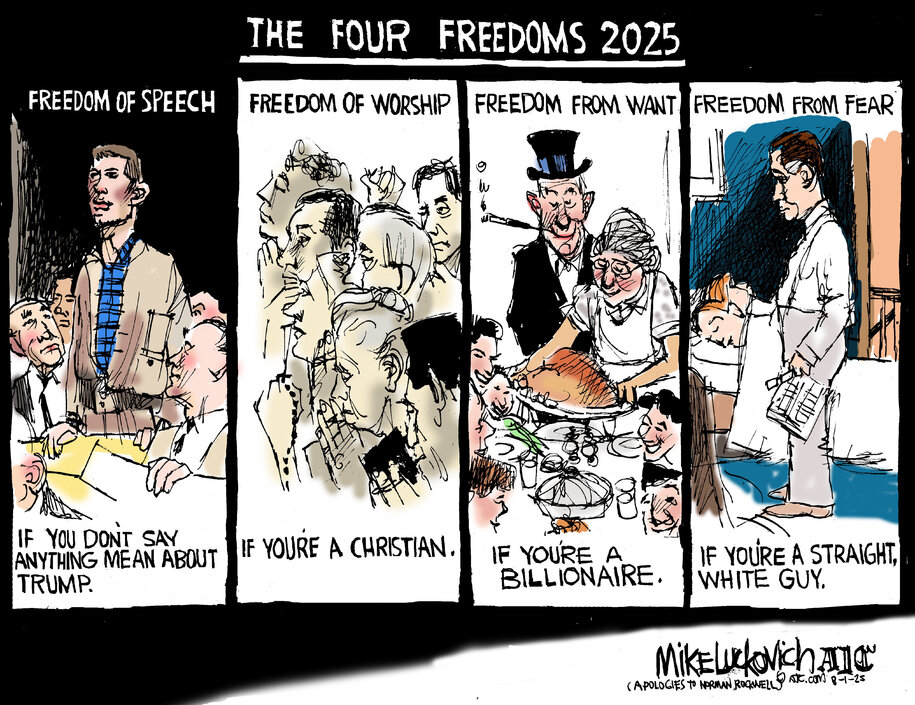
A cartoon by Mike Luckovich. Related | Federal employees can now be harassed about religion by their bosses
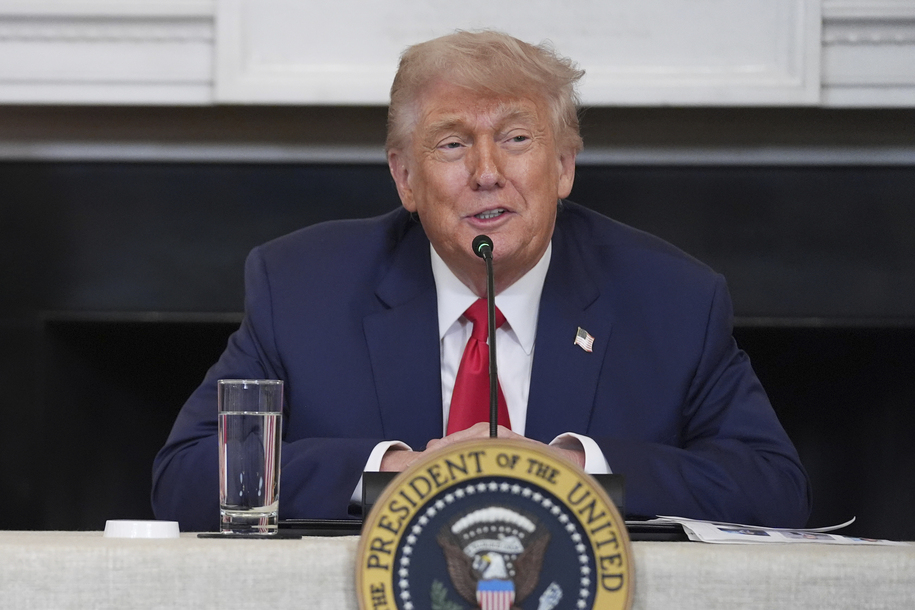
President Donald Trump is addicted to the fanfare of announcing his trade “deals,” but he doesn’t care about the details or what happens afterward. As trade policy expert William Reinsch told the Washington Monthly, “For Trump, the squeeze is more important than the juice.” That’s a powerful character flaw for other nations to exploit. Take, for instance, the European Union. Trump has been touting a new “deal” with the E.U. that’s more framework than substance. But again, he doesn’t care—it’s all about the flashy toplines. Among them: The E.U. will supposedly buy $250 billion worth of U.S. energy imports per year, for the next three years. That’s over three times what the E.U. imported last year from the U.S. However, with this deal, there’s no binding commitment, no timeline, no enforcement mechanism. It’s little more than a press-release number designed to impress. It’s not a real plan, just a fantasy dressed up as a win. President Donald Trump and European Commission President Ursula von der Leyen shake hands after reaching a trade deal in Turnberry, Scotland, on July 27. That big, shiny number sure looks like a victory. But as Reuters energy columnist Clyde Russell wrote, the pledge is “delusional,” calling it a “level of imports that the EU has virtually no chance of meeting, and one that U.S. producers would also struggle to supply.” At the link, you can follow the math. And this isn’t isolated to the E.U. Japan signed a vague promise to invest $550 billion in American industries, with at least some of that supposedly earmarked for energy. South Korea threw in another $100 billion. As The New York Times noted in its headline, “Countries Promise Trump to Buy U.S. Gas, and Leave the Details for Later.” The subhead was just as damning: “U.S. trading partners are committing to buy more gas than they need or than the U.S. can produce, at least in the short term.” It’s easy to see what’s happening. Knowing that Trump doesn’t care about the substance, these countries promise the world. Big numbers. The biggest numbers. And because these are just frameworks, there’s no legal requirement that these countries meet their benchmarks. Why would there be? Trump doesn’t give a damn. Any final agreement will inevitably lack enforcement mechanisms because everyone in the room knows those targets are impossible. Trump just wants to yell that he’s making America great. And when the numbers inevitably collapse under scrutiny? Fake news! This has happened before. “The scale of the delusion probably exceeds what Trump and China agreed in their so-called Phase 1 trade deal in December 2019, under which China was supposed to buy $200 billion of additional U.S. energy by the end of 2021,” Russell notes. “The reality is that China never even came close to buying that level, and its imports of U.S. energy didn’t even reach what they were before Trump launched his first trade war in 2017.” Trump knows it. His negotiators know it. Foreign governments absolutely know it. The only ones not in on the charade are the MAGA cultists lapping up his bullshit.
Caribbean Matters is a weekly series from Daily Kos. Hope you’ll join us here every Saturday. If you are unfamiliar with the region, check out Caribbean Matters: Getting to know the countries of the Caribbean. The ghost of pedophile Jeffrey Epstein and what information will be gleaned from ex-girlfriend Ghislaine Maxwell has dominated much of the media these days, including debates about “the list” of who did or didn’t visit and participate in various illegal deeds when on Epstein’s island. I had to remind myself that the isle in question is in the U.S. Virgin Islands. My coverage of the USVI here in the past has mostly been either historical, hurricane related, or cultural. I really hadn’t thought about what this Epstein story has meant in island politics. Epstein owned not only the island of Little St. James, but also Great St. James, according to News Nation: Epstein initially purchased Little St. James, which is more than 70 acres, for $8 million in 1998, building several structures on the property, according to Forbes. Great St. James, around 165 acres, was then bought by Epstein in 2016 for $22.5 million. A view of Jeffrey Epstein’s stone mansion on Little St. James Island. Federal authorities consider Little St. James Island to have been Epstein’s primary residence in the United States. I have to admit I was surprised that I found almost no interviews with any Black Virgin Islanders who worked on that island—the maids, cooks, cleaners, and other “invisible workers” who keep the estates of the wealthy running. I could find no data on the race of the island’s employees. There were few tales from the boat crews who ferried guests back and forth. During the days in the past when I stayed in St. Thomas I hung out with guys who owned or crewed some of those kinds of ships. They knew all the island gossip and helped create some of it, given that they were retired gunrunners and retirees from other not-legal or quasi-legal endeavors. I also knew some of the mostly Black female staff who worked for mostly white elites, and they were full of funny stories. But there are a few mentions, like the fact that locals referred to Epstein’s property as “Pedophile Island:” The 66-year-old financier bought Little St. James Island off this US Caribbean territory more than two decades ago and began to transform it — clearing the native vegetation, ringing the property with towering palm trees and planting two massive US flags on either end. When guides took scuba divers to spots near the island, security guards would walk to the water’s edge. It was off-putting to residents of St. Thomas — a lush tropical island east of Puerto Rico with winding roads through mountains dotted with dainty Danish colonial-era homes. Then, when Epstein pleaded guilty in a 2008 to soliciting and procuring a minor for prostitution, his need for privacy began to appear more sinister. “Everybody called it ‘Pedophile Island,’” said Kevin Goodrich, who is from St. Thomas and operates boat charters. “It’s our dark corner.” Many people who worked for Epstein told The Associated Press this week that they had signed long non-disclosure agreements, and refused to talk. One former employee who declined to be identified said Epstein once had five boats, including a large ferry in which he transported up to 200 workers from St. Thomas to his island every day for construction work. This Associated Press story in 2022 detailed the secrecy of the island: Several individuals from St. Thomas who worked on Jeffrey Epstein’s private island, Little Saint James, have shared details of their experiences, painting a picture of an unusual and secretive environment. One former worker described a strict “keep to yourself and do your thing” atmosphere when Epstein was present, implying workers were discouraged from observing his activities closely. This individual also recounted seeing young women on the property and believed them to be over 18, though they acknowledged some uncertainty. Another worker noted the secrecy surrounding a particular steel safe in Epstein’s office, suggesting it contained sensitive materials beyond just money. This worker also revealed that employees were not permitted to enter certain rooms, including the offices, without authorization, according to the Los Angeles Times. […] Beyond these individual accounts, some St. Thomas residents who didn’t work directly on the island have also shared their observations about Epstein and his activities, with some locals even referring to Little Saint James as “Pedophile Island”. Two employees at the local airstrip told Vanity Fair that they witnessed Epstein boarding his private plane with girls who appeared to be underage, according to Vanity Fair. My curiosity was piqued by a July 24, 2024 letter to the editor in The Virgin Islands Daily News, titled “Where’s the Epstein money?” signed by David Silverman, St. John: Dear Editor, How quickly we all seem to forget. It was less than one year ago when [USVI] Governor [Albert] Bryan announced that the Virgin Islands had reached a $75 million dollar settlement with JP Morgan Chase Bank stemming from the bank’s alleged involvement with Jeffrey Epstein in the Virgin Islands. Of that $75 million dollars, $20 million was to go to outside counsel for legal fees and the remainder was to go to the USVI. And it was in January 2021 when [Epstein’s financier] Leon Black agreed to pay $62.5 million to the USVI to settle any potential claims involving his relationship with Epstein. We learned about that settlement in January 2023, two years after the fact. […] And perhaps most importantly, and most contentiously, how about appointment of an independent special prosecutor to determine whether any current or past government employees were complicit in the sex trafficking activities of Jeffrey Epstein in the Virgin Islands? We cannot “put this episode behind us” as some in government desperately want to do, until all individuals involved are held accountable. Depending on lawsuits from “Jane Doe” victims to uncover the truth about the USVI is decidedly not
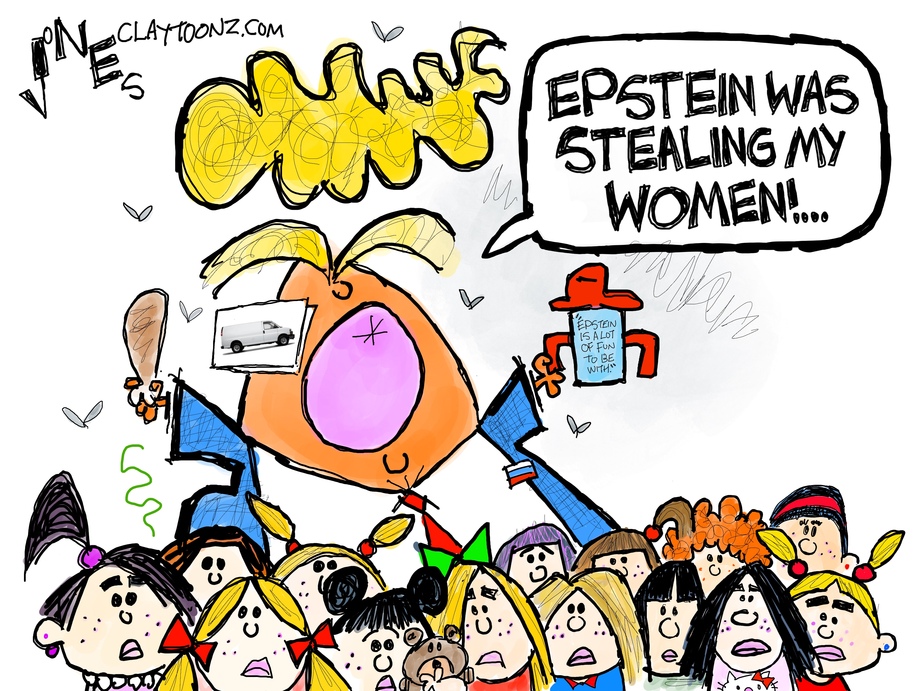
A cartoon by Clay Jones. Related | Trump has Epstein files on the brain as presser goes off the rails
The DOJ’s Civil Rights Division had brought lawsuits accusing Louisiana of confining prisoners longer than they should and South Carolina of keeping mentally ill people in unreasonably restrictive group homes. Both cases are now on hold. By Corey G. Johnson for ProPublica The Trump administration has halted litigation aimed at stopping civil rights abuses of prisoners in Louisiana and mentally ill people living in South Carolina group homes. The Biden administration filed lawsuits against the two states in December after Department of Justice investigations concluded that they had failed to fix violations despite years of warnings. Louisiana’s prison system has kept thousands of incarcerated people behind bars for weeks, months or sometimes more than a year after they were supposed to be released, records show. And the DOJ accused South Carolina of institutionalizing thousands of people diagnosed with serious mental illnesses — sometimes for decades — rather than provide services that would allow them to live in less restricted settings, as is their right under federal law. Federal judges temporarily suspended the lawsuits in February at the request of the states and with the support of the DOJ. Related | The Justice Department has turned into a raging dumpster fire under Trump Civil rights lawyers who have monitored the cases said the move is another sign of the Trump administration’s retreat from the department’s mission of protecting the rights of vulnerable groups. Since January, President Donald Trump’s DOJ has dropped racial discrimination lawsuits, abandoned investigations of police misconduct and canceled oversight of troubled law enforcement agencies. “This administration has been very aggressive in rolling back any kind of civil rights reforms or advancements,” said Anya Bidwell, senior attorney at the public-interest law firm Institute for Justice. “It’s unquestionably disappointing.” The cases against Louisiana and South Carolina were brought by a unit of the DOJ’s Civil Rights Division tasked with enforcing laws that guarantee religious freedom, access to reproductive health services, constitutional policing, and the rights of people in state and local institutions, including jails, prisons and health care facilities for people with disabilities. The unit, the Special Litigation Section, has seen a dramatic reduction in lawyers since Trump took office in January. Court records show at least seven attorneys working on the lawsuits against Louisiana and South Carolina are no longer with the DOJ. The section had more than 90 employees at the start of the year, including about 60 front-line attorneys. By June, it had about 25, including around 15 front-line lawyers, according to a source familiar with its operation. Sources said some were reassigned to other areas of the department while others quit in protest against the direction of the office under Trump, found new jobs or took early retirement. Similar departures have been seen throughout the DOJ. Related | Justice Department smothers Biden-era police reform deals The exodus will hamper its ability to carry out essential functions, such as battling sexual harassment in housing, discrimination against disabled people, and the improper use of restraints and seclusions against students in schools, said Omar Noureldin, a former senior attorney in the Civil Rights Division and President Joe Biden appointee who left in January. “Regardless of your political leanings, I think most people would agree these are the kind of bad situations that should be addressed by the nation’s top civil rights enforcer,” Noureldin said. A department spokesperson declined to comment in response to questions from ProPublica about the Louisiana and South Carolina cases. Sources familiar with the lawsuits said Trump appointees have told DOJ lawyers handling the cases that they want to resolve matters out of court. The federal government has used settlement talks in the past to hammer out consent decrees, agreements that set a list of requirements to fix civil rights violations and are overseen by an outside monitor and federal judge to ensure compliance. But Assistant Attorney General Harmeet K. Dhillon, Trump’s appointee to run the DOJ’s civil rights division, has made no secret of her distaste for such measures. Donald Trump is greeted by Harmeet Dhillon in Sept. 2019 as he arrives for a fundraiser in Mountain View, Calif. In May, Dhillon announced she was moving to dismiss efforts to impose consent decrees on the Louisville, Kentucky, and Minneapolis police departments. She complained that consent decrees turn local control of policing over to “unelected and unaccountable bureaucrats.” A DOJ investigation in the wake of the 2020 murder of George Floyd by a Minneapolis police officer accused the department of excessive force, unjustified shootings, and discrimination against Black and Native American people. The agency issued similar findings against the Louisville Metro Police Department after the high-profile killing of Breonna Taylor, who was shot in 2020 when officers forced their way into her home to execute a search warrant. Noureldin, now a senior vice president at the government watchdog group Common Cause, said consent decrees provide an important level of oversight by an independent judge. By contrast, out-of-court settlements can be subject to the political whims of a new administration, which can decide to drop a case or end an agreement despite evidence of continuing constitutional violations. “When you have a consent decree or a court-enforced settlement, the Justice Department can’t unilaterally just withdraw from the agreement,” Noureldin said. “A federal judge would have to agree that the public interest is served by terminating that settlement.” “I Lost Everything” In the case of Louisiana, the Justice Department issued a scathing report in January 2023 about the state confining prisoners beyond their sentences. The problems dated back more than a decade and remained widespread, the report said. Between January and April 2022 alone, more than a quarter of everyone released from prison custody was held past their release dates. Of those, 24% spent an additional 90 days or more behind bars, the DOJ found. Among those held longer than they should have been was Robert Parker, a disc jockey known as “DJ Rob” in New Orleans, where he played R&B and hip-hop music at weddings and private parties. Parker, 55, was arrested in late 2016 after violating a restraining order brought by a former girlfriend. He was supposed to be released
We are 100% reader-supported. There are no billionaires, oligarchs, or political parties looking over our shoulder. You can stand arm in arm with us, supporting facts and truth by becoming a subscriber. Subscribe now Trump’s decision to fire the head of the BLS (Bureau of Labor Statistics) because he didn’t like the jobs numbers was the sort of thing that Dollar Store petty tyrants do, but it was his explanation of why he did what he did that should have, but did not, raise eyebrows in the mainstream media. In the video above, I go through point by point of Trump’s reasoning and show where the media fails to question Trump, and what Trump is really saying about his own mental state as he tries to justify the firing. PoliticusUSA is a reader-supported publication. To receive new posts and support our work, consider becoming a free or paid subscriber. During Trump’s first term, the mainstream press was criticized for normalizing Trump. The press’s insistence on treating Trump’s decision-making process and behavior as just like any other president resulted in Trump trying to overturn the election by sending his supporters to attack the Capitol on 1/6. This is a president who hasn’t been able to shake off the Epstein scandal. And if you notice something, Trump is no longer mentally able to rapid-fire-steamroll these things with reporters. He can’t do it. He gets stuck on one thing, and he descends into the conspiracy. It used to be he would say so many things so quickly that it was impossible to get hung up on one or cover one, or catch all the lies. Here, he’s older, he’s slower. He lives in his own reality. So he gets hold of one thing and he tries to make that one thing real. He’s gonna make that real. He’s the president and you better give him numbers to make that real Look, this is a real problem. The media won’t talk about it. Nobody will talk about it in the mainstream press. Fundamentally, the person making the decisions is not making the decisions in the Oval Office based on reality. Until we confront that issue, this nonsense is gonna continue, and until the media stops trying to force a square peg into a round hole by treating Trump like a normal president, this is going to only get worse. We need to start calling this what it is. We need to start saying this is not normal, and we need to vote accordingly to limit this guy’s power as soon as possible. What do you think about Trump’s reasoning and what it says about his mental state? Please discuss it with me in the comments below. Leave a comment
Injustice for All is a weekly series about how the Trump administration is trying to weaponize the justice system—and the people who are fighting back. Eighth Circuit keeps vying to be the worst circuit For years now, the Fifth Circuit Court of Appeals has been known as the most conservative appeals court in the country. But with 11 of its 12 members being GOP appointees, the Eighth Circuit is making a run for the title. This time around, it’s holding that private citizens and groups cannot sue under the Voting Rights Act for disability-based discrimination. Instead, only state attorneys general can sue to enforce the Voting Rights Act. This follows on the heels of a 2023 decision from the same court saying that there was no private right of action under Section 2 of the Voting Rights Act, which prohibits racially based gerrymandering. While this might sound arcane, what it means is that groups like the NAACP could no longer sue to challenge a redistricting decision, or a disability advocacy group could not sue over laws that restricted their access to voting. If only state attorneys general can do it, you’re just guaranteed that conservative attorneys general are never going to sue to enforce the civil rights of voters in their state when they agree with the restrictions passed by the state legislature. The federal courts have been relentlessly chipping away at the Voting Rights Act for years. And everyone knows that Chief Justice John Roberts is no fan of the law. It’s going to be hard to watch decades of progress being unwound. Democrats sue DHS over law that says exactly what it says Twelve Democratic members of Congress have been forced to sue the Department of Homeland Security over its restrictions on access to immigration detention facilities. Though Trump signed the 2019 law explicitly allowing members of Congress to inspect Immigration and Customs Enforcement facilities without prior notice, DHS has provided “guidance” that says just the opposite. First, the policy stated that members of Congress had to provide 72 business hours’ notice to visit and 24 hours’ notice before entering a detention facility. The administration later bumped that visit notice requirement to seven days. Detainees walk toward a fenced recreation area during a media tour at the U.S. Immigration and Customs Enforcement detention facility in Tacoma, Washington. The explanation for defying the law is the same one that the administration always offers, which is that no one can stop the president from doing whatever he wants. Per Tricia McLaughlin, DHS assistant secretary for public affairs, “Requests should be made with sufficient time to prevent interference with the President’s Article II authority to oversee executive department functions—a week is sufficient to ensure no intrusion on the President’s constitutional authority.” This stance, of course, means that Congress can never pass any law that in any way affects the executive branch, which is a very … interesting … view of the separation of powers. Now, as with so many other things these days, the only way that the law will be enforced is if someone can successfully sue the Trump administration, a thing which is less and less likely with a Supreme Court that really loves to give Trump his way. Eric Tung is the perfect example of a second-term Trump judicial pick, and that’s not a compliment Trump has tapped Eric Tung for a lifetime seat on the Ninth Circuit Court of Appeals. Tung brings the qualifications we’ve come to expect from a Trump judicial nomination, which is to say that he has never been a judge, has never served as lead counsel on a case, has never tried a case to verdict, and has spent about 10% of his time on criminal cases. Well, it’s not like the Ninth Circuit hears a lot of criminal cases. Oh, wait. Tung wasn’t selected for having any relevant experience, though. He was selected for his worldview. Tung clerked for Justices Antonin Scalia and Brett Kavanaugh, then took a job at Jones Day, the law firm that is a breeding ground for hard-right lawyers. He hates unions, doesn’t believe there is a constitutional right to same-sex marriage, and thinks striving for racial equity is bad. He has a history of misogynistic remarks complaining about “radical feminists try[ing] to blur gender roles, but refused to answer questions about that during his confirmation hearing. His logic? Because things like gender roles are “the subject of wide debate,” and therefore as a nominee, “I cannot answer under judicial canons.” He also wouldn’t answer questions about whether a minor who is sexually assaulted or the victim of incest should be forced to give birth. Given that the Senate Republicans confirmed Emil Bove, the former Trump criminal defense lawyer who told DOJ attorneys they should disobey court orders, Tung is a shoo-in. Another court order broken. Weird how that keeps happening Judge Royce Lamberth told Trump officials on Wednesday it was likely the administration violated his order to restore news programming at Voice of America. He also said they are violating numerous other statutory provisions, provided misleading info to the court, and flip-flopped in sworn declarations. So, business as usual for the administration, basically. Can’t wait to hear how Lamberth is a wild-eyed commie as opposed to an 82-year-old Reagan appointee. Administration does nomination shenanigans for not one, not two, but three U.S. attorneys The administration has a problem. Trump keeps tapping objectively unqualified people to serve as U.S. attorneys, people so unqualified he knows they won’t get through the Senate, which is saying something, given this Senate. So, the administration has to stitch together various types of temporary appointments that don’t require Senate confirmation, nor the approval of the judges in the district. Alina Habba That’s why Alina Habba, one of Trump’s numerous personal attorneys, is now the acting U.S. attorney, which doesn’t require confirmation and allows her to serve for 210 more days. Same thing for Bill Essayli, who is now the acting U.S. attorney

Karen Fiorito A billboard installed on the Fourth of July in Phoenix, Arizona. The post Swamp King appeared first on The Nation.