Politics

Politics

Cartoon: Raiders of the Lost Snark

Consider supporting my work so I can continue creating it: Substack: https://nickanderson.substack.com/ Patreon: https://www.patreon.com/c/editorialcartoons Ko-Fi: https://www.patreon.com/c/editorialcartoons Related | Trump has Epstein files on the brain as presser goes off the rails

Politics

GOP’s latest attempt to distract from Epstein scandal is so dumb

Republican Sen. James Lankford of Oklahoma continued his craven bootlicking in service to Donald Trump on Thursday by promoting a brand-new Russiagate conspiracy theory to deflect from the president’s failure to release the long-promised Epstein files. “Russia’s goal was to be able to confuse everything and everybody. Russia was trying to be able to pursue ways they could get into voting machines and in the secretaries of states’ offices as they were actively doing that,” Lankford said. “Russia was definitely trying to interfere in both sides of the election. But Donald Trump did not hire a Russian group to try to interfere with the Hillary Clinton campaign. Hillary Clinton hired a Russian group to try to interfere with Donald Trump.” YouTube Video Did you catch all of that? According to Lankford, Russia interfered with our election—but it was former Secretary of State Clinton, who was openly hostile toward Vladimir Putin during her presidential campaign, who conspired with Russia to undermine… her own candidacy. It seems Trump and his Republican minions are shifting their conspiracy theory smokescreen from President Barack Obama back to their favorite target: Hillary Clinton, whom they have spent decades obsessing over.  Related | Trump has Epstein files on the brain as presser goes off the rails Unfortunately, Trump’s incoherent trade wars and another tax giveaway to the rich—aka the “One Big, Beautiful Bill”—which puts millions of Americans’ health care in danger, are pushing voters away from the Republican Party.  A recycled, baseless conspiracy theory isn’t likely to fix what Trump has broken.

Politics

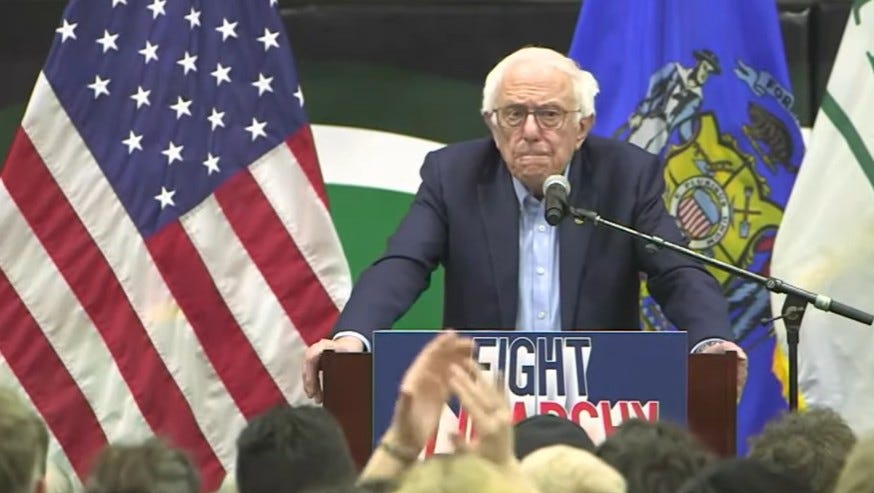
Bernie Sanders To Bring Fighting Oligarchy Tour To Rural West Virginia And North Carolina

PoliticusUSA is an independent voice urging you to join us in the fight against oligarchs and misinformation. Help us by becoming a subscriber. Subscribe now The Fighting Oligarchy tour is back. Sen. Bernie Sanders is going to fight the oligarchs and call out the Big Beautiful Bill in red districts in West Virginia and North Carolina in August. Sen. Sanders said, “Red state, blue state — the people of this country are opposed to an economy that works for the 1% and not for working class Americans. I’ll be heading to West Virginia and North Carolina to discuss the need for decent paying jobs, health care for all, and the end of a corrupt campaign finance system in which billionaires buy politicians. Together, we can defeat the oligarchs who have taken hold of our country.” PoliticusUSA is a reader-supported publication. To receive new posts and support our work, consider becoming a free or paid subscriber. In case you are thinking that Bernie Sanders is just talking to his supporters, two-thirds of the people who are RSVPing to attend Fighting Oligarchy rallies are new to the Sanders list. More than 270,000 people have attended Fighting Oligarchy rallies so far, and these attendees are not the same Democrats and progressives who have traditionally supported Sen. Sanders. Bernie Sanders seems to be getting new people activated and involved through his rallies, and now those rallies will come into very red West Virginia and rural North Carolina next weekend. Here is the schedule for the next round of rallies: Friday, August 8 Wheeling, WVDoors open at 3:30 p.m. ET. Parking is available on the street and in nearby surface lots.. Tickets are not required, but an RSVP is encouraged. Saturday, August 9 Lenore, WVDoors open at 11:30 a.m. ET. Free parking is available onsite. Tickets are not required, but an RSVP is encouraged. Saturday, August 9 Charleston, WV Doors open at 3:30 p.m. ET. Free parking available onsite. Tickets are not required, but an RSVP is encouraged. Sunday, August 10 Greensboro, NCDoors open at 11:30 a.m. ET. Free parking is available onsite. Tickets are not required, but an RSVP is encouraged. Sunday, August 10 Asheville, NCDoors open at 3:30 p.m. ET. Parking available in the nearby Harrah’s Cherokee Center Garage. Tickets are not required, but an RSVP is encouraged. What do you think about the Fighting Oligarchy Tour coming to West Virginia and North Carolina? Will you be attending? Share your thoughts in the comments below. Leave a comment

Politics

Conservatives hate government—but not when it benefits them

For once, a conservative is being honest about his hatred for the government and support for its destruction—so long as it doesn’t impact him. “There are government programs that I’d like to see discontinued or cut back, especially those that don’t affect me,” but don’t touch the programs he personally depends on: “But the ones like the Postal Service, yes, we count on them,” Rick Wallace, a retired firefighter in rural Nebraska, told the Nebraska Examiner. Of course they do. He lives in the kind of place where, if efficiency or cost savings become the standard, he’s completely screwed.  Wallace’s local mail carrier, Roger McDonald, drives nearly 150 miles every day to hit 334 delivery points. That kind of route bleeds money, and the long distance and sparse population density are part of why the U.S. Postal Service experiences annual losses. It’s also exactly the kind of thing that would vanish under President Donald Trump’s proposed privatization scheme, where unprofitable routes would inevitably be slashed, regardless of who’s left behind. A U.S. Postal Service carrier delivers mail in Portland, Maine. But the government isn’t supposed to be profitable. It’s supposed to serve the common good, even when that good is a tiny outpost in the middle of nowhere. Liberals have long understood that. We’ve been fine subsidizing rural America—its roads, its phone lines, its mail service, and its hospitals—because that’s what a shared society does.  But in return, rural conservatives have demonized the very government that sustains their communities. Worse, they’ve vilified the people—us—who’ve supported those subsidies. And now they admit that they only want to fund what affects them. Well, rural broadband doesn’t affect me. I have fast internet—screw everyone else. The expensive rural postal network? Doesn’t affect me, why should I pay for it? All that costly telephone infrastructure? Let it rot. The Department of Agriculture? I’m not a farmer, cut it all. Medicaid funding for rural hospitals? I’ve got 5 hospitals within 15 minutes. Rural road maintenance? Let them crumble. Black lung benefits for coal miners? Sucks to be them. Meth epidemic in rural towns? Let them bootstrap their way out. None of it affects me, right? It’s fucking gross, isn’t it?  That’s the difference between the right and left. Conservatives get off on the suffering of people who aren’t like them—that’s why they voted for Trump. But liberals? We’d be horrified if someone earnestly made the argument I just laid out. We believe in a basic social obligation to each other—even when it costs us something. Especially when it costs us something. Wallace doesn’t give a damn about programs that don’t directly benefit him. But we’re supposed to spend whatever it takes to keep his mail coming 6 days a week? That’s not how this works.  The social contract isn’t a vending machine for personal convenience; it’s a mutual agreement that binds a nation of people together, one that says we all pitch in so that no one—no matter where they live—falls through the cracks. It’s a recognition that the government is the tool we use to express collective values, not individual preferences.  When conservatives start picking and choosing what parts of society are worth funding based solely on their own needs, they’re not just being selfish. They’re breaking the very foundation that holds this country together.

Politics

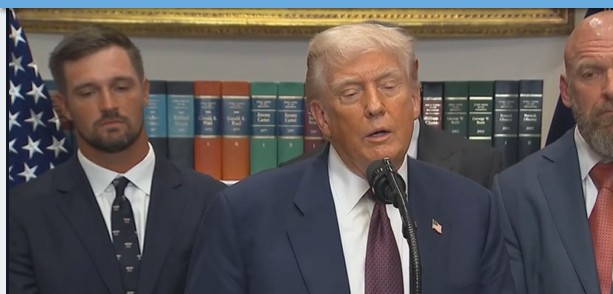
The Pressure Is Getting To Him As Trump Snaps At Reporter For Asking About Epstein

PoliticusUSA is independent news that is 100% supported by our readers. Please consider supporting us by becoming a subscriber. Subscribe now Nearly every day, Donald Trump steps in front of a microphone and tries to spin his failing presidency as a success, but after he delivers his remarks without fail, someone in the press will ask about Jeffrey Epstein. This has been the pattern for more than a month, and on Thursday, Trump showed that the pressure was getting to him. Video: At an event where he was announcing that he was reviving the presidential fitness test, which is disturbing because few presidents have been champions of poor diet and physical unfitness like Donald Trump, the president took some questions from reporters, and this is what ABC News asked him if he knew what Epstein was doing with the underage girls that he hired away from Trump. Read more

Politics

The Media Was Wrong: There Are Now More Democrats Than Republicans In The US

PoliticusUSA is an independent voice that will never bend the knee. Support our work by becoming a subscriber. Subscribe now All of the hysterical gloom and doom surrounding the coverage of the Democratic Party after Trump won the 2024 election focused on how Democrats were “out of touch” with the American people and how the country had “moved to the right.” Democratic and media elites went into a full-blown panic and claimed that the party was in crisis and needed to change all of its messaging because it wasn’t connecting with voters anymore. It turns out that none of it was true. According to new data from Gallup: In the second quarter of 2025, an average of 46% of U.S. adults identified as Democrats or said they are independents who lean toward the Democratic Party, while 43% identified as Republicans or said they lean Republican. That three-percentage-point Democratic advantage compares with a tie between the two parties in the first quarter of 2025, after a four-point Republican lead in the fourth quarter of 2024. Until now, the Republican Party had led or tied in most quarters since 2023. … The net three-point increase in Democratic affiliation between Q4 2024 and Q2 2025, from 43% to 46%, is entirely due to more Americans saying they are independents who lean toward the Democratic Party (up four points), not because more are identifying as Democrats outright (down one point). Meanwhile, Republicans’ four-point decline over the same period is due to equal two-point declines in the percentages of people identifying as and leaning Republican. So what’s happening here? Read more

Politics

Why Trump Broke With Bibi Over the Gaza Famine

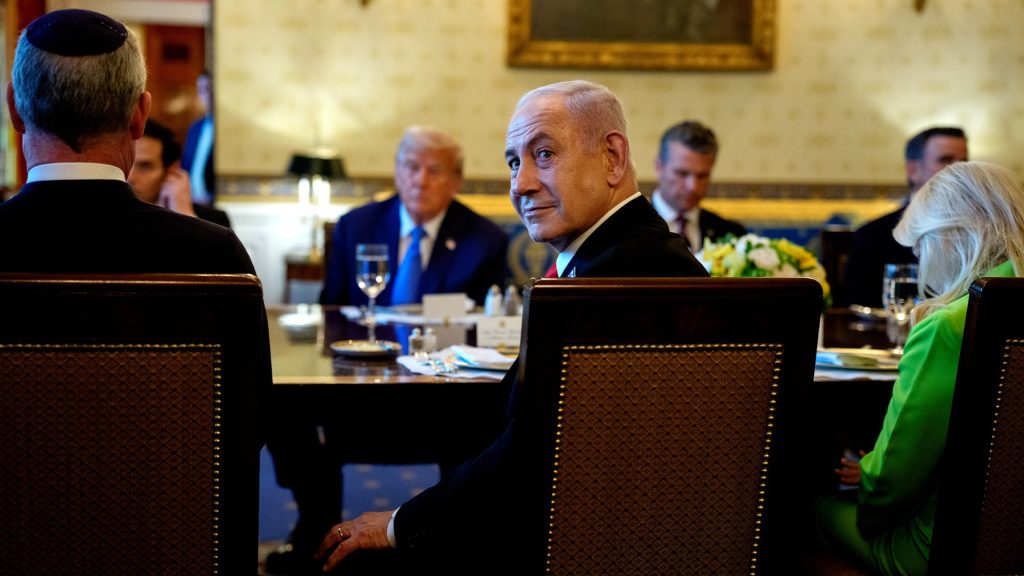
A few weeks ago, President Donald Trump and Israeli Prime Minister Benjamin Netanyahu each gave the other something of great symbolic value. Trump excoriated the “out-of-control” prosecutors responsible for the Israeli prime minister’s corruption trial, and Netanyahu nominated the American president for the Nobel Peace Prize he has long coveted. But whatever goodwill was generated by these gestures quickly dissipated, and was not enough to overcome deeper sources of conflict between the two men: starvation in the Gaza Strip, air strikes in Syria, and the lack of a cease-fire agreement between Israel and Hamas. Trump in recent days has publicly and repeatedly broken with Netanyahu, dismissing his on-again, off-again ally’s attempts to downplay the famine in Gaza, which has drawn international condemnation. Upset by images of dying children, Trump dispatched his diplomatic envoy, Steve Witkoff, to the region partly to pressure Israel to ease the hunger crisis. Meanwhile, the president and his senior aides were blindsided by recent Israeli strikes on Syria and a missile attack that hit Gaza’s only Catholic Church. Trump, two administration officials told us, has come to believe what many in Washington have thought for months: that Netanyahu is looking to prolong the conflict in Gaza, in open defiance of Trump’s wish for the war to end. The president and some of his aides think that Israel’s military objectives in Gaza were achieved long ago, and that Netanyahu has continued Israel’s assault, which has claimed tens of thousands of civilian lives, to maintain his own political power. The White House also believes that Netanyahu is taking steps that interfere with a potential cease-fire deal. [Yair Rosenberg: The corrupt bargain behind Gaza’s catastrophe] But the two officials said they did not anticipate that Trump would hold Netanyahu accountable in any meaningful sense. (Like others, they spoke with us on the condition of anonymity to discuss sensitive matters.) Even as Trump has felt disrespected by Netanyahu, his anger hasn’t translated into any significant shift in U.S. policy. The president blamed Hamas for the most recent breakdown of cease-fire talks. He resisted joining France and the United Kingdom in their vows this week to recognize a Palestinian state if Israel does not improve the humanitarian situation in Gaza and commit to a peace process. A White House official insisted to us that “there is no significant rupture” between Trump and Netanyahu and that “allies can sometimes disagree, even in a very real way.” This morning, seemingly trying to set aside his differences with Netanyahu, Trump wrote on Truth Social: “The fastest way to end the Humanitarian Crises in Gaza is for Hamas to SURRENDER AND RELEASE THE HOSTAGES!!!” Netanyahu has a long history of frustrating U.S. presidents. Joe Biden went from wrapping the prime minister in a bear hug in the days after the October 7, 2023, attacks to yelling at him over his prosecution of the war. Trump and Netanyahu were close during the president’s first term, until Trump grew angry at his Israeli counterpart for recognizing Biden’s 2020 victory. Their relationship has proceeded in fits and starts since then. Trump has hosted Netanyahu at the White House three times in the past six months, including a visit earlier this month, when they exchanged warm words. But Trump did not make a stop in Israel on his recent Middle East trip. The hunger crisis in Gaza has put a new strain on their relationship. In March, Israel enforced a blockade of the Strip, which is densely populated, preventing food and supplies from reaching Gazans after more than 20 months of war. Human-rights organizations warned this month about widespread famine, particularly among children. Under intense international pressure, Netanyahu has allowed some food aid into the region in recent days, but he has also insisted that there is “no starvation” in Gaza. Before a meeting with United Kingdom Prime Minister Keir Starmer in Scotland on Monday, Trump was asked by reporters whether he agreed with Netanyahu’s assessment. “Based on television, I would say not particularly, because those children look very hungry,” Trump said. Later, he added: “That’s real starvation stuff. I see it, and you can’t fake that.” This is not the first time that Trump has responded to gruesome photos. In 2017, he ordered missile strikes on a Syrian air base after he was shown what he said were “horrific” images of children killed by chemical weapons days before. Earlier this year, he unleashed some rare tough rhetoric on Vladimir Putin after being shown photos of Ukrainian children killed by a Russian air strike. And this week, the two administration officials told us, Trump was bothered by images of a Russian strike on a nursing home in Kyiv. [Hussein Ibish: Food aid in Gaza has become a horror] Trump’s frustration with the ongoing war in Russia has colored his response to what he is now seeing in Gaza, one of the officials and a close outside adviser to the president told us. During the 2024 campaign, Trump frequently boasted that he had kept the world free of conflict during his first term, and he returned to the Oval Office this year pledging to bring the wars in Gaza and Ukraine to a quick close. Instead, both have escalated, to Trump’s humiliation. Putin has repeatedly defied Trump’s wishes for a cease-fire, causing the president, who so often views foreign policy through a personal lens, to consider finally standing up to the Russian leader. (This week, Trump announced that he was giving Putin 10 days to stop the war in Ukraine or he would green-light a series of sanctions.) Similarly, Netanyahu’s recent strikes in Syria and his rejection of claims about the Gaza famine have angered Trump. The president is eager to stabilize the Middle East—and expand the Abraham Accords, which normalized relations between Israel and several Gulf states in his first term—in order to foster business and trade relationships in the region. Two additional U.S. officials told us that Trump’s willingness to contradict Netanyahu reflects less a new breach


Politics

ICE’s Mind-Bogglingly Massive Blank Check

The more than $175 billion that Congress handed to the nation’s immigration enforcers when it passed the One Big Beautiful Bill Act is larger than the annual military budget of every country in the world except the United States and China. Immigration and Customs Enforcement—just one component of the Department of Homeland Security—is getting more money than any other law-enforcement agency in America. All of this cash will be used to fund the next three and a half years of a deportation campaign that the public is already starting to question, at a time when the southern border is all but deserted. But as striking as the overall amount of money is how little we know about why it was necessary or how the funds will be spent. The bill placed few guardrails on ICE or Customs and Border Protection—both of which have a history of financial mismanagement—and dedicated no money to oversight. What we do know from the agencies’ public statements and contracts that are already in the works is that the money will be used to expand detention and surveillance systems, and that it will enrich some of the administration’s closest friends. When Donald Trump was inaugurated, top executives at the two largest private-prison companies that contract with the federal government to detain immigrants reacted with glee. In an earnings call with investors, Damon Hininger, the CEO of CoreCivic, called this “truly one of the most exciting periods” in his 32-year career with the company. CoreCivic’s stock price rose by more than 80 percent in the week after Trump’s reelection, while that of its top competitor, the GEO Group, doubled in less than a month. GEO’s CEO, J. David Donahue, told investors that “we believe the scale of the opportunity before our company is unlike any we’ve previously experienced.” GEO’s executive chairman and founder, George Zoley, estimated that the company could make $1 billion in additional revenue. (Whereas some in the private-prison industry might have become jittery when Trump started talking about detaining immigrants in Guantánamo Bay or countries such as El Salvador, instead of the United States, Hininger assured his investors that there would be enough detained immigrants to go around. “I want to be very clear on this: We don’t see that as an either/or. We actually see it as a both,” he said.) [Read: Trump loves ICE. Its workforce has never been so miserable.] GEO invested $70 million preparing to expand its detention capacity before Trump even took office; CoreCivic spent $40 million doing the same before a single new contract was signed. Just three years earlier, President Joe Biden had signed an executive order directing the Justice Department not to renew its contracts with private-prison companies, saying that they amounted to “profit-based incentives to incarcerate” in a system that “imposes significant costs and hardships on our society and communities and does not make us safer.” JPMorgan Chase said it would stop working with the industry. But now, with Trump, the companies’ leaders had good reason to feel confident: His election meant the elevation of figures such as Pam Bondi, who worked as a lobbyist for GEO as recently as 2019 and became attorney general in February, and Tom Homan, the president’s border czar, who was a GEO consultant during the Biden administration. The website for Homan’s consulting firm touted a “proven track record of opening doors and bringing successful relationships to our clients, resulting in tens of millions of dollars of federal contracts to private companies.” Homan has said he is recusing himself from contract negotiations now that he is back working for the government. For years, high-level officials at ICE have retired from the agency into plum roles at both companies. Daniel Bible, who oversaw ICE’s detention system, is an executive vice president at GEO, and Matt Albence and Dan Ragsdale, ICE’s former acting director and deputy director, are senior vice presidents. CoreCivic has taken on at least two former ICE field-office directors and ICE’s former head of budgeting. David Venturella has ping-ponged between the two: After 22 years at ICE, he rose through the executive ranks at GEO to become the company’s head of client relations. Then, after Trump took office, he returned to ICE as a senior adviser. This revolving door of hiring effectively puts private-prison-company executives at the negotiating table across from their former underlings, who may also hope to cash out in the private sector when they leave their government jobs. These conditions are not exactly conducive to making sure that the government’s top negotiators don’t agree to overpay for what they are purchasing, or that they hold contractors to account. DHS officials didn’t respond to my request for a comment. Ryan Gustin, a spokesman for CoreCivic, told me the company follows rules set by the government for how former employees may interact with their previous agencies, and that “there’s no basis for the claim that hiring former ICE officials results in higher costs or reduced accountability.” The confidence expressed by GEO and CoreCivic executives has paid off. Trump’s spending bill provides $45 billion to ICE to expand the nation’s detention system. It also dedicates $3.33 billion to immigration courts, but caps the number of judges who can be hired at 800–one of the few limits the bill contains. At the same time, the administration has actually been firing immigration judges, who have the power to hand down deportation orders and without which a person can’t be removed from the United States. Hiring more will take months or years, and in the meantime, having fewer of them around now will only lead to more people being detained. “They’re not really serious about getting rid of as many people as they can. They’re serious about causing human pain and suffering,” a former high-level ICE official, who spoke on the condition of anonymity for fear of retribution, told me. “Putting someone into detention isn’t a removal, it’s a punishment.” Allies of the administration are also in for a windfall in

Politics

The Rule of Law Is Dead in the US

Elie Mystal The rule of law presupposes that there are rules that provide a consistent, repeatable, and knowable set of outcomes. That’s no longer the case. The post The Rule of Law Is Dead in the US appeared first on The Nation.

Scroll to Top