Politics

Politics

Trump’s tariffs are wrecking this key industry

Two of the largest automakers, which each employ thousands in the U.S., are saying that President Donald Trump’s tariff policies have lost them billions in profits in the first half of 2025. The news highlights ongoing economic problems caused by Trump’s tariffs, despite the improving economy that Trump inherited. General Motors said on Tuesday that it had lost $1 billion in the second quarter of 2025, compared with its profits at the same time last year. A year ago, when Joe Biden was in the White House, GM had profits of $2.9 billion, but this year, under Trump, that was down to $1.9 billion. The company also saw a 2% drop in sales this year. Stellantis, which oversees brands like Chrysler, Jeep, and Dodge, reported similar bad news on Monday. In an announcement that shocked Wall Street, the company said it estimated that it would experience a net loss of nearly $2.7 billion in the first half of 2025. The company attributed much of the problem to the early effects of Trump’s tariffs. President Donald Trump proudly announces his new economy-wrecking tariffs at the White House on April 2, only to heavily—but not fully—walk them back days later. Following Trump’s April announcement of his “Liberation Day” tariffs on nearly all countries, his administration claimed that it would swiftly close new trade deals and that the tariffs would not hurt the economy. That hasn’t happened. Instead, the administration has promised over and over that deals are coming, with little to show for it. In fact, as GM was relaying the bad news on Tuesday, Treasury Secretary Scott Bessent told Fox Business, “We’re about to announce a rash of trade deals in the coming days.” Bessent also said the administration’s deadline for negotiating tariffs with China would once again be extended, since that nation has largely refused to bend to Trump’s demands. Trump has continued to push his tariff-based economic policies despite their harm to the global economy. In recent days, he has floated additional tariffs on the European Union and Mexico, which are expected to lead to increased prices for consumer goods for Americans. But the public doesn’t believe his policies will work. In an April poll by Gallup, 70% of Americans said the tariffs will cost Americans more money than the tariffs will bring in from foreign sources. An overwhelming majority of independents (74%) and Democrats (96%) expressed skepticism about Trump’s actions. But even 36% of Republicans think his policies are primed to fail. Datawrapper Content In addition to the hit on automakers, other businesses are shutting their doors under the weight of tariffs, including Howard Miller, a 100-year-old furniture manufacturing business in western Michigan—a state Trump won in the 2024 presidential election. When they’re not going under, businesses like Amazon are instead passing on the price hikes caused by tariffs on to the consumer. Meanwhile, a recent report by congressional Democrats revealed that China has benefitted from the chaos, swooping in to sign economic agreements while America has walked away from global commerce and erected new trade barriers. Trump inherited an economy in recovery, after Biden put in place policies to respond to Trump’s mismanagement of affairs during the COVID-19 outbreak and his first presidential administration. Now that recovery is going in reverse because of Trump’s tariff obsession.

Politics

What Trump’s Feud With Jerome Powell Is Really About

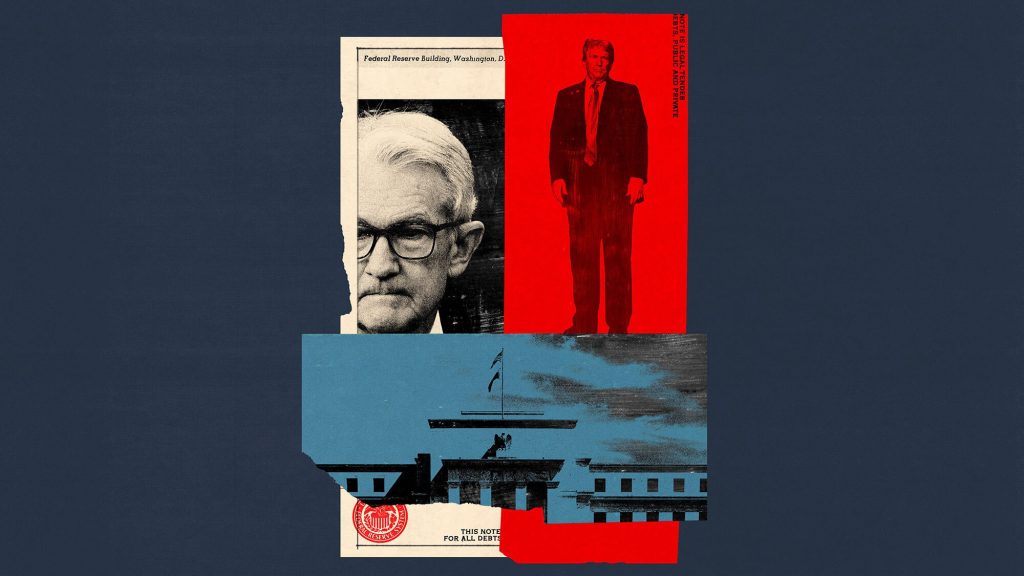
Donald Trump has been bullying Federal Reserve Chair Jerome Powell—calling him “too late,” insulting his intelligence, and trying to gin up a case that Powell spent too much on renovations of the agency’s headquarters as a pretext for firing him. The New York Times recently observed that the two men have a “toxic relationship,” which is true, as far as it goes. But the actual reason for the president’s hostility is neither alleged cost overruns nor Powell’s ability to manage the business cycle. Trump doesn’t think Powell is bad at his job. He objects to the job itself. The Federal Reserve’s assignment is to steward the long-term interests of the U.S. economy—even at the occasional expense of short-term pain—by balancing the twin objectives of suppressing inflation and managing the unemployment rate. Trump, however, believes that the Fed’s objective should be to speed up the economy under Republican administrations and slow it down under Democratic ones. To the extent that the central bank balances unemployment and inflation, he would like to see the pain of high unemployment shifted onto Democratic administrations so that Republican ones can benefit from rapid economic growth. Trump’s philosophy on monetary policy is easy to define because he has been publicly vilifying the Fed for at least a decade and a half. His opinions shift, but they shift predictably between two forms, with no relationship to economic circumstances. If the president is a Democrat, Trump complains that interest rates are too low. If the president is a Republican, he complains that they’re too high. [David Frum: Trump needs someone to blame] During the Obama years, the U.S. economy featured low inflation and elevated unemployment as it recovered from the Great Recession. Trump nonetheless spent that time complaining about low interest rates. “The Fed’s reckless monetary policies will cause problems in the years to come,” he tweeted in 2011. “The Fed has to be reined in or we will soon be Greece.” Five years later, with inflation still below target and the job market still recovering, he was still at it. “They’re keeping the rates down so that everything else doesn’t go down,” Trump complained in 2016. “We have a very false economy.” Then Trump became president, and abruptly reversed his position. “I do like a low-interest-rate policy, I must be honest with you,” he told The Wall Street Journal in April 2017. As the Federal Reserve began raising rates, which it generally does when the economy is running hot, Trump denounced those moves. He pushed repeatedly for lower rates, even when the economy was at its peak. “I think they should drop rates and get rid of quantitative tightening,” he said in 2019. “You would see a rocket ship.” At that time, rates were historically low. That changed after the pandemic sent prices soaring in 2021. Did Trump push back on the Fed’s decision to raise rates to combat inflation? Of course not, because Joe Biden was now president. Last October, Trump denounced Powell for easing interest rates by half a percentage point. “It was too big a cut, and everyone knows that was a political maneuver that they tried to do before the election,” he claimed. Almost immediately after winning his second term, however, he resumed his public drumbeat for cheaper money, a demand he has now backed with the threat of firing Powell. Whether Trump will follow through on that threat remains unclear, as does whether the courts would allow him to. Even if Trump eventually installs a more pliant figure in Powell’s place (his term as Fed chair expires next year), experts question whether that would actually lead to reduced interest rates. If the Fed loses credibility in the market, borrowing costs could paradoxically get even higher. [Annie Lowrey: Trump is flirting with economic disaster] Trump does not appear to have any master plan for how the Fed should function in a world in which he has compromised its independence. For one thing, he doesn’t believe that independence is possible. Laced through his commentary about the Fed over the years is a belief that its commitment to apolitical economic stewardship is a facade hiding naked partisanship. “Janet Yellen is highly political, and she’s not raising rates for a very specific reason,” he said a decade ago: “because Obama told her not to, because he wants to be out playing golf in a year from now and he wants to be doing other things, and he doesn’t want to see a big bubble burst during his administration.” Trump offered the same diagnosis when Powell was preparing to cut rates last year. “I think he’s political,” he told Fox News. “I think he’s going to do something to probably help the Democrats, I think, if he lowers interest rates.” Just as Trump is convinced that every president has secretly deployed the Justice Department for their own partisan ends, he believes that monetary policy is nothing but a way to win elections. Trying to advance the national interest, rather than some venal end goal, is a foreign concept. Economic analysts are now trying to predict what would happen under a regime in which the Fed chair is merely following the president’s short-term whims. Trump’s convictions begin with the premise that this is the world that has always existed.

Politics

Senate candidate shows Democrats how to run on Trump’s Epstein scandal

Michigan state Sen. Mallory McMorrow is running for fellow Democrat U.S. Sen. Gary Peters’ soon-to-be vacated seat. And in a new video, she demonstrates how she has outdone all other candidates in the race so far. Posted on Instagram, the video features McMorrow’s response to whether she, as a U.S. senator, would vote to release the Epstein files.  “Yes! Oh my God,” she replies emphatically before adding, “We should release the files immediately because Americans deserve to know what the truth is, so we do not have two systems of justice in this country: one that protects you if you’re rich and powerful, and one for the rest of us.” YouTube Video McMorrow catapulted onto the national stage after delivering a powerhouse speech on the Michigan Senate floor, in which she dissected the GOP’s attempts to paint her as someone “grooming” children, exposing the abject hypocrisy of so-called “conservative Christians.”  The Epstein scandal presents a catch-22 for President Donald Trump, as he and his minions either fabricated a conspiracy in order to manipulate the public or—even more cravenly—are actively covering up the heinous crimes perpetrated by the wealthy and powerful against minors.

Politics

White House offers new shiny objects to distract from Epstein scandal

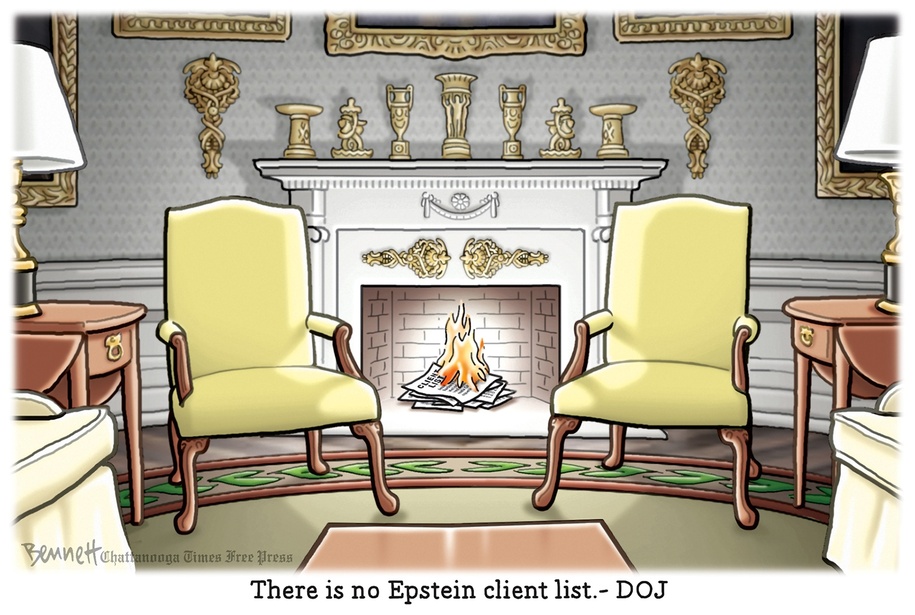
In a desperate ploy to change the subject from the bungled Epstein files saga, Attorney General Pam Bondi on Monday released documents relating to the late Martin Luther King Jr.’s assassination and the investigation into Hillary Clinton’s emails. Neither case is timely, but releasing documents related to the case offers red meat for right-wing propaganda networks to run with. That way  they can ignore the fact that President Donald Trump’s MAGA base is enraged that Bondi said there are no files in the Department of Justice’s possession that incriminate the powerful people who were friends with convicted sex offender Jeffrey Epstein. “The American people deserve answers decades after the horrific assassination of one of our nation’s great leaders,” Bondi said in a statement, which said that the DOJ was releasing 230,000 pages of documents relating to the assassination. “The Department of Justice is proud to partner with Director Gabbard and the ODNI at President Trump’s direction for this latest disclosure.” Bondi announced the release of the MLK files, even though his daughter, Bernice King, said she did not want them released because they would not be instructive and would only open painful wounds. “I wonder why I have to be confronted once again with something that was very confusing and distressing for me as a five-year-old. I am, honestly, not prepared to revisit the gruesome details of this painful history. For me, there is no real value in it; there is only reliving the trauma,” she wrote in a piece published in Vanity Fair. Bernice King went on to post an image of her father looking displeased with the text, “Now, do the Epstein files.” Bondi on Monday also said she turned over documents relating to the Clinton email investigation to Senate Judiciary Chair Chuck Grassley (R-IA), who is still probing the non-issue eight years later. It’s likely an effort to throw a bone to Trump’s base, which is enraged about the administration’s claim that there is nothing more to be released about Epstein. Deputy Attorney General Todd Blanche Apparently realizing that this wouldn’t be enough to make the Epstein scandal go away, Deputy Attorney General Todd Blanche on Tuesday released a statement reiterating that there are no documents in the DOJ’s possession from the Epstein case that incriminate other people, but said that the DOJ will speak with jailed Epstein associate Ghislane Maxwell to see if she has any information about Epstein that could lead to future investigations. “This Department of Justice does not shy away from uncomfortable truths, nor from the responsibility to pursue justice wherever the facts may lead. The joint statement by the DOJ and FBI of July 6 remains as accurate today as it was when it was written. Namely, that in the recent thorough review of the files maintained by the FBI in the Epstein case, no evidence was uncovered that could predicate an investigation against uncharged third parties,” Blanche wrote. He added, “President Trump has told us to release all credible evidence. If Ghislane Maxwell has information about anyone who has committed crimes against victims, the FBI and the DOJ will hear what she has to say.” Meanwhile, over on Capitol Hill, the House is mired in a state of paralysis due to the Epstein files brouhaha. Speaker Mike Johnson (R-LA)—who is blocking a bipartisan bill that would legally compel the Trump administration to release the files—is refusing to put his own toothless resolution on the floor that would urge the release of files relating to Epstein, but holds no legal weight to actually force them into public view. He wants to wait to put his nothingburger resolution up for a vote after Congress returns from a five-week-long August recess, hoping that maybe the scandal will have blown over by then. That has congressional Republicans fuming. “Dangling bits of red meat no longer satisfies,” GOP Rep. Marjorie Taylor Greene of Georgia—who is defying Trump to fight for the release of the Epstein files—wrote in a post on X. “They want the whole steak dinner and will accept nothing else.” What’s more, Democrats on the House Rules Committee—a powerful committee that tees up legislation for votes on the House floor—planned to offer other amendments relating to the Epstein files to bills this week. But because Republicans on that committee didn’t want to have to vote against those amendments, as directed by GOP leadership, Republican leaders decided that the Rules Committee simply wouldn’t meet at all. Punchbowl News’ Jake Sherman wrote: “THE HOUSE FLOOR is frozen because House Republicans are rebelling against @SpeakerJohnson strategy for dealing with the EPSTEIN FILES. The HOUSE RULES COMMITTEE is supposed to hold the line for the leadership and vote down any Democratic amendments. But they are unwilling to kill Epstein amendments, which means Johnson’s leadership team cannot bring anything to the floor. JOHNSON tried to push a non-binding resolution, but declined to bring it to the floor. JOHNSON is caught between a House Republican Conference that is wary about voting against Epstein related measures and a president who wants nothing to do with revisiting the sordid episode.” Ultimately, the ghost of Jeffrey Epstein is haunting Trump and the Republican Party. 

Politics

A Full Blown Cover-Up: GOP May Shut Down The House For 6 Weeks To Avoid Releasing Epstein Files

Unlike other outlets, PoliticusUSA is run by the wealthy or corporations. We are truly independent, and we need your support. Please consider supporting us by becoming a subscriber. Subscribe now Republicans Are Shutting Down The House To Protect Trump Speaker Mike Johnson (R-LA) has been working for days on a strategy to block his own members from joining with Democrats to prevent the passage of legislation that would require the DOJ to release the Epstein files. Johnson understands that any bill that comes out of the House on the Epstein files will have overwhelming support in the Senate, likely enough to override a Trump veto, so the House is Trump’s last line of defense to block the release of the files. PoliticusUSA is a reader-supported publication. To receive new posts and support our work, consider becoming a free or paid subscriber. So, the Speaker is refusing to hold a vote. What House Republican leadership has decided to do is shut down the legislative process by putting the House on ice for 6 weeks. Meredith Lee Hill of Politico posted on X: House Rules Committee isn’t returning AT ALL tonight and likely not AT ALL THIS week amid Epstein + other issues, per sources Scalise confirms to me it’s “not likely” Rules return – meaning House would leave without advancing immigration and several other bills. Rep. Alexandria Ocasio-Cortez (D-NY) wants answers for why Republicans are shutting down the House for six weeks: Ummm so let me get this straight: Republicans have ground Congress to a halt and are considering adjourning the entire House for 6 weeks to avoid releasing the info they have on Epstein? What is going on here? What is going on here is that Republicans and the White House are shutting it down so that members can’t make any moves to release the Epstein files, and Trump hopes that the scandal will go away over the next month and a half. House Republican leadership is so afraid of the files being released that they are willing to shut down the House before the August recess, which is usually a busy period before members go home for a month, in the hope of stopping the momentum behind releasing the files. If Trump has nothing to hide, why are House Republicans going to this extreme to cover for him? AOC is right. There is something going on here. Republicans are covering up the abuse and assault of women and girls on the orders of Donald Trump. What do you think? Please share your thoughts in the comments below. Leave a comment

Politics

ICE is paying retirees big bucks to come back and terrorize immigrants

Now that the Immigration and Customs Enforcement budget is larger than those for most of the world’s militaries, they’ve got plenty of money sloshing around to hire 10,000 new agents, which will surely allow them to ratchet up arrests of harmless day laborers at Home Depot. But how to find those 10,000 new hires? ICE seems to be starting by begging retirees to come back.  A recruitment page on ICE’s website features the obligatory scowling Uncle Sam. Retired ICE agents who return are eligible for up to $50,000 in bonuses and can still receive their basic federal retirement annuity. In other words, for these rehires, taxpayers will be paying: Their base salary, which starts at $105,000 for ICE criminal investigators and nearly $89,000 for deportation officers. Federal health care benefits. Base federal retirement annuity. A stratospheric hiring bonus of up to $50,000.  That may seem like a steep price, but hey, how else to ensure that migrant children are left alone when their mothers are deported, or that immigrants are mistakenly deported? How else to ensure that ICE has enough agents to arrest migrants at courthouses after federal immigration judges, in collusion with government attorneys, drop immigration cases so that the migrant can be immediately arrested when they leave the courtroom? Immigration and Customs Enforcement officers detain a person on Jan. 27 in Silver Spring, Maryland. Past, present, and future ICE agents are the only federal workers the administration seems to care about. As Trump’s latest tax scam progressed through Congress, the Senate parliamentarian forced that chamber to strike the worst measures targeting federal workers, and yet it’s useful to see how Republicans propose to treat other federal workers.  In a previous draft of the legislation, the GOP had proposed that all newly hired federal employees agree to serve at the pleasure of the administration, rather than receiving civil service protections. If those potential employees didn’t agree to give up the protections they are entitled to, they would have been forced to pay an extra 5 percentage points into their federal retirement plans. There was also a measure that would have required federal employees to pay $350 to file an appeal of an adverse employment action to the Merit Systems Protection Board.  Obviously, the administration has been wildly successful in its main attack on federal workers, though, which is to fire thousands of them at a time, a move that has been blessed by the Supreme Court.  Datawrapper Content Surely, though, only the very best and brightest folks will respond to massive financial incentives to join what is rapidly turning into the Trump administration’s secret police force. No, it won’t be at all like the last big immigration-enforcement hiring spree, which began in 2006, when Customs and Border Protection almost doubled its workforce in six years. At that time, CBP slashed hiring requirements, cutting Spanish-language training, shortening time at the training academy, and shifting some training online.  Back then, roughly 20% of Border Patrol recruits failed to graduate from training, so sure, make it easier—great idea. This surge resulted in a surge of arrests of CBP employees for misconduct and an uptick in high-profile corruption cases, such as CBP agents working with drug cartels. Only the best people.  This is just another example of the Trump administration’s chaotic approach to federal staffing. It fired expert employees across the government, all while showering cash on potential employees they deem worthy. And there’s no one the administration considers more worthy than those who will help execute Trump’s illegal and violent immigration crackdown, so money is no object.

Politics

Surprise medical bills were supposed to be a thing of the past. Surprise—they’re not.

By Elisabeth Rosenthal for KFF Health News Last year in Massachusetts, after finding lumps in her breast, Jessica Chen went to Lowell General Hospital-Saints Campus, part of Tufts Medicine, for a mammogram and sonogram. Before the screenings, she asked the hospital for the estimated patient responsibility for the bill using her insurance, Tufts Health Plan. Her portion, she was told, would be $359 — and she paid it. She was more than a little surprised weeks later to receive a bill asking her to pay an additional $1,677.51. “I was already trying to stomach $359, and this was many times higher,” Chen, a physician assistant, told me. The No Surprises Act, which took effect in 2022, was rightly heralded as a landmark piece of legislation, which “protects people covered under group and individual health plans from receiving surprise medical bills,” according to the Centers for Medicare & Medicaid Services. And yet bills that take patients like Chen by surprise just keep coming. With the help of her software-wise boyfriend, she found the complicated “machine-readable” master price list that hospitals are required to post online and looked up the negotiated rate between Lowell General and her insurer. It was $302.56 — less than she had paid out-of-pocket. CMS is charged with enforcing the law, so Chen sent a complaint about the surprising bill to the agency. She received a terse email in return: “We have reviewed your complaint and have determined that the rights and protections of the No Surprises Act do not apply.” When I asked the health system to explain how such a surprising off-estimate bill could be generated, Tufts Medicine spokesperson Jeremy Lechan responded by email: “Healthcare billing is complex and includes various factors and data points, so actual charges for care provided may differ from initial estimates. We understand the frustration these discrepancies can cause.” Here’s the problem: While the No Surprises Act has been a phenomenal success in taking on some unfair practices in the wild West of medical billing, it was hardly a panacea. In fact, the measure protected patients primarily from only one particularly egregious type of surprise bill that had become increasingly common before the law’s enactment: When patients unknowingly got out-of-network care at an in-network facility, or when they had no choice but to get out-of-network care in an emergency. In either case, before President Donald Trump signed the law late in his first term, patients could be hit with tens or hundreds of thousands of dollars in out-of-network bills that their insurance wouldn’t pay. The No Surprises Act, which took effect in 2022, was supposed to provide new protections for people from unexpected medical bills. The No Surprises Act also provided some protection from above-estimate bills, but at the moment, the protection is only for uninsured and self-pay patients, so it wouldn’t apply in Chen’s case since she was using health insurance. But patients who do qualify generally are entitled to an up-front, good-faith estimate for treatment they schedule at least three business days in advance or if they request one. Patients can dispute a bill if it is more than $400 over the estimate. (The No Surprises Act also required what amounted to a good-faith estimate of out-of-pocket costs for patients with insurance, but that provision has not been implemented, since, nearly five years later, the government still has not issued rules about exactly what form it should take.) So, surprising medical bills — bills that the patient could not have anticipated and never consented to — are still stunning countless Americans. Jessica Robbins, who works in product development in Chicago, was certainly surprised when, out of the blue, she was recently billed $3,300 by Endeavor Health for a breast MRI she had received two years earlier, with prior authorization from her then-insurer, Blue Cross and Blue Shield of Illinois. In trying to resolve the problem, she found herself caught in a Kafkaesque circle involving dozens of calls and emails. The clinic where she had the procedure no longer existed, having been bought by Endeavor. And she no longer had Blue Cross. “We are actively working with the patient and their insurer to resolve this matter,” Endeavor spokesperson Allie Burke said in an emailed response to my questions. Mary Ann Bonita of Fresno, California, was starting school this year to become a nursing assistant when, on a Friday, she received a positive skin test for tuberculosis. Her school’s administration said she couldn’t return to class until she had a negative chest X-ray. When her doctor from Kaiser Permanente didn’t answer requests to order the test for several days, Bonita went to an emergency room and paid $595 up front for the X-ray, which showed no TB. So she and her husband were surprised to receive another bill, for $1,039, a month later, “with no explanation of what it was for,” said Joel Pickford, Bonita’s husband. In the cases above, each patient questioned an expensive, unexpected medical charge that came as a shock — only to find that the No Surprises Act didn’t apply. “There are many billing problems out there that are surprising but are not technically surprise bills,” Zack Cooper, an associate professor of economics at Yale University, told me. The No Surprises Act fixed a specific kind of charge, he said, “and that’s great. But, of course, we need to address others.” Cooper’s research has found that before the No Surprises Act was passed, more than 25% of emergency room visits yielded a surprise out-of-network bill. Related | Trump vowed to end surprise medical bills. The office working on that just got slashed. CMS’ official No Surprises Help Desk has received tens of thousands of complaints, which it investigates, said Catherine Howden, a CMS spokesperson. “While some billing practices, such as delayed bills, are not currently regulated” by the No Surprises Act, Howden said, complaint trends nonetheless help “inform potential areas for future improvements.” And they are needed. Michelle Rodio, a teacher in Lakewood, Ohio, had a lingering cough weeks after a bout of pneumonia that required

Politics

The Hype Man of Trump’s Mass Deportations

In the upper ranks of the Border Patrol, 20 officials have the title of sector chief. Gregory Bovino is the only one holding a gun in his social-media profile photo. Most of the others conform to a pretty standard formula: wearing a crisp green uniform in front of Old Glory and the black-and-green Border Patrol flag. Bovino’s photo is more like a movie poster, or an AI-generated image of a comic-book character. He stands wearing a bulletproof vest against a black background, holding a tricked-out M4 rifle with a scope in his hands. He isn’t holding the weapon so much as cradling it affectionately, like a cellist getting ready to play. Bovino’s jaw is stiff, and his gaze is distant. Several Customs and Border Protection veterans with whom I spoke—who value the quiet strength of professional modesty—think the photo is ridiculous. And yet, the performative qualities that have made Bovino a sometimes-mocked figure within CBP are the same ones that have landed him a starring role in the promotion of President Donald Trump’s deportation campaign. Bovino, whose formal title is chief patrol agent of the El Centro sector, has been put in charge of the administration’s immigration crackdown on the streets of Los Angeles, more than 200 miles from his office, which sits near the border. While much of the local anger has been directed at ICE, it’s actually Bovino who’s been calling the shots. The guys in camouflage, masks, and military gear running around Southern California car washes and Home Depot parking lots aren’t Immigration and Customs Enforcement officers, but Border Patrol tactical teams trained to hunt drug smugglers in remote mountains and deserts. When horse-mounted Border Patrol agents rode through MacArthur Park in downtown Los Angeles with camera crews in tow on July 7, Mayor Karen Bass came rushing to the scene and pleaded with Bovino to call them off. No arrests were made, but the sight of heavily armed federal agents advancing in formation through palm trees and soccer fields was jarring to a city on edge after weeks of raids and protests. Marqueece Harris-Dawson, the Los Angeles City Council president, told reporters that if Bovino wanted to make Border Patrol promotional videos, he should “apply for a film permit like everybody else” and “stop trying to scare the bejesus out of everybody.” “Better get used to us now, because this is going to be normal very soon,” Bovino fired back on Fox. On Friday, he released a video—set to the song “DNA” by the rapper Kendrick Lamar, who is from L.A.—showing National Guard troops and mounted agents parading through the park with an armory of weapons and black masks covering their faces. “People ask for it, we make it happen,” Bovino posted to his government account on X, sounding more like a hype man than a lawman. [Joshua Braver: When the military comes to American soil] At a time when Trump-administration officials have done little to conceal their frustration with ICE leaders, demoting several over the past few months for missing the White House’s ambitious arrest quotas, Bovino’s assignment in California has been viewed by some at ICE as a slight against the agency. Current and former CBP officials told me it was more an indication that the White House wants field generals who will press the president’s deportation goals as aggressively as possible. During the Biden administration, Border Patrol agents were often overwhelmed and exhausted as record numbers of migrants crossed into the United States. Unlawful entries fell sharply during Joe Biden’s last year in office, but they have plunged in recent months to levels not seen since the 1960s as a result of Trump’s all-out push to seal the border. That has left the Border Patrol’s roughly 19,000 agents with far less work and a lot more time. ICE, under relentless White House pressure to ramp up arrests and deportations, is now the agency that needs help. Bovino, a 29-year veteran of the Border Patrol, seemed to anticipate the opportunity well before Trump took office. Two weeks before Inauguration Day, he sent dozens of El Centro Border Patrol agents five hours north to Kern County, California, near Bakersfield. Over the course of several days, agents in plainclothes made arrests at gas stations and stopped vehicles along the highway. The surprise tactics sent a wave of fear through the farms of California’s Central Valley, and though Bovino said his agents had targeted criminals, only one of the 78 people they arrested had a criminal conviction, according to records obtained by the nonprofit news organization CalMatters. The ACLU and other advocacy groups sued the government in February and won an injunction barring the Border Patrol from racially profiling suspects, and a federal district court found that Bovino’s teams likely violated Fourth Amendment protections against unreasonable searches. (Earlier this month, another federal judge ordered the government to stop racially profiling suspects in Los Angeles.) Bovino had launched the Kern County expedition, which he called “Operation Return to Sender,” without getting clearance from superiors in Washington, according to CBP officials I spoke with who weren’t authorized to speak to reporters. The raids far from the border were not the kind of operation Biden officials would have endorsed. But those officials were already on their way out, and the Trump team coming in was thrilled with Bovino’s audition. The Department of Homeland Security did not approve my request to interview Bovino. I sent a list of more than a dozen questions to DHS and CBP, asking about his record in the Border Patrol and why he’s been elevated to his current role. “Because he’s a badass” was all that the DHS spokesperson Tricia McLaughlin wrote back. What Bovino is doing in Los Angeles is a pilot of sorts. It showcases the potential for a broader Border Patrol role in U.S. cities and communities, especially those that have adopted “sanctuary” policies restricting local police cooperation with ICE. By law, the Border Patrol’s ability to conduct warrantless searches is limited

Scroll to Top