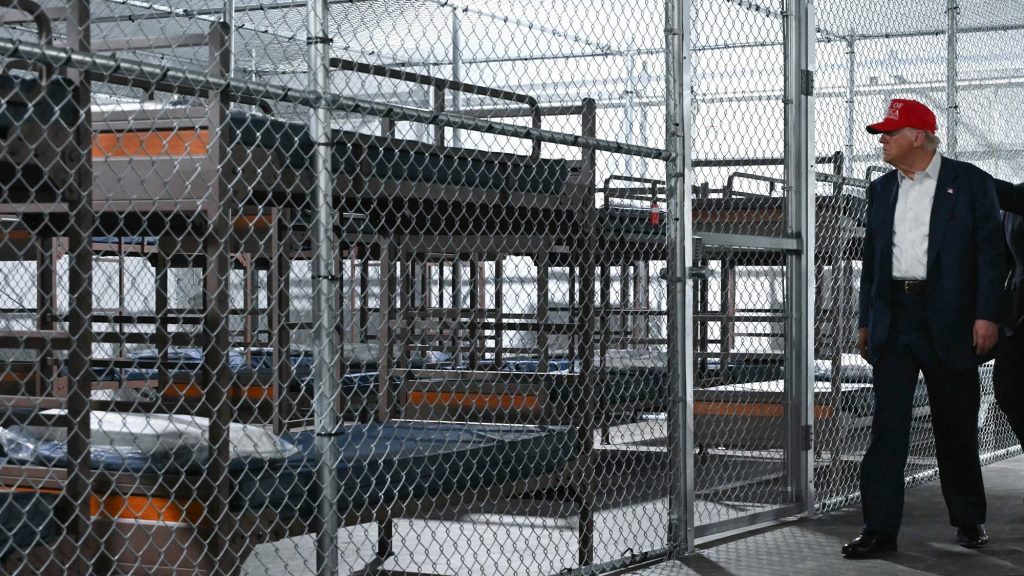
Three weeks ago, Donald Trump attended the opening of an immigrant-detention center in the Florida Everglades, about 50 miles west of Miami. “Pretty soon, this facility will handle the most menacing migrants, some of the most vicious people on the planet,” the president said. Officially named Alligator Alcatraz, it was constructed in eight days by the state of Florida on a disused airport runway. The detention center features tents that contain chain-link cages crammed with bunk beds, surrounded by miles of barbed wire. By the end of August, it may have the capacity to hold 4,000 people waiting to hear whether they’ll be deported. On Fox News that night, Stephen Miller, the White House’s deputy chief of staff for policy, argued that there was nothing dehumanizing about an immigrant-detention center built in a hot, humid, mosquito-infested, subtropical wetland. “What is dehumanizing is when Democrats let illegal alien rapists into the country to attack our children,” Miller said. Laura Loomer, a Trump adviser, expressed the hope that alligators would eat the immigrants detained in the Everglades. “Alligator lives matter,” she posted on X, along with an implied threat to the Latino population of the United States: “The good news is, alligators are guaranteed at least 65 million meals if we get started now.” The Everglades detention center, the nationwide roundups of immigrants, the massive increase in spending for ICE, and the Trump administration’s harsh rhetoric were foreshadowed during the 2024 presidential campaign. “This is country changing; it’s country threatening; and it’s country wrecking,” Trump said about undocumented immigration at one campaign rally. At another he said, “It’s a massive invasion at our southern border that has spread misery, crime, poverty, disease, and destruction to communities all across our land.” Trump called immigrants “animals,” accused them of stealing and eating pet dogs and cats, and claimed that they were “poisoning the blood of our country.” These claims helped ensure Trump’s election. Last year, an opinion poll commissioned by CBS News found that almost half of all adults in the United States agreed that undocumented immigrants are “poisoning the blood” of the country. More than three-quarters of Republican adults agreed. I’ve been writing about the role of undocumented immigrants in the American economy for 30 years. They are the bedrock of our food, construction, and hospitality industries. They are also some of the nation’s poorest, most vulnerable, most devout, most family-oriented workers in the U.S. They routinely suffer wage theft, minimum-wage violations, sexual harassment on the job, and workplace injuries that go unreported and uncompensated. Most of them have lived here for more than a decade. The lies now being spread about them are too numerous to mention. But one that must be addressed is the falsehood at the heart of Trump’s immigration policy: that undocumented immigrants are likely to be murderers, rapists, and violent criminals who wreak havoc upon law-abiding citizens. [Stephanie McCrummen: The message is ‘we can take your children’] A recent study of 150 years of American incarceration data, from 1870 to 2020, found that immigrant men were far less likely to be sent to prison than men born in the U.S. Since 1990, the number of undocumented immigrants in the U.S. has roughly tripled—yet the homicide rate has fallen by almost 50 percent. A 2020 study published in the journal PNAS compared the crime rates of undocumented immigrants in Texas with the crime rates of U.S.-born citizens there. “Relative to undocumented immigrants,” the study found, U.S.-born citizens “are over 2 times more likely to be arrested for violent crimes, 2.5 times more likely to be arrested for drug crimes, and over 4 times more likely to be arrested for property crimes.” That helps explain why crackdowns on undocumented immigration aren’t the most effective way to improve public safety. Texas would be a much safer place if everyone born in Texas got deported. “Under President Trump’s leadership, we are targeting eight terrorist organizations, including six Mexican drug cartels that threaten the foreign policy, the public safety, the national security of the United States,” Miller said during his Fox News appearance, stressing the urgent need to build more ICE detention centers. But ICE isn’t part of the criminal-justice system. The apprehension and deportation of immigrants is conducted under civil law by the executive branch of the federal government. The phrase criminal alien, widely used by the Trump administration, is misleading. It conjures images of a dangerous, perhaps homicidal, stranger. Kristi Noem, the Department of Homeland Security secretary, likes to issue grave warnings about the threat posed by “illegal criminal aliens” and “criminal illegal aliens.” That threat is greatly overstated. A criminal alien is an immigrant who has already been convicted of a crime. Last year, the U.S. Border Patrol arrested about 17,000 criminal aliens. Among the convictions recorded for that group, 29 were for homicide or manslaughter, 221 were for sex offenses—and 10,935 were for unlawful entry or reentry to the U.S. The Trump administration’s harsh, fearmongering rhetoric is contradicted by a simple fact: The overwhelming majority of criminal aliens become criminals by violating immigration laws. And almost three-quarters of the people now being held in ICE detention centers aren’t even criminal aliens. The federal agencies actually devoted to hunting down terrorists and members of Mexican drug cartels—-the FBI, the Drug Enforcement Administration (DEA), the Bureau of Alcohol, Tobacco, Firearms and Explosives (ATF)—all face major cuts in Trump’s 2026 budget. The FBI’s budget will be reduced by $545 million; the ATF’s by $418 million; the DEA’s by $112 million. The Justice Department’s Organized Crime and Drug Enforcement Task Forces program, created to “disrupt and dismantle transnational criminal networks,” will lose its entire $547 million in funding. The program is being completely shut down. Meanwhile, the omnibus bill that Trump signed on July 4 triples the size of ICE’s budget and allocates about $170 billion to immigration enforcement. Roughly $45 billion will be spent during the next four years to build new ICE detention centers, which will hold mainly people who