Politics

Politics

The IRS is building a vast system to share millions of taxpayers’ data with ICE

ProPublica has obtained the blueprint for the Trump administration’s unprecedented plan to turn over IRS records to Homeland Security in order to speed up the agency’s mass deportation efforts. By William Turton, Christopher Bing and Avi Asher-Schapiro for ProPublica The Internal Revenue Service is building a computer program that would give deportation officers unprecedented access to confidential tax data. ProPublica has obtained a blueprint of the system, which would create an “on demand” process allowing Immigration and Customs Enforcement to obtain the home addresses of people it’s seeking to deport. Last month, in a previously undisclosed dispute, the acting general counsel at the IRS, Andrew De Mello, refused to turn over the addresses of 7.3 million taxpayers sought by ICE. In an email obtained by ProPublica, De Mello said he had identified multiple legal “deficiencies” in the agency’s request. Two days later, on June 27, De Mello was forced out of his job, people familiar with the dispute said. The addresses have not yet been released to ICE. De Mello did not respond to requests for comment, and the administration did not address questions sent by ProPublica about his departure. The Department of Government Efficiency began pushing the IRS to provide taxpayer data to immigration agents soon after President Donald Trump took office. The tax agency’s acting general counsel refused and was replaced by De Mello, who Trump administration officials viewed as more willing to carry out the president’s agenda. Soon after, the Department of Homeland Security, ICE’s parent agency, and the IRS negotiated a “memorandum of understanding” that included specific legal guardrails to safeguard taxpayers’ private information. Related | How DOGE’s cuts to the IRS threaten to cost more than DOGE will ever save In his email, De Mello said ICE’s request for millions of records did not meet those requirements, which include having a written assurance that each taxpayer whose address is being sought was under active criminal investigation. “There’s just no way ICE has 7 million real criminal investigations, that’s a fantasy,” said a former senior IRS official who had been advising the agency on this issue. The demands from the DHS were “unprecedented,” the official added, saying the agency was pressing the IRS to do what amounted to “a big data dump.” In the past, when law enforcement sought IRS data to support its investigations, agencies would give the IRS the full legal name of the target, an address on file and an explanation of why the information was relevant to a criminal inquiry. Such requests rarely involved more than a dozen people at a time, former IRS officials said. Danny Werfel, IRS commissioner during the Biden administration, said the privacy laws allowing federal investigators to obtain taxpayer data have never “been read to open the door to the sharing of thousands, tens of thousands, or hundreds of thousands of tax records for a broad-based enforcement initiative.” A spokesperson for the White House said the planned use of IRS data was legal and a means of fulfilling Trump’s campaign pledge to carry out mass deportations of “illegal criminal aliens.” Taxpayer data is among the most confidential in the federal government and is protected by strict privacy laws, which have historically limited its transfer to law enforcement and other government agencies. Unauthorized disclosure of taxpayer return information is a felony that can carry a penalty of up to five years in prison. The system that the IRS is now creating would give ICE automated access to home addresses en masse, limiting the ability of IRS officials to consider the legality of transfers. IRS insiders who reviewed a copy of the blueprint said it could result in immigration agents raiding wrong or outdated addresses. “If this program is implemented in its current form, it’s extremely likely that incorrect addresses will be given to DHS and individuals will be wrongly targeted,” said an IRS engineer who examined the blueprints and who, like other officials, spoke on condition of anonymity for fear of retribution. Related | Treasury IG probes if DOGE, Trump sought private taxpayer info The dispute that ended in De Mello’s ouster was the culmination of months of pressure on the IRS to turn over massive amounts of data in ways that would redefine the relationship between the agency and law enforcement and reduce taxpayers’ privacy, records and interviews show. In one meeting in late March between senior IRS and DHS officials, a top ICE official made a suggestion: Why doesn’t Homeland Security simply provide the name and state of its targets and have the IRS return the addresses of everyone who matches that criteria? The IRS lawyers were stunned. They feared they could face criminal liability if they handed over the addresses of individuals who were not under a criminal investigation. The conversation and news of deeper collaboration with ICE so disturbed career staff that it led to a series of departures in late March and early April across the IRS’ legal, IT and privacy offices. They were “pushing the boundaries of the law,” one official said. “Everyone at IRS felt the same way.” The Blueprint The technical blueprint obtained by ProPublica shows that engineers at the agency are preparing to give DHS what it wants: a system that enables massive automated data sharing. The goal is to launch the new system before the end of July, two people familiar with the matter said. The DHS effort to obtain IRS data comes as top immigration enforcement leaders face escalating White House pressure to deport some 3,000 people per day, according to reports. One federal agent tasked with assisting ICE on deportations said recent operations have been hamstrung by outdated addresses. Better information could dramatically speed up arrests. “Some of the leads that they were giving us were old,” said the agent, who spoke on condition of anonymity because he was not authorized to speak with the press. “They’re like from two administrations ago.” In early March, immigrants rights groups sued the IRS hoping to block the plan, arguing that the memorandum of understanding between

Politics

Virginia Republican admits Trump is an albatross around her neck

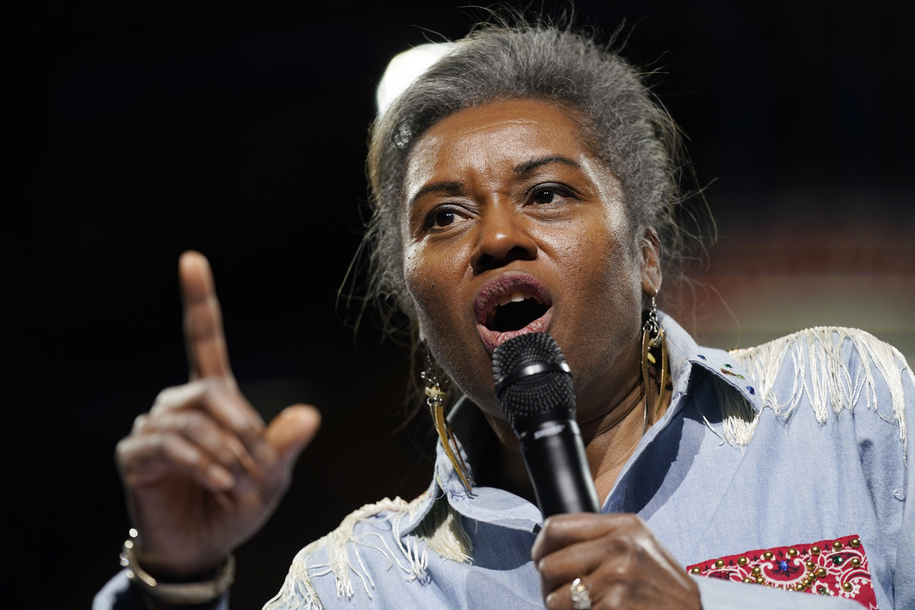
Republicans in this fall’s two governor’s races are clinging to President Donald Trump, despite running in left-leaning states. It’s a strange strategy, one made all the stranger by the fact that one of those Republicans is aware of the liability Trump poses to her campaign. In audio obtained by the news outlet Dogwood, Virginia’s Republican gubernatorial nominee, Winsome Earle-Sears, admits the damage that Trump, Elon Musk, and their so-called Department of Government Efficiency did to her chances. She claims her race against Democratic nominee Abigail Spanberger was “neck and neck” until Trump’s reelection and DOGE’s war on the federal bureaucracy rattled Northern Virginia’s D.C.-adjacent suburbs. “[Spanberger] was throwing that on the left and right,” Earle-Sears said at a Virginia Beach event in June. “Just DOGE, DOGE, DOGE, DOGE and Trump and DOGE and Trump. And so then I started down six points. Dropped me six points in January.” Abigail Spanberger, Democratic candidate the governor of Virginia, speaks during the Women’s Summit in Herndon, Virginia, in 2018. Later in the same audio, she tries to project optimism—because that’s required at campaign events—but the reality is harsher, as polling shows. A new poll from Virginia Commonwealth University shows that 49% of registered voters in the state support Spanberger, while only 37% back Earle-Sears. A December survey from the same pollster had Spanberger’s lead slightly narrower, at 44% to Earle-sears’ 34%. The new VCU poll finds Trump’s approval in Virginia at a dismal 40%. And that’s largely in line with other polling, which shows to be pretty unpopular in the state. Last month, Morning Consult found that 45% of Virginia voters disapproved of the job he was doing as president, while a majority (52%) disapproved.  Worse for Earle-Sears? A CNN poll released Thursday finds that 72% of Democrats and Democratic-leaning voters are “extremely motivated” to vote in next year’s midterms, compared with just 50% of Republican-aligned voters. Despite acknowledging that Trump is a drag on her campaign, Earle-Sears can’t quit him. Just weeks ago, she went on the right-wing outlet Newsmax to praise Trump’s Big Beautiful Bill, claiming it “does so many great things.” But that’s the catch. In today’s GOP, it doesn’t pay to buck Trump—even when it’s electorally the smart thing to do.

Politics

Can This Man Save Harvard?

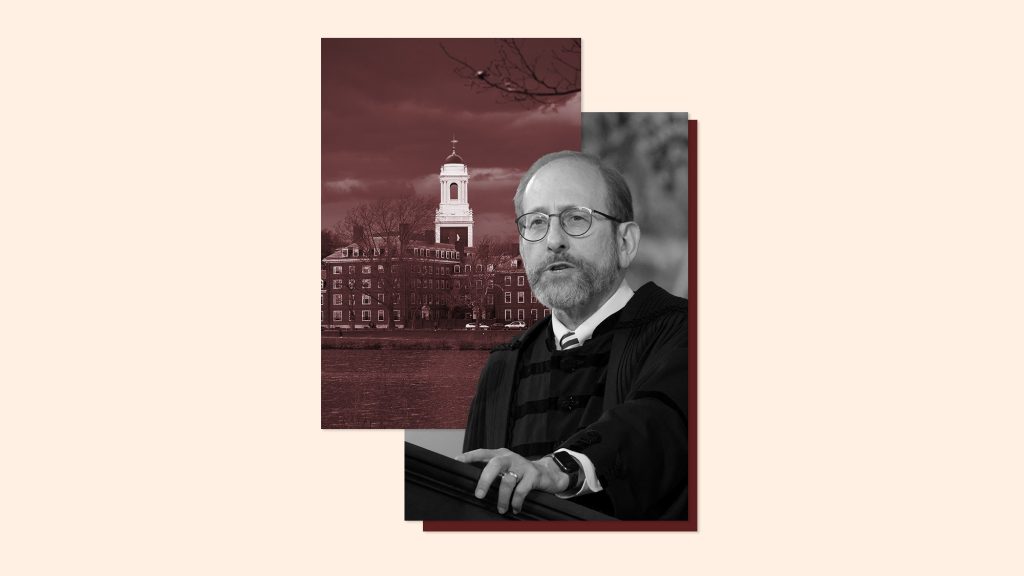
The email landed at 10 minutes to midnight on a Friday in early April—a more menacing email than Alan Garber had imagined. The Harvard president had been warned that something was coming. His university had drawn the unwanted and sustained attention of the White House, and he’d spent weeks scrambling to stave off whatever blow was coming, calling his institution’s influential alumni and highly paid fixers to arrange a meeting with someone—anyone—in the administration. When he finally found a willing contact, he was drawn into aimless exchanges. He received no demands. No deadlines. Just a long conversation about the prospect of scheduling a conversation. Garber wanted an audience because he believed that Harvard had a case to make. The administration had been publicly flogging elite universities for failing to confront campus anti-Semitism. But Garber—a practicing Jew with a brother living in Israel—believed Harvard had done exactly that. In the spring, Garber had watched Donald Trump take aim at Columbia, where anti-Israel demonstrations the previous year had so overwhelmed the campus that the university canceled the school’s graduation ceremony and asked the New York Police Department to clear encampments. In early March, the Trump administration cut off $400 million in federal funding to the school and said that it would consider restoring the money only if Columbia agreed to dramatic reforms, including placing its Middle East–studies department under an auditor’s supervision. Ever since William F. Buckley Jr. turned his alma mater, Yale, into a bête noire, the American right has dreamed of shattering the left’s hegemony on campus, which it sees as the primary theater for radical experiments in social engineering. Now the Trump administration was using troubling incidents of anti-Jewish bigotry as a pretext to strip Ivy League adversaries of power and prestige. The administration’s demands of Columbia impinged on academic freedom. But from Harvard’s parochial vantage point, they were also oddly clarifying. Whatever had gone wrong in Cambridge—and Garber’s own university faced a crisis of anti-Jewish bias—it hadn’t metastasized like it had in Morningside Heights. Harvard had disciplined protesters, and Garber himself had denounced the ostracism of Jewish students. Whichever punishment the administration had in mind, surely it would fall short of the hammer dropped on Columbia. [Franklin Foer: Columbia University’s anti-Semitism problem] That was Garber’s frame of mind when the late-night ultimatum arrived: Submit to demands even more draconian than those imposed on Columbia, or risk forfeiting nearly $9 billion in government funding. Even for Harvard, with a $53 billion endowment, $9 billion represented real money. The email ordered the university to review faculty scholarship for plagiarism and to allow an audit of its “viewpoint diversity.” It instructed Harvard to reduce “the power held by faculty (whether tenured or untenured) and administrators more committed to activism than scholarship.” No detail, no nuance—just blunt demands. To the Trump administration, it was as if Harvard were a rogue regime that needed to be brought to heel. Trump’s team was threatening to unravel a partnership between state and academe, cultivated over generations, that bankrolled Harvard’s research, its training of scientists and physicians, its contributions to national security and global health. Federal funds made up 11 percent of the university’s operating budget—a shortfall that the school couldn’t cover for long. Stripped of federal cash, Harvard would have to shed staff, abandon projects, and shut down labs. Yet the message also offered a kind of relief. It spared Garber from the temptation of trying to placate Trump—as Columbia had sought to do, to humiliating effect. The 13 members of the Harvard Corporation, the university’s governing body, agreed unanimously: The only choice was to punch back. The university’s lawyers—one of whom, William Burck, also represented Trump-family business interests—wrote, “Neither Harvard nor any other private university can allow itself to be taken over by the federal government.” Soon after Harvard released its response, absurdity ensued. The Trump administration’s letter had been signed by three people, one of whom told Harvard he didn’t know the letter had been sent. The message, Garber realized, may have been sent prematurely. Or it may have been a draft, an expression of the White House’s raw disdain, not the vetted, polished version it intended to send. But the administration never disavowed the letter. And over the next three months, the president and his team would keep escalating. On Memorial Day, I met Alan Garber at his home, a 10-minute walk from Harvard Yard. One of the perks of leading Harvard is the right to reside in Elmwood, an imposing Georgian mansion that befits a prince of the American establishment. But Garber had declined the upgrade, choosing instead to remain in the more modest home provided to the university’s provost. When he took the president’s job last year at 69, after 12 years as provost, he agreed to a three-year term; he didn’t want to uproot his life. I was surprised he found time to talk. It wasn’t just a national holiday—it was the start of the most stressful week on a university president’s calendar. Graduation loomed on Thursday, with all its ceremonial burdens: the speechifying, the glad-handing, the presence of the school’s biggest donors. Garber led me into his living room, undid his tie, and slouched into a chair. A health-care economist who also trained as a physician, he carries himself with a calm that borders on clinical. Even an admirer such as Laurence Tribe, a Harvard Law professor, describes Garber as “meek in the way he sounds.” He is the opposite of bombastic: methodical, a careful listener, temperamentally inclined to compromise. But after Harvard’s feisty reply to the administration, Garber found himself cast a mascot of the anti-Trump resistance. This was surprising, because in his 18 months as president, Garber has positioned himself as an institutionalist and an opponent of illiberalism in all its forms: its Trumpian variant, yes, but also illiberal forces within his own university, including those concentrated in the divinity and public-health schools, the hot centers of extremism after October 7, 2023. [Rose Horowitch: What

Politics

How the Right Is Waging War on Climate-Conscious Investing

In January 2020, Larry Fink, the CEO of BlackRock—the world’s largest asset-management firm—released his annual letter to corporate executives. The letters had become something of a tradition: part investor missive, part State of the Union, dispatched each year from the top of the financial world. This one struck a tone of alarm that would reverberate far beyond Wall Street. “Climate change has become a defining factor in companies’ long-term prospects,” Fink warned. “We are on the edge of a fundamental reshaping of finance.” He said that BlackRock would be “increasingly disposed to vote against management and board directors when companies are not making sufficient progress” on sustainability. The message signaled the degree to which a once-obscure investing philosophy known as ESG—short for “environmental, social, and governance”—had become a boardroom priority. For a moment, it looked like corporate America would weigh carbon emissions alongside profits. More major companies soon announced climate goals and promised new standards of accountability. BlackRock helped lead an effort to elect sustainability advocates to the board of ExxonMobil. A consensus seemed to be forming: Business could be a force for good, and markets might even help save the planet. Now, just five years later, that consensus is crumbling. BP is pulling back on a commitment to invest in renewables—and is reportedly expanding plans for drilling. PepsiCo and Coca-Cola have scaled back their plastic-reduction pledges. Major banks, such as JPMorgan Chase and Wells Fargo, are hedging their climate bets and investing heavily in fossil-fuel companies. Asset-management firms that joined BlackRock in embracing ESG—including Vanguard and State Street—have also backed off. And Fink’s 2025 letter to investors does not even mention the word climate. [James Surowiecki: The hottest trend in investing is mostly a sham] “This further exacerbates the problem of slow-walking climate action at a time when the temperature records are being broken and devastating weather events are accelerating,” Richard Brooks, the climate finance director for Stand.earth, an international environmental-advocacy organization that focuses in part on corporate contributions to climate change, told us. This global retreat has been particularly acute in the United States, where political resistance to ESG has grown into an organized countermovement. The issue is now a fixture in partisan attack ads, Republican statehouse legislation, and right-wing media. The forces arrayed against ESG say they are just getting started. In January, a group of present and former Republican state officials gathered at a posh resort in Sea Island, Georgia, together with conservative leaders, for a two-day lesson in how to dismantle corporate America’s most ambitious response to climate change. At the Cloister, with its golf courses, tennis courts, and beaches, ESG was denounced as a sinister force undermining free markets and democracy. “I would hope everyone here is pretty much committed to destroying ESG,” said Will Hild, the executive director of Consumers’ Research, the organization that has led the fight. His group, he said, had spent $5 million running ads “educating consumers” about the dangers of ESG. Hild spread a similar message at other events this spring, according to transcripts of his remarks that we obtained. “ESG is when they use their market share to push a far-left agenda, without ever having to go to voters, without any electoral accountability,” said Hild at a March meeting of state activists. “This is not the free market operating. This is a cartel. This is a mafia.”   At its core, ESG investing means integrating nonfinancial factors—such as climate risk, carbon emissions, pollution, and corporate governance—into investment decisions, with the idea that these issues could materially affect long-term performance. Firms that offer ESG funds screen out companies that don’t meet a set of criteria for climate protection, and pitch their products to investors as climate-friendly alternatives to conventional funds. But in the eyes of its critics, ESG investing undermines democratic governance, imposes political priorities through the financial system, and breaches the independence of state financial officers to seek maximum return on investments. “By applying arbitrary ESG financial metrics that serve no one except the companies that created them, elites are circumventing the ballot box to implement a radical ideological agenda,” Florida Governor Ron DeSantis said in 2023 when he introduced legislation prohibiting the use of ESG investment by Florida pension and other state funds. That narrative has taken hold with a wide swath of Republican leaders. Donald Trump attacked ESG on the campaign trail last year, and in an April 8 executive order, the president said that state-level climate-emissions and ESG laws “are fundamentally irreconcilable with my Administration’s objective to unleash American energy. They should not stand.” The roots of ESG can be traced to faith-based investing of the 18th century, when some religious denominations sought to avoid investment in corporations that promoted trading enslaved people. In the 20th century, the movement called “socially responsible investing” gained momentum during the civil-rights era and, later, in connection with opposition to apartheid in South Africa. The term ESG was formally coined in a 2004 report by the United Nations Global Compact titled “Who Cares Wins,” which argued that better corporate integration of environmental, social, and governance factors could lead to more-sustainable markets and better outcomes around the globe. ESG investing grew in the 2010s as the public grew more concerned about diversity, the environment, and executive pay. Major asset managers such as BlackRock, Vanguard, and State Street began offering ESG products, and companies competed to establish metrics to track compliance. As the world’s largest asset manager, BlackRock played an especially influential role. Because there was no single established metric for meeting climate goals, critics on the left complained that ESG encouraged greenwashing, in which companies claim to be making environmental progress without making an actual commitment. But even critics were forced to concede that ESG brought about increased transparency. In 2018, 34 percent of publicly traded global companies disclosed greenhouse-gas-emission details. By 2023, that share had risen to 63 percent, an increase generally attributable to ESG efforts, according to R. Paul Herman, the founder and CEO of HIP Investor Inc.


Politics

LGBTQ+ suicide hotline goes dark

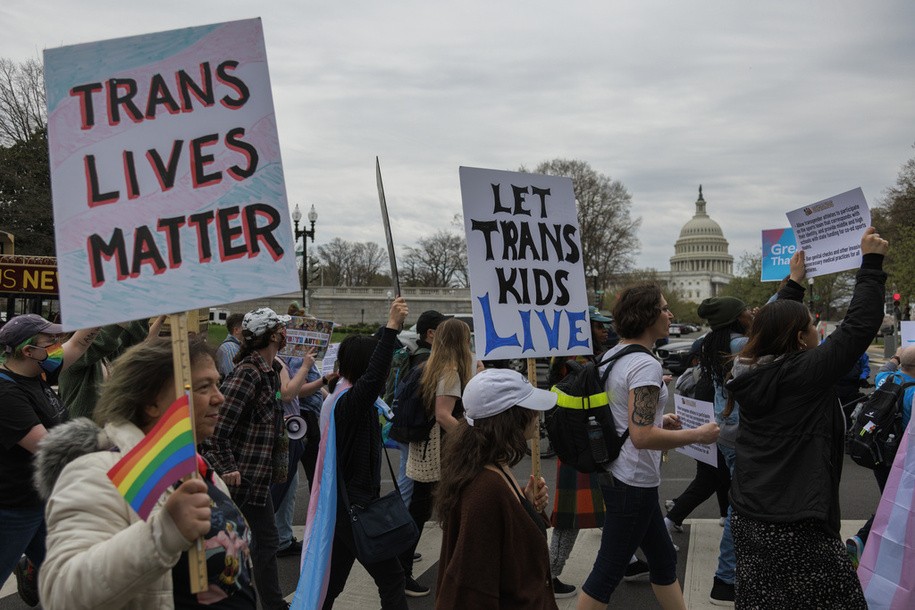
On Thursday, specialized services for LGBTQ+ youth calling the 988 Suicide and Crisis Lifeline are going dark.  The 988 hotline, which was federally established by President Donald Trump during his first term, will still exist, but it will no longer offer a specific dial option for LGBTQ+ youth to feel safe and understood in a time of crisis.  “Our country’s federal government—including the very agency in charge of protecting our mental health—cut a literal lifeline that has provided 1.5 million LGBTQ+ youth with suicide prevention services,” Jaymes Black, CEO of The Trevor Project, said in a statement released Thursday. “I am heartbroken that this administration has decided to say, loudly and clearly, that they believe some young people’s lives are not worth saving.” A protester outside the Kansas Statehouse holds a sign after a rally for transgender rights in March 2023, in Topeka, Kansas. LGBTQ+ youth are at a significantly increased suicide risk, according to a 2023 study by the Centers for Disease Control and Prevention. The study found that 41% of LGBTQ+ youth seriously considered attempting suicide in the previous 12 months, and 20% attempted it. In April, the Trump administration’s budget proposed cutting all funding to 988’s specialized service for LGBTQ+ youth. And last month, the administration followed through on this. The Trevor Project, which worked with the government on the specialized service, operates its own separate hotline. Since taking office in January, Trump and his underlings have worked overtime in their assault on the LGBTQ+ community. Government websites were scrubbed of LGBTQ+ terms. And transgender members of the military were pushed out of their positions on the argument that they were not mentally fit to serve.  And despite Trump being the one who signed the 2020 law acknowledging that LGBTQ+ youth face a disproportionately high suicide rate, the president’s efforts toward erasure and pain have been successful.  For LGBTQ+ youth seeking help, they are still able to call into The Trevor Project’s 24/7 hotline at 1-866-488-7386, via chat at TheTrevorProject.org/Get-Help, or by texting START to 678678.

Politics

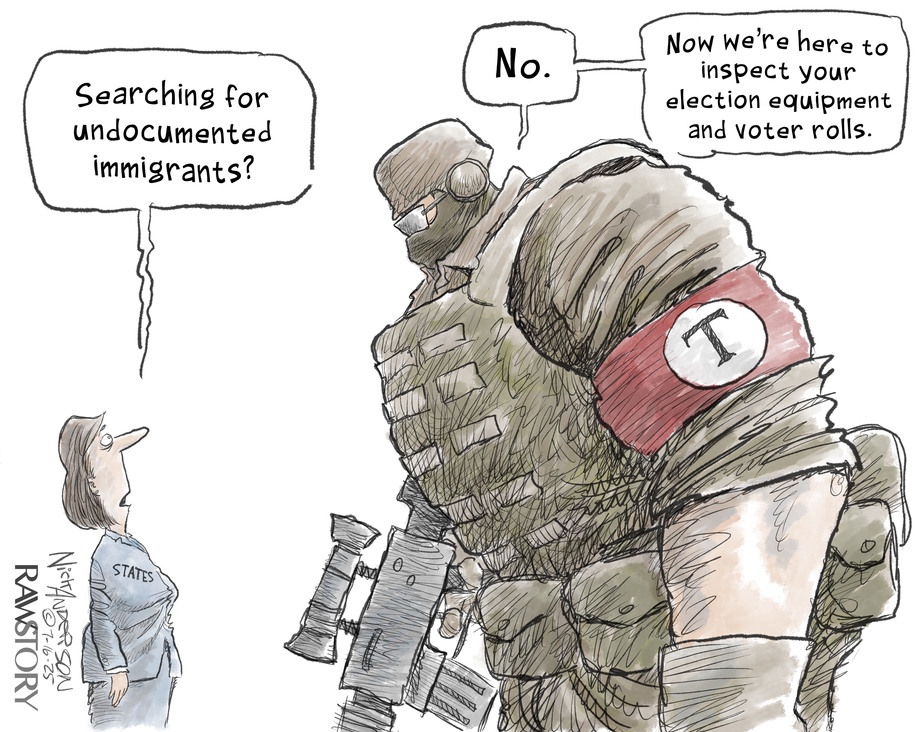
Cartoon: Federal overreach

A cartoon by Nick Anderson. Consider supporting my work so I can continue creating it: Substack: https://nickanderson.substack.com/ Patreon: https://www.patreon.com/c/editorialcartoons Ko-Fi: https://www.patreon.com/c/editorialcartoons Related | Even Republican elections officials aren’t down with Trump’s demands

Politics

Trump’s DOJ wants Breonna Taylor’s killer to get off easy

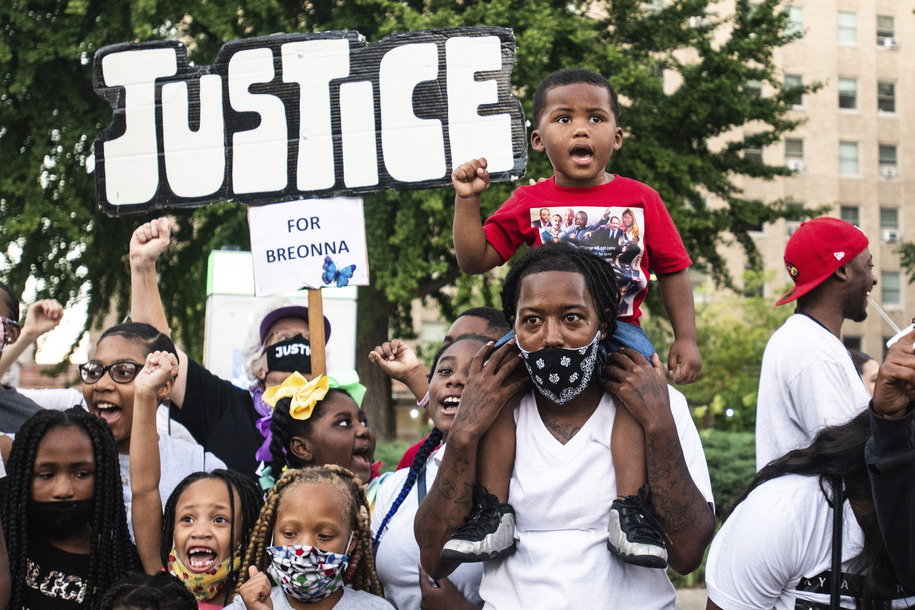
President Donald Trump’s Justice Department wants the cop convicted of violating Breonna Taylor’s civil rights to serve just one day in jail—and suggests he never should’ve been prosecuted in the first place.  The DOJ made the surprising request late Wednesday night, asking a judge to sentence Brett Hankison—the only officer convicted so far on criminal charges related to the deadly 2020 raid on Taylor’s apartment—to a single day behind bars, which would count as time served. The department also recommended three years of supervised release and used the memo to argue that Hankison never should have faced civil rights charges in the first place. Former Louisville Police officer Brett Hankison describes what he saw in the apartment of Breonna Taylor during testimony, on March 2, 2022, in Louisville, Kentucky. The request wasn’t just unusually lenient—it was blatantly political. It wasn’t signed by the career prosecutors who handled the case, but by Trump appointee Harmeet Dhillon, who now heads the DOJ’s Civil Rights Division, and her senior counsel, Robert Keenan. Neither had a role in prosecuting Hankison. Hankison, a former Louisville officer, was found guilty last year after firing 10 shots through a covered window and glass door during a botched “no-knock” raid, endangering Taylor and her neighbors. None of the bullets hit Taylor, but several tore through the apartment’s walls and into the unit next door. Taylor was fatally shot by another officer after her boyfriend, Kenneth Walker, fired a warning shot with a legally owned firearm. Taylor’s killing happened just weeks before the murder of George Floyd in Minneapolis, and became a key moment for the Black Lives Matter movement—one of several cases that sparked nationwide protests against police violence. Before Hankison’s conviction, the only person held criminally responsible in the raid was Kelly Goodlett, a former detective who pleaded guilty to federal charges for helping falsify the search warrant used to enter Taylor’s home and cover up her actions after Taylor’s death. If Hankison gets a lenient sentence, it could reignite anger among activists who say the justice system protects police officers from consequences. His federal conviction was the first time any officer had been held criminally responsible in Taylor’s death. He faces up to life in prison, with sentencing scheduled for Monday. But the DOJ’s new filing insists Hankison “did not shoot Ms. Taylor and is not otherwise responsible for her death.” The memo notes that the Justice Department respects the jury’s verdict, but questions whether the case should’ve gone forward at all, stating: “Counsel is unaware of another prosecution in which a police officer has been charged with depriving the rights of another person under the Fourth Amendment for returning fire and not injuring anyone.”  Legal experts and former DOJ officials were alarmed. According to The Washington Post, Samantha Trepel, a former civil rights prosecutor who helped secure convictions against the officers who violated Floyd’s rights, called the memo “transparent, last-minute political interference” and “a betrayal of the jury’s verdict.” The memo, she said, sends a dangerous message “that the Justice Department will not hold officers accountable who violate the law.” Hankison was previously acquitted on state charges. His first federal trial ended in a mistrial in November 2023, but a second jury convicted him last November. Notably, they found him not guilty on a separate charge involving Taylor’s neighbors. Related  | Justice Department smothers Biden-era police reform deal The DOJ memo is just the latest sign of Trump’s aggressive efforts to dismantle Biden-era reforms meant to hold law enforcement accountable. In May, the department eliminated consent decrees in Minneapolis and Louisville, Kentucky, two cities at the center of the 2020 protests. Consent decrees are legally binding court agreements meant to enforce civil rights reforms in departments found to have engaged in unconstitutional practices. And it fits Trump’s broader pattern: from Daniel Penny to Kyle Rittenhouse, he’s repeatedly embraced men who harmed or killed people of color, then turned them into heroes. So yes, Trump loves criminals. But only the ones who serve his politics.

Scroll to Top