Politics

Politics

Democrats To Storm GOP House Districts With Rallies Marches And Town Halls

PoliticusUSA is reader-supported news that you can rely on. You can support our work by becoming a subscriber. Subscribe now House Democrats aren’t going to sleep. They are going to work. That is the message that is being sent by how Democrats plan to spend their time trying to win back the majority on the ground by hammering House Republicans in their districts for supporting Trump’s wildly unpopular “Big Beautiful Bill. House Democratic Leader Hakeem Jeffries (D-NY) told Punchbowl News what Democrats will be doing as he visited Louisiana, which is the home state of Speaker Mike Johnson and Majority Leader Steve Scalise. Punchbowl News reported: Jeffries said Democrats will hold more speeches, rallies and marches, plus town hall events in GOP districts. Jeffries is planning to visit districts in New York, New Jersey, California and the Midwest. We asked Jeffries if the reconciliation vote changes the size of the House battlefield by bringing redder districts into reach for Democrats. The DCCC has identified 35 GOP-held districts on their target list. Jeffries said the bill would “further complicate” Republicans’ efforts to hold the House but declined to say if it would change the map. “That vote will haunt them and we’re gonna tattoo their support for the One Big Ugly Law on the forehead of every single vulnerable House Republican in America,” Jeffries asserted. Republicans have the majority in the House because they won districts in blue states like Illinois, New Jersey, California, and New York. If Democrats win some districts in red states, they could build a massive majority, but winning the majority itself will involve taking back seats in blue states that slipped away in 2022 and 2024. The strategy of putting House Democratic leaders and well-known faces on the ground in Republican-held districts appears to be a good one that is working. When a Jeffries, Jamie Raskin, AOC, Jasmine Crockett, Maxwell Frost, or any others come to Republican-held districts, they get local media attention and they motivate Democrats along with Independents while having conversations that Republicans don’t want to have about their decision to choose Trump over their constituents. Data shows that face-to-face contact with voters is the most effective way to secure their support. There will be plenty of time to run ads in 2026, but the Democrats are laying the groundwork in 2025 and doing what needs to be done to win back the majority in 2026. What do you think about the Democratic plan to hold marches, rallies, and town halls in GOP districts? Share your thoughts in the comments below. Leave a comment

Politics

Trump Cognitively Declines In Front Of The World During Meet With NATO Leader

The World Witnessed A Declining President Trump’s meeting at the White House was supposed to be about aid to Ukraine. While NATO Secretary General Mark Rutte was able to keep the president focused on Ukraine, everything was okay. Trump announced that the US is providing more weapons to Ukraine through NATO, but it was when Trump was asked if he viewed providing more assistance to Ukraine as a path to peace that the floodgates opened. Video: The president said: I think this is a chance at getting peace or it’s just going to be the same thing. And I have to tell you, Europe has a lot of spirit for this war. A lot of people, you know, when I first got involved, I really didn’t think they did, but they do. And I saw that a month ago when you were there, most of you many of you were there. The level of esprit de corps spirit that they have is amazing. They really think it’s a very, very important thing to do or they wouldn’t be doing. Look, they’re agreeing to just, you know, they’re paying for everything. We’re not paying any more. We have an ocean separating us. I said, we have a problem. We have. We make the best stuff, but we can’t keep doing this. And Biden should have done this years ago. He should have done it from the beginning. But he didn’t. Read more

Politics

House Republicans Plan To Cut Medicare Before The End Of The Year

PoliticusUSA is independent news that you can depend on. Please support our work by becoming a subscriber. Subscribe now House Republicans aren’t done cutting Medicaid, and they have added a new target to their hit list. By the end of the year, House Republicans are also planning to cut Medicare. Bloomberg reported: House Budget Committee Chairman Jodey Arrington in an interview with Bloomberg said Republicans will seek deeper cuts to Medicaid, new spending reductions in Medicare and fix any errors inserted into the US tax code by the “Big, Beautiful Bill.” “I think we will do one before the end of the year,” Arrington said. “It’s going to be a more targeted set of reforms.” The budget chairman said sees the follow-on legislation as a chance to secure Medicare spending cuts he sought but couldn’t win in the Trump tax and spending package. High among his goals, he said, is reducing reimbursements to hospitals through a site-neutral payment system that pays the same rate whether a procedure is done at a clinic or doctor’s office. PoliticusUSA is a reader-supported publication. To receive new posts and support our work, consider becoming a free or paid subscriber. By ‘reforms,’ Arrington means cuts in healthcare. If Medicare reimbursements get cut, that would be a death sentence for many rural hospitals. If you thought that the last reconciliation bill that Republicans passed and Trump signed into law was the worst of it, you were wrong. It is as if taking healthcare away from 17 million Americans wasn’t enough, so Republicans are moving on to attacking the remaining people on Medicaid and coming for Medicare. These cuts could cost Republicans their House majority, but these are ideologues who are on a mission to destroy the social safety net and seemingly won’t stop until all national wealth has been redistributed to the top 1%. What do you think about the House GOP plan to come for Medicaid next? Share your thoughts in the comments below. Leave a comment

Politics

Why Trump Can’t Make the Epstein Story Go Away

Donald Trump’s ham-fisted reversal on his promise to release a secret list of Jeffrey Epstein’s clients has accomplished something long considered impossible by virtually everybody, including Trump himself: He has finally exceeded his followers’ credulity. The Epstein matter is so crucial to Trump’s base, and the excuse offered is so flimsy, that the about-face has raised questions within perhaps the most gullible movement in American history. Over the past decade, Trump’s hold on his fan base has been a mysterious and unchanging fact of American political life, the inspiration for innumerable journalistic diner safaris and the source of agonized self-reflection on the left. Trump understands that his most committed fans will believe almost anything he tells them. Any discomfiting fact is instantly dismissed as a lie coming from the “Radical Left” (Democrats), the “FAKE NEWS” (non-Republican-aligned media), the “Deep State” (any government statistic or official finding), or “RINOs” (whenever a Republican has the temerity to question him). [Kaitlyn Tiffany: Conspiracy theorists are turning on the president] Crucial to this cultlike epistemology is that Trump himself defines what is true, and can alter the nature of that reality at his whim. A journalist or politician may go from Well Respected to Failing Loser and back again as many times as needed. Extravagant promises (to give everybody “terrific” health care, to end the Russia-Ukraine war in a day, to bring down grocery prices) could be issued and then memory-holed. The MAGA-endorsed conspiracy theory that Epstein was blackmailing powerful people with tacit government support was not crazy. (Unproven, yes. Impossible, no.) The crazy part was that this theory had been assimilated into the pro-Trump worldview. Epstein had been Trump’s buddy. Trump had publicly acknowledged more than 20 years ago his awareness of Epstein’s preference for young girls. Epstein came into the custody of the Justice Department and died in prison in 2019, while Trump was president. Trump said “I wish her well” of Epstein’s lieutenant, Ghislaine Maxwell—an odd thing to say of an alleged child sex trafficker. In a rational world, the Epstein saga would have been an obsession of Trump’s enemies, not his supporters. And so Trump naturally must have assumed that his promises to release Epstein’s records would go the same way all his other promises had: straight into the memory hole. Attorney General Pam Bondi claimed in February that she had the fabled Epstein client list on her desk, and that she would release it. After the Department of Justice claimed that there was no client list at all,  Trump instructed his followers that the issue was now dead. “Are you still talking about Jeffrey Epstein?” he scolded a reporter after the DOJ announcement. “This guy’s been talked about for years. You’re asking—we have Texas, we have this, we have all of the things, and are people still talking about this guy, this creep? That is unbelievable.” When his supporters continued raising questions, Trump floated a new line on Truth Social: The files did exist, but they were anti-Trump disinformation created by the Democrats. “Why are we giving publicity to Files written by Obama, Crooked Hillary, Comey, Brennan, and the Losers and Criminals of the Biden Administration, who conned the World with the Russia, Russia, Russia Hoax, 51 ‘Intelligence’ Agents, ‘THE LAPTOP FROM HELL,’ and more?” he wrote. “They created the Epstein Files, just like they created the FAKE Hillary Clinton/Christopher Steele Dossier that they used on me, and now my so-called ‘friends’ are playing right into their hands. Why didn’t these Radical Left Lunatics release the Epstein Files?” Not only did this new line blatantly contradict the repeated promises to release the files that Trump’s allies had made, but it was not even internally consistent. Barack Obama had concocted the Epstein files to smear Trump … but Democrats had refused to make them public, for some reason? And because the “Radical Left Lunatics” had kept them secret, Trump needed to do the same thing? [Read: We still don’t know what to do with the endless stream of Trump’s lies] But whatever. Trump’s lies often lack even the veneer of plausibility. His devotees have generally not made him work very hard to maintain their trust. You could almost picture Trump lazily mouthing the same tropes—“fake news,” “Russia, Russia, Russia”—expecting the same result. Except this time, Trump pushed the buttons, and nothing happened. Trump fans just grew angrier; how could Trump pretend that a pledge to uncover a sinister cabal had never mattered at all? Why, exactly, this reversal dismayed his followers when a thousand precious reversals had bounced right off them is hard to say precisely. One possible reason is that, compared with promises about normal policy issues, the Epstein saga is both easier to understand and generates unusually strong feelings; the sexual abuse of underage girls is more visceral than more abstract harms of, say, taking away peoples’ access to health insurance, and this subject is central to the QAnon movement. The Epstein saga also seems to hold a load-bearing place in the populist mythology, explaining why the “deep state” is out to get Trump. Casually retconning the narrative, so that the Epstein files cease to be the secret document that will expose Trump’s enemies but rather become a libel written by those enemies, is too wrenching a shift for even them to accept. It is probably too much to expect that Trump’s base will defect en masse. But we can be thankful for small victories. After years of complete impunity, Trump has finally discovered that his power to brainwash his idolaters is finite.

Politics

How Putin Humiliated Trump

President Donald Trump is finally taking the fight to Vladimir Putin. Sort of. For now. Trump’s deference to Russia’s authoritarian leader has been one of the most enduring geopolitical subplots of the past decade. But his frustration with Putin has grown. Last week, the president said the United States was taking “a lot of bullshit” from Putin. Today, he authorized a significant shipment of U.S. defensive weapons to Ukraine via NATO and threatened Russia with new tariffs if the war does not end in 50 days. The change, though, is not reflective of Trump adopting a new strategic worldview, two White House officials and two outside advisers to the president told me, speaking on the condition of anonymity to discuss sensitive matters. Trump did not develop a new fondness for Ukraine or its president, Volodymyr Zelensky. He did not abruptly become a believer in the traditional transatlantic alliances prized by his predecessors as a counterweight to Moscow. Rather, Trump got insulted. By ignoring Trump’s pleas to end the war and instead ratcheting up the fighting, Putin has made Trump look like the junior partner in the relationship. The Russian leader has “really overplayed his hand,” one of the officials told me. “The president has given him chance after chance, but enough is enough.” Trump came into office believing that he could deliver a lasting truce between Ukraine and Russia within 24 hours, banking on his relationship with Putin, which he considered good. For months, he largely sided with Moscow in its war against Ukraine, absolving Russia for having started the conflict and threatening to abandon Kyiv as it mounted a desperate defense. He upbraided Zelensky in the Oval Office in February and briefly stopped sharing intelligence with Ukraine. He believed that he could, in addition to working with his Russian counterpart to end the war, reset relations and forge new economic ties between the two countries. He even envisioned a grand summit to announce a peace deal. But Putin rejected repeated American calls to stop his attacks. Russia’s talks with Trump’s emissary, Steve Witkoff, went nowhere. Trump pulled back diplomatic efforts. In recent weeks, Trump has grown angrier with Putin and ended a brief pause by the Pentagon in sending weapons to Ukraine. Zelensky, meanwhile, has worked on repairing his relationship with Trump and agreed to a U.S. cease-fire proposal. In Trump’s own words, Putin began “tapping him along” by spurning that same deal while unleashing some of the biggest bombardments of the war. Trump and Putin have spoken a half dozen times in the past six months, and Trump has grown steadily more frustrated, the four people told me. He told advisers this spring that he was beginning to think Putin didn’t want the war to end, an assessment that U.S. intelligence agencies reached more than a year ago. [Read: Trump hands Putin another victory] When Trump recently intensified his calls for a cease-fire—at one point writing on social media, “Vladimir, STOP!”—Putin chose to defy him by escalating attacks on Ukraine yet again. The president was disturbed by his most recent call with Putin, held earlier this month, in which the Russian leader reiterated his goal to “liberate” Ukrainian territory that he believes belongs to Russia, one of the White House officials told me. The conflict’s front line remains largely frozen, but U.S. and European officials believe that Putin is planning a summer offensive and will launch more attacks on civilians in Ukraine’s cities. With Putin continuing to ignore his pleas for a deal, Trump has felt humiliated, fearing that he appears weak, one of the officials and one of the outside advisers told me. “I speak to him a lot about getting this thing done. And then I hang up and say, ‘That was a nice phone call,’ and the missiles are launched into Kyiv or some other city,” Trump told reporters in the Oval Office today, referring to Putin. “And then after that happens three or four times, you say the talk doesn’t mean anything.” Trump announced today that he would authorize a number of American weapons to be sent to the battlefield, including as many as 17 Patriot missile batteries, which will dramatically bolster Ukraine’s ability to shoot down incoming Russian missiles and drones (and were long sought by Zelensky). Seventeen would be a tall order; so far, the United States has provided two such batteries in three years of war. German Defense Minister Boris Pistorius, after meeting with U.S. Defense Secretary Pete Hegseth at the Pentagon today, told reporters that Germany would engage in talks with the United States to purchase two Patriot missile batteries to pass on to Ukraine. But Ukraine would likely not receive the systems for months, Pistorius said. The measures announced today will likely not alter the overall trajectory of the war, and they fall short of what some hoped Trump would authorize. But they could blunt Russia’s momentum in the conflict and, in turn, its desire to prolong the war. The moves also offered reassurances to Ukraine and Europe that Washington could still be a partner in their fight; NATO allies will finance the purchase of the American-made weapons, Trump said while sitting next to the alliance’s secretary general, Mark Rutte, in the Oval Office. “It’s not my war, and I’m trying to get you out of it. We want to see an end to it,” Trump said to Rutte. “I’m disappointed in President Putin because I thought we would have had a deal two months ago, but it doesn’t seem to get there.” Axios reported that Trump might also send some offensive, long-range weapons to Ukraine, but the president made no mention of that today. Since Inauguration Day, two competing camps have pressured Trump on Ukraine and Russia. Isolationists such as Vice President J. D. Vance and Steve Bannon, Trump’s longtime adviser, have pushed the president to walk away from Kyiv; more traditional Republicans, including the Trump-whispering Senator Lindsey Graham and Senate Majority Leader John Thune, have pushed

Politics

Utah Sen. Mike Lee touts selling off federal lands as a solution to housing crisis

By Abe Streep for ProPublica On Monday, June 23, a crowd of about 2,000 people surrounded the Eldorado Hotel & Spa in Santa Fe, New Mexico, where members of President Donald Trump’s Cabinet had come for a meeting of the Western Governors’ Association. “Not for sale!” the crowd boomed. “Not one acre!” There were ranchers and writers in attendance, as well as employees of Los Alamos National Laboratory, all of whom use public land to hike, hunt and fish. Inside the hotel ballroom where the governors had gathered, Michelle Lujan Grisham, the New Mexico governor, apologized for the noise but not the message. “New Mexicans are really loud,” she said. On the street, one sign read “Defend Public Lands,” with an image of an assault rifle. Others bore creative and bilingual profanities directed at Trump, Secretary of the Interior Doug Burgum, who oversees most of the country’s public acreage, and Sen. Mike Lee, the Republican from Utah, who on June 11 had proposed a large-scale selloff of public lands. Lee, who chairs the Senate Committee on Energy and Natural Resources, was not in Santa Fe, so the crowd focused on Burgum, who earlier that afternoon had addressed the governors about energy dominance and artificial intelligence. “Show your face!” the crowd chanted. But he had already departed the hotel through a back door. That night, a hunting group projected an image of him on the exterior wall of the hotel. “Burgled by Burgum,” it read. Related | Rural populations near federal lands worry job cuts will hurt their communities In the weeks before the meeting, the possibility of selling off large swaths of public lands had seemed as likely as at any time since the Reagan administration. On June 11, Lee had introduced an amendment to the megabill Congress was debating to reconcile the national budget. The amendment mandated the sale of up to 3 million acres of land controlled by the U.S. Forest Service and the Bureau of Land Management, with the vast majority of proceeds going to pay for tax cuts. Although Lee had framed his measure as a solution to the West’s acute lack of affordable housing, it would have allowed developers to select the land they most desired. Under the amendment’s original language, the ultimate power to nominate parcels for sale fell to Burgum and Brooke Rollins, head of the Department of Agriculture, which oversees the U.S. Forest Service. Interior Secretary Doug Burgum In the days after the Santa Fe protest, the outcry from hunting and outdoor recreation groups escalated across the West and the Senate parliamentarian ruled that Lee’s amendment violated the chamber’s rules. Republican lawmakers from Montana opposed the amendment; Burgum also distanced himself from it. (“It doesn’t matter to me at all if it’s part of this bill,” he told a reporter on June 26.) By the time Burgum made his comments, Lee’s effort seemed doomed, and days later he announced that he was removing the amendment; public land advocates celebrated. “This win belongs to the hunters, anglers, and public landowners,” wrote Patrick Berry, the president of Backcountry Hunters and Anglers. But the celebration may have been premature. In a social media post announcing his decision, Lee indicated that he would revisit the issue: “I continue to believe the federal government owns far too much land,” he wrote. And powerful forces still support privatization. At the Santa Fe gathering, Rollins had been asked during a press conference about the effort to sell federal land. She told reporters she wasn’t familiar with the specifics of Lee’s amendment but supported his broader vision and suggested such efforts will continue regardless of the fate of the amendment. “Half of the land in the West is owned by the federal government,” said Rollins. “Is that really the right solution for the American people?” The circumstances that led to Lee’s proposal continue to simmer. The American West has an acute lack of affordable and attainable housing. According to the National Low Income Housing Coalition, Colorado, with a population of 6 million, is lacking 175,000 rental units for people who earn up to 50% of area median income. New Mexico, which has one-third of Colorado’s population, is lacking 52,000 such rentals; Utah, 61,000. But nowhere is the issue as acute as in Nevada, where Las Vegas and Reno are encircled by public land. The state of 3.27 million is estimated to lack 118,000 such rentals. Agriculture Secretary Brooke Rollins The lack of housing emerged as a lever for Lee, who has sought to challenge federal control of public lands since he was first elected to the Senate in 2010. A year after winning his seat, he introduced a bill to sell a limited amount of public land, saying, “There is no critical need for the federal government to hold onto it.” In 2013, he and others in his state’s delegation wrote a letter demanding the transfer of federal lands to Utah and angrily accusing the Bureau of Land Management, which manages 245 million acres nationwide, of “obvious abuse.” And in a 2018 address at a think tank, he compared federal land managers — and people who recreate on public acreage — to feudal lords, ruling from far-off kingdoms on the coasts. He also denounced “elite publications” that advocated for the protection of public lands, and he used the language of political war to describe the conflict over federal land: “It will take years, and the fight will be brutal.” (Lee’s office did not respond to detailed questions from ProPublica.) But this spring, Lee found support from unlikely places: the coastal elites he previously railed against seemed open to some of his ideas. The arguments in favor of privatization and development use a word of the season: abundance. Ezra Klein and Derek Thompson’s bestselling book of the same name argues that burdensome regulatory processes have crushed the American housing market. While the authors focus on increasing supply in urban areas, in April, The New York Times ran an op-ed calling for building housing on public lands. That same

Politics

Republicans bet on Trump in blue state governor races

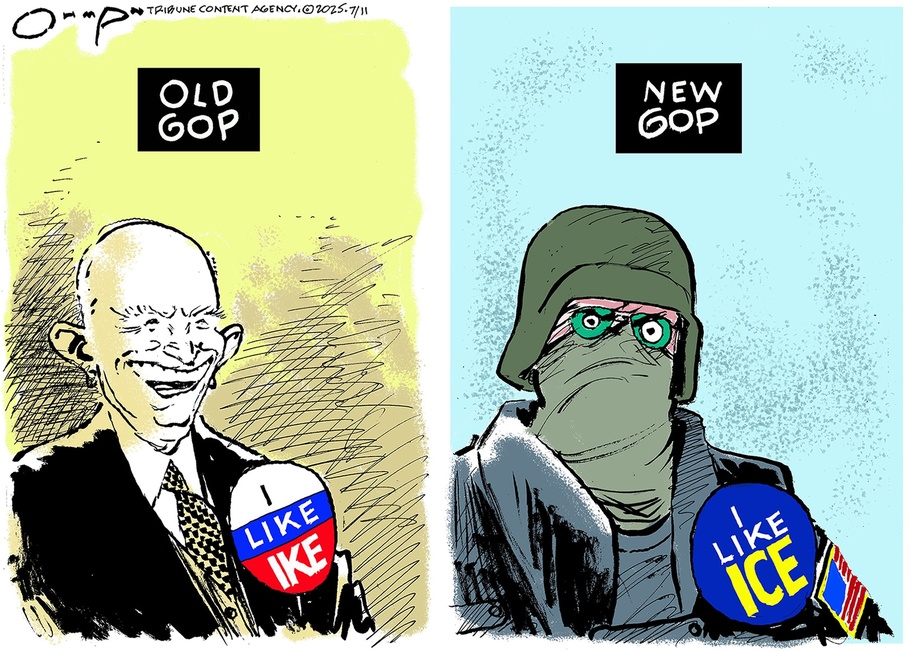
There are two governor’s races this November: New Jersey and Virginia. Both are open-seat contests, with Democratic Gov. Phil Murphy in New Jersey and Republican Gov. Glenn Youngkin in Virginia reaching their term limits. These are both blue states, though they swung significantly to the right in 2024. New Jersey went from +16 Biden in 2020 to just +6 in 2024, and Virginia dropped from +10 to +6. Republicans hope those trends continue, but … good luck with that. President Donald Trump’s national approval rating is falling, and political data analyst G. Elliott Morris estimates that he’s 17 points underwater in both New Jersey and Virginia. Worse for Republicans, their party’s signature achievement—the so-called One Big, Beautiful Bill, which is now law—has polling numbers that are downright toxic. A cartoon by Jack Ohman. YouGov:  Support: 35% Oppose: 53% Quinnipiac:  Support: 29% Oppose: 55% Fox News:  Support: 38% Oppose: 59% Those are national numbers, buoyed by deep-red states. In New Jersey and Virginia, support is likely even weaker. So what are Republican gubernatorial candidates to do, knowing that they need to overperform their states’ partisan lean just to compete? In New Jersey, Republican nominee Jack Ciattarelli is going all in. In a July 4 video, he forcefully defended the law, pushing the lie that its tax benefits trickle down past the billionaire class. He also tried to spin Medicaid cuts as only affecting working-age adults and undocumented immigrants—a line Republicans have unsuccessfully leaned on, given the law’s overwhelming unpopularity. Indeed, Ciattarelli has spent months rallying Republicans behind this deficit-busting, social safety net-gutting legislation. Back in May, as he fended off a primary challenger, he told a radio host that all Republicans must support it. “Shame on any Republican across the country that doesn’t support this. The president supports this. I’d be calling every one of our 14 members of the Congress … to make sure they’re voting yes on this. And if they’re not, I’d be letting the people of New Jersey know that they’re not,” he said. Democratic Rep. Mikie Sherrill, left, and Jack Ciattarelli will be facing off in New Jersey’s gubernatorial race. Ciattarelli’s facing Democratic nominee Rep. Mikie Sherrill, a former Navy pilot and federal prosecutor who has won tough House races in the suburbs and is now running on affordability, health care, and opposition to Trump’s agenda. In Virginia, GOP nominee Lt. Gov. Winsome Earle-Sears struck a similar tone, telling Newsmax that the law “does so many great things,” all while hugging Trump and his agenda tightly.  She’s up against Democratic nominee Abigail Spanberger, a former CIA officer and centrist congresswoman who flipped a red district in 2018—the one represented by former GOP House Leader Eric Cantor. As a disciplined, no-nonsense candidate, the contrast couldn’t be starker.  November’s results will be closely monitored by nervous Republicans. Two high-profile figures—Rep. Don Bacon of Nebraska and Sen. Thom Tillis of North Carolina—have already announced their retirements. Now, all eyes are on Sen. Joni Ernst of Iowa and whether she’ll run for reelection. The size of Democratic victories in New Jersey and Virginia will shape how many Republicans flee. The bigger the wins, the more GOP incumbents will head for the exits. And there’s no bigger advantage in politics than incumbency.  The more open seats Republicans are forced to defend next year, the higher the odds of a blue wave.

Politics

Flattery, Firmness, and Flourishes

Italian Prime Minister Giorgia Meloni’s April visit to the White House was, by all accounts, a success. She soothed President Donald Trump with dulcet talk of “Western nationalism,” eased through a potentially awkward moment regarding Ukraine, and invited Trump to visit Rome—extracting a promise that he would come in the “near future.” Yet despite the apparently seamless choreography, she and her team offered some after-action advice to fellow world leaders hoping for similarly controversy-free exchanges with Trump: Prepare for the unexpected. Specifically, she had been caught off guard when, before a supposedly private lunch in the Cabinet Room, journalists had been escorted in for seven minutes of questions; she found herself awkwardly positioned with her back to the cameras—much of the footage of Meloni captures the silky blond strands atop her head—and she was forced to either ignore the media in order to address Trump directly or twist herself to the left, away from the president, to try to speak with the reporters. Exactly a week later, when Jonas Gahr Støre, the prime minister of Norway, arrived at the White House, he was prepared. His team had watched videos of prior visits with world leaders, and strategized over various scenarios. Having seen Trump seem to bristle when Meloni was asked a question in her native Italian, they encouraged their own press corps to pose their queries exclusively in English. (The Norwegian journalists also seemed to have done their homework; young female reporters positioned themselves near the front, smiling to catch Trump’s attention, and got in an early flurry of questions.) “You have to—to use Trump’s words—play the cards you have,” one European diplomat told us anonymously, like nearly every other diplomat or foreign official we spoke with, to avoid angering Trump or revealing their nation’s strategies for managing the mercurial U.S. president. [Anne Applebaum: The U.S. is switching sides] In Trump’s second term, foreign leaders now meticulously prepare for their phone calls and meetings with him, often war-gaming possible surprises and entanglements, and trading information and best practices with allies. Eight diplomats and officials from six countries, as well as other foreign-policy experts, all described to us an unofficial formula for ensuring fruitful interactions with Trump: an alchemic mix of flattery, firmness, and personal flourishes. Foreign leaders, especially those from fellow democracies, face an inherent tension in wanting to woo Trump while also advocating for their country’s own interests and maintaining their standing back home. “There is a sense that you want to be on the right side of history. You do want to be able to look at yourself in the mirror and reread your statements in the Oval Office a couple of years later and say, ‘I feel good about what I said,’” a second European diplomat told us. This, of course, can prove complicated. Ukrainian President Volodymyr Zelensky learned this lesson rather publicly in a now-infamous Oval Office blowup on the last day of February, which got him booted from the White House so quickly that Trump’s aides ate the lunch intended for him and his fellow Ukrainians. (“No deal and no meal,” Axios blared at the time.) And in May, South African President Cyril Ramaphosa was meeting with Trump in the Oval when the U.S. president unexpectedly dimmed the lights and began playing a video that he said buttressed his unsupported claim that South Africa’s white population is facing a “genocide.” “The leaders of friendly countries are turning keys in the lock desperately trying to find a way to prevent their meetings with President Trump from being disasters,” Kori Schake, the director of defense and foreign-policy studies at the American Enterprise Institute and a contributing writer at The Atlantic, told us. “The challenge for foreign leaders is that President Trump seems to only have two categories—supplicants and enemies.” But that hasn’t stopped visiting officials and diplomats from trying. “They ask knowledgeable Americans, ‘Might this work? This is what we’re thinking of trying. Do you think this is good enough?’” Schake told us. Even some of the preparations—walking through the day’s expected events in advance of the actual visit—underscore the inherent unpredictability of this administration. “Our entire walk-through with the White House was like, ‘This is what it’s going to be like, but we follow the lead of the president,’” the second European diplomat told us, laughing. Trump has long been eager to receive a Nobel Peace Prize—for any conflict, in any region. So it was not entirely surprising when the government of Pakistan nominated Trump for the prize last month for helping resolve tensions between Pakistan and India. Pakistan, after all, was simply following the dependable diplomatic crutch of flattery with Trump, hoping to improve its standing with the U.S. president by offering him the possibility of something he desperately covets. (His subsequent bombing of Iran’s nuclear sites created understandable consternation among Pakistanis, but during an Oval Office meeting last week, Israeli Prime Minister Benjamin Netanyahu took up the cause, announcing that he had, too, nominated Trump for the Nobel Prize—this time for his work in the Middle East.) The same week that Pakistan put Trump up for the peace prize, NATO Secretary General Mark Rutte engaged in some behind-the-scenes blandishments with Trump ahead of a NATO summit in the Netherlands—which became public when Trump posted on Truth Social the entirety of a text message Rutte had sent him. The missive praised Trump for his “decisive action in Iran,” which Rutte called “truly extraordinary,” before moving on to laud Trump for pressuring his NATO allies to spend more on defending their countries. “You are flying into another big success in The Hague this evening,” Rutte wrote. “Europe is going to pay in a BIG way, as they should, and it will be your win.” During the actual summit, Rutte went on to call Trump “Daddy” as Trump likened Israel and Iran to fighting schoolchildren. “Daddy has to sometimes use strong language,” the NATO chief said. Trump and his team were, predictably, delighted. They began selling

Scroll to Top