
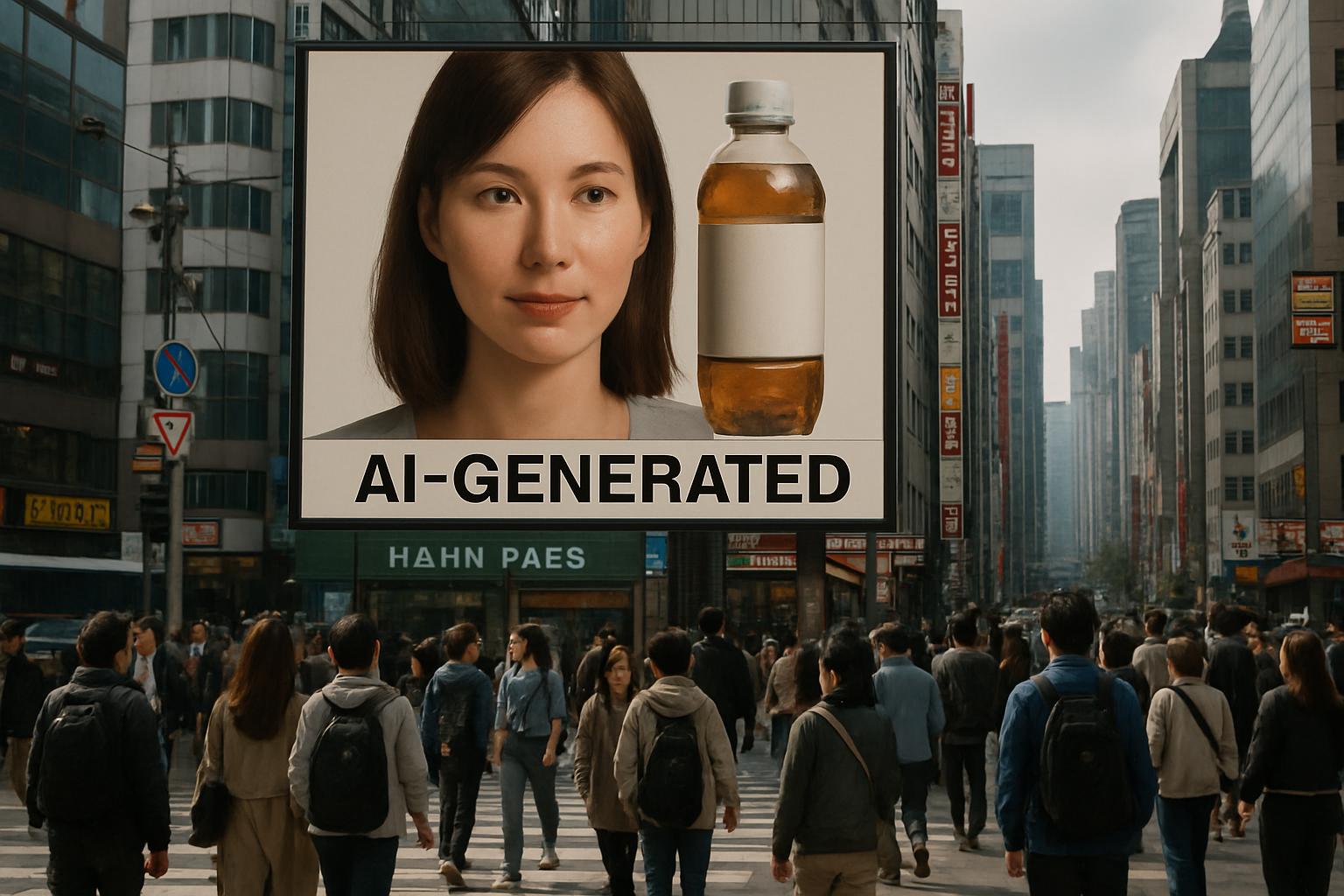
South Korea may be doing something the rest of the world should have done the moment artificial intelligence escaped the laboratory and flooded the internet, pushing mandatory watermarking for AI-generated content, as society is rapidly reaching the point where nobody knows what is real anymore.
People still think this is about funny fake images or celebrities with six fingers floating around social media, but they completely fail to grasp where this leads once artificial intelligence can perfectly mimic human voices, video, photographs, news reports, interviews, and eventually entire events that never happened. South Korea’s proposed legislation would require generated content to carry visible or invisible watermarks identifying it as artificial because even governments are beginning to realize this technology is moving faster than society can handle.
You already cannot trust half the videos or web accounts circulating online. Deceptive marketing practices are abundant, but there are more sinister issues. Audio recordings can be cloned, fake war footage spreads instantly, and entire news stories generate within seconds complete with fake witnesses, fake experts, fake photographs, and emotional manipulation engineered specifically to provoke outrage and panic.

This is no longer simple misinformation. It has become industrialized deception operating at a scale never before possible in human history. The speed of this transformation is what should terrify people most because just a few years ago AI-generated images looked absurd and obvious, yet now ordinary people struggle to distinguish fake from real.
That destroys the concept of evidence itself since video, photography, and audio recordings were historically treated as proof. Once those mediums can be fabricated flawlessly, society begins losing the ability to establish objective reality. Every scandal becomes questionable, every recording becomes debatable, and every piece of evidence can simply be dismissed as AI-generated manipulation.
South Korea is at least acknowledging the danger openly by requiring AI systems to identify generated material through embedded watermarks and disclosures. Some content would carry visible warnings while other systems would insert invisible digital signatures into files themselves, with substantial financial penalties for violations.
The deeper problem is psychological because civilization depends on shared reality. Once people no longer know what to believe, institutions begin collapsing alongside trust itself. Media credibility evaporates, governments lose legitimacy, personal relationships deteriorate, and paranoia spreads because nobody can confidently determine whether the information they are seeing is genuine.
This becomes extraordinarily dangerous during periods of geopolitical instability and civil unrest since synthetic media can trigger financial panic, riots, diplomatic crises, or military escalation before verification ever occurs. Markets move emotionally and populations react emotionally, meaning artificial intelligence now possesses the ability to manipulate society faster than governments or journalists can respond.
Eventually the internet may become so saturated with synthetic content that genuine human material becomes nearly impossible to separate from machine-generated output, and once trust collapses entirely, societies begin fragmenting because truth itself no longer functions as a stable foundation.
That is why watermarking matters. It may not solve the problem completely because malicious actors will always attempt to bypass safeguards, but at minimum it acknowledges the reality that the public deserves to know whether something was created by a human being or by a machine designed to imitate one.